


















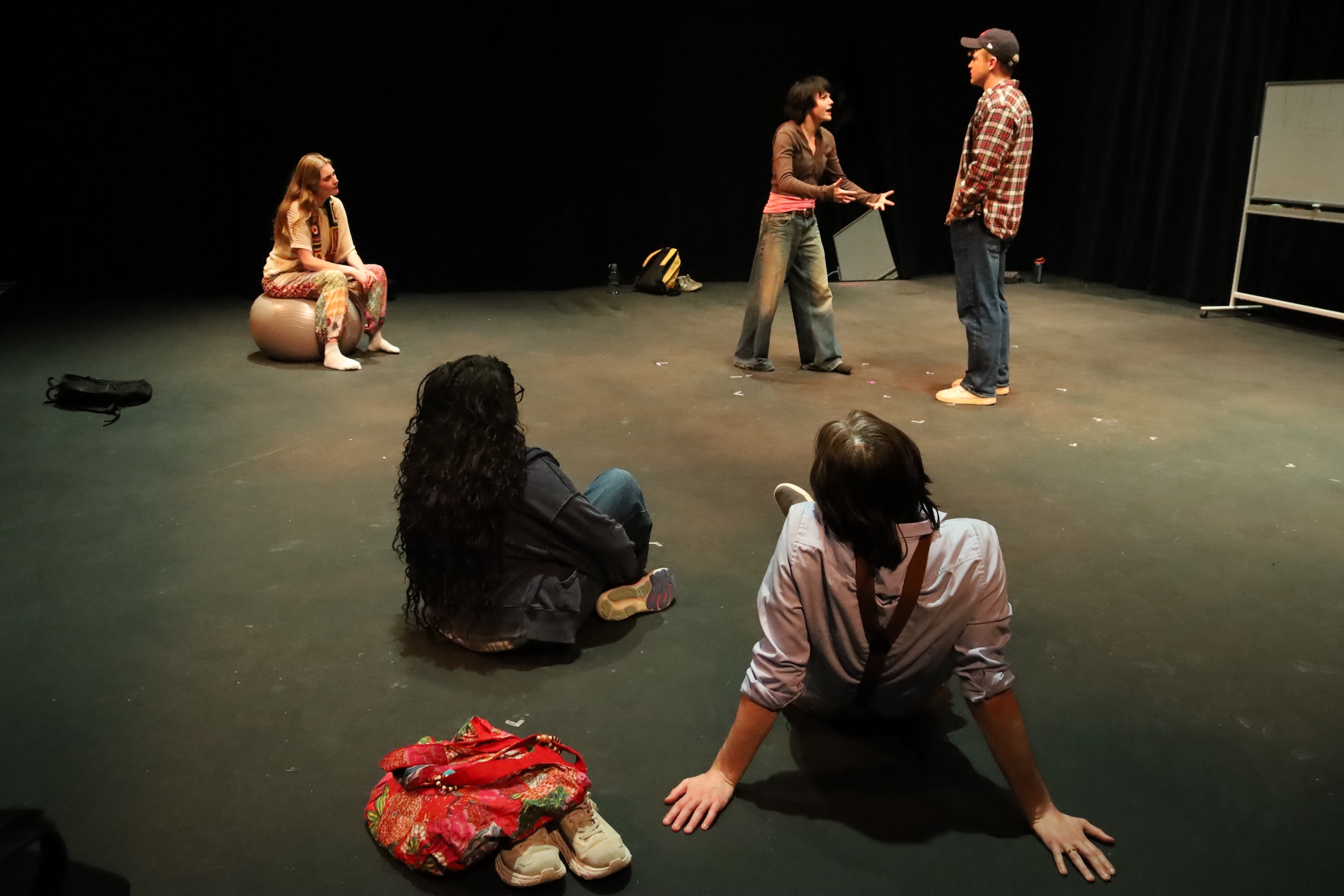
When walking into The Studio Theatre for this past weekend’s performance of “Circle Mirror Transformation,” audience members only saw a When walking into the Studio Theatre for this past weekend’s performance of “Circle Mirror Transformation,” audience members only saw a white board, a yoga ball, a hula hoop and a mirror. All these objects were on the edges of the stage, leaving the middle completely empty. This emptiness was necessary, because once the actors came onstage, they filled the room with their honesty, sincerity and ultimately, their humanity.
“Circle Mirror Transformation,” written by Annie Baker and directed by Seannie Cahill-Swenson ‘27, is the story of an adult acting class in a small Vermont town. Five characters are involved in the class: the instructor Marty, her husband James, recent divorcee Schultz, actress Teresa who recently moved from New York City and quiet but judgmental high school student Lauren. They participate in theatrical exercises that range from evocative to absurd; in one, characters take turns pretending to be one of their classmates and recite that other person’s life story, leading to some of the funniest and most touching moments in the play. As Riley Younger ‘29, the Inclusivity & Equity Chair for the Muhlenberg Theatre Association (MTA) put it, “Sometimes it’s very difficult to tell your own story and being able to have people around you who see it and share it and remember it is super impactful and something that I am glad I got to see represented in this way.”
Another one of the exercises involved the characters laying on the ground and counting to ten out loud, one number at a time, without anyone saying the same number at the same time. As anyone who has taken a theatre class can attest, it’s harder than it sounds, and the character Lauren finds it particularly frustrating. We see several failed attempts throughout the play before the final success. Audience member Lilly Fleischer ‘29 expressed, “Something that really resonated with me was when they were laying on the floor doing the numbers. I never thought I would feel that emotional about them getting to ten. When they got to ten and it was Lauren who was the one who said ten, I was very emotional about it.”
The dialogue of the play is a feature that stands out in particular. Unlike many playwrights, Baker chose to write her dialogue in an extremely colloquial way– ums, likes, hesitations and false starts all included. There are also quite a few silences, awkward or otherwise, explicitly written in the text of the play. As a reading experience, it can feel grating, but seeing the show and hearing the words spoken aloud is very powerful and contributes to the overall feeling of sincerity. Cahill-Swenson directed this show in part because of this unique writing. “I chose this script because I have been reading Annie Baker since high school and think she is one of the greatest playwrights to ever exist. The way she captures the smallest moments of the human experience and turns it into grand stories about love, loss and moving forward is incredible.”
Thankfully, audience members were treated to a company of incredibly capable and discerning performers. Each one committed fully to their characters and to the situation, further adding to the earnestness of the entire production.
However, this dialogue is only as effective as the actors who deliver it. Thankfully, audience members were treated to a company of incredibly capable and discerning performers. Each one committed fully to their characters and to the situation, further adding to the earnestness of the entire production. As Lana DaRocha ‘30 said, “It was really relatable … just how naturally the characters came through the actors. I couldn’t see a difference between my friend Griffin [Blackburn ‘28] and the actual character!” Cahill-Swenson added that “My favorite part of this process has been working with the cast. They are all talented, passionate and fun to work with and have made rehearsals something I look forward to throughout the entire process. The way they bring Baker’s words to life is beautiful to watch and I think their passion and effort is evident throughout every scene.”
The directing process taught Cahill-Swenson a lot. “Near the beginning, I was always overthinking and second-guessing myself, worrying that what I was doing wasn’t good enough for the actors,” he said. “But through chatting with them and seeing their characters grow and evolve day after day, I began to trust myself more and realize my vision for the show and how I was communicating it was steering the show in the right direction.” Similarly, Emma Alexis ‘30, who played Lauren, learned, “That I should trust myself more. I am more capable than I think I am and I shouldn’t be afraid to just go for it.”
“Circle Mirror Transformation” was a transformative piece of student-produced theatre, and as Alexis said, it reminds us “That everybody is more than they appear on the outside and we should take the time to get to know people before we judge them.”

