


















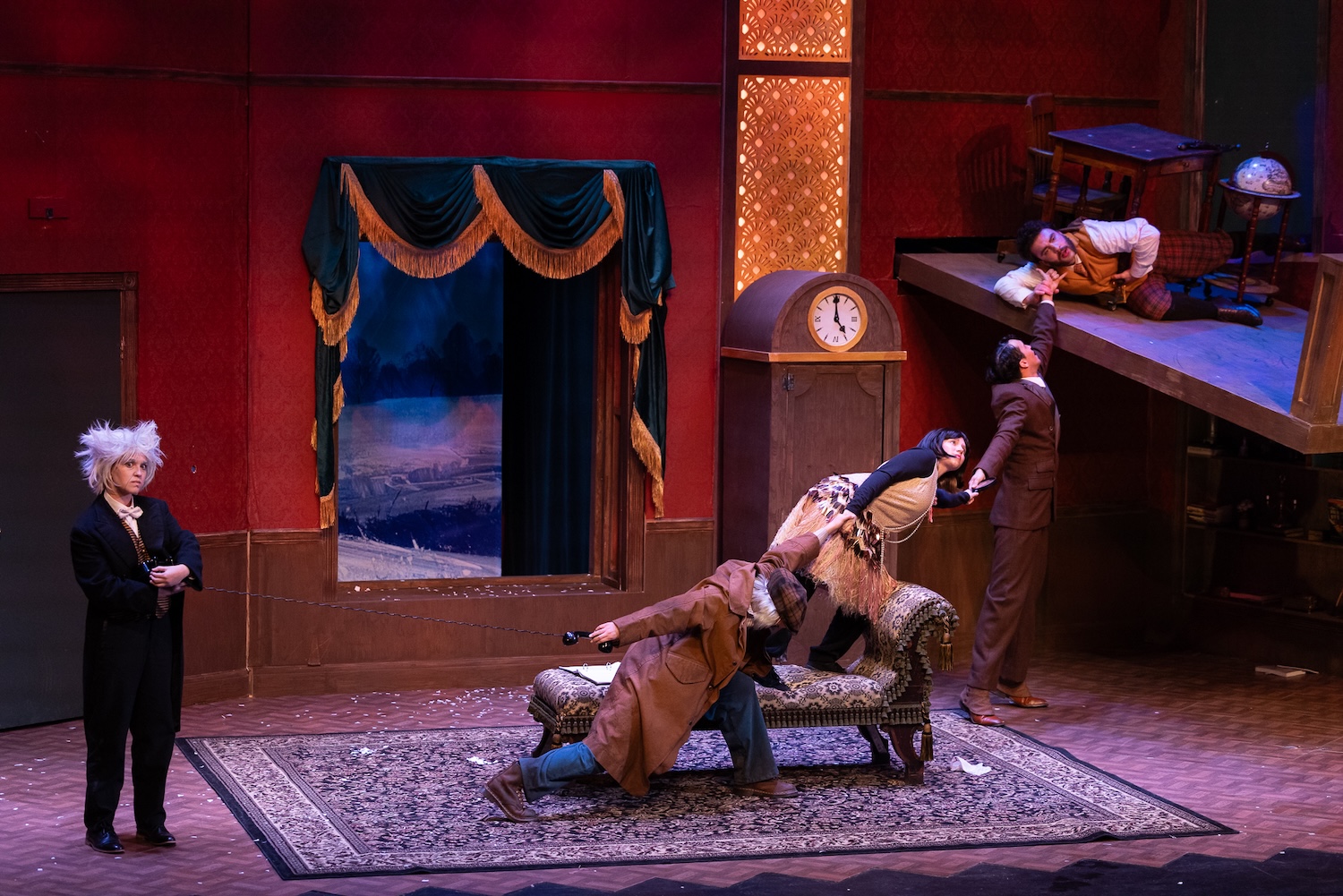
With a title like “The Play That Goes Wrong,” audiences were likely expecting either a comedy or a disaster. Nothing could have prepared such audiences for the heights of comedic chaos reached by this production.
Originally written by Henry Lewis, Jonathan Sayer, and Henry Shields, “The Play That Goes Wrong,” is a British farce in which just about everything that can, does go wrong. The audience is taken into the world of the Cornley Polytechnic Drama Society as they’re putting on a production of “The Murder at Haversham Manor”– the play within the play. Charles Haversham is found murdered on the night of his engagement party, and no one knows who did it or why. Charles’ brother, butler, fiance and the fiance’s brother are joined by the inspector in an attempt to solve the murder before anyone else gets killed. The drama society is not, however, the most capable or organized. As the play goes on, issues with the actors, props and set slowly reveal themselves until the final climax in which three of the flats which make up the set’s walls fall down in succession.
Throughout the show, the audience witnessed (and often laughed at) the worst nightmares of any actor. This included getting stuck in dialogue loops, props not being where they should, stage hands having to cover for missing actors and the second floor platform losing its support while actors were standing on it!
Putting on a production with this many technical elements was definitely a challenge for everyone involved. Alex Piteris ‘27, who saw the show, was particularly impressed with the set: “My favorite mishap was the platform gradually collapsing. The set designers did a fantastic job and the actors utilized the space in such an engaging way.”
“My favorite mishap was the platform gradually collapsing. The set designers did a fantastic job and the actors utilized the space in such an engaging way.” – Alex Piteris ‘27
The set was nearly unfinished by the time the play opened, however. “The most challenging part of the process would have to be having an incomplete set until opening night,” said Tyler Motlasz ‘26, who played Jonathan. “The set is essentially its own character with how prominent and important it is throughout the entire show. With how specific everything had to be backstage, not knowing what we would and would not be able to include was not only challenging, but concerning. Our walls didn’t even fall until opening night. But because of how amazing the cast and crew were, especially the backstage crew, all of these challenges were tackled head on and easily worked around in case things didn’t go as planned.”
Mattea Pappa ‘26, who played Sandra, echoed the importance of the set. “So much of the show’s humor relies on how the Cornley Polytechnic Drama Society reacts to their world falling apart. The adjustment period of being on stage felt like adding in a whole new character. That said, it was really rewarding when everything came together.”
Because of the sheer chaos of the show within the show, and the fact that many of the actors were essentially playing two roles at once, “The Play That Goes Wrong” required a slightly different rehearsal process that was more incorporative of the entire cast and crew. Shay Seymour ‘27, who played Trevor, the lighting and sound operator, said, “Rehearsals were different than a lot of other processes… we all showed up every night even if we weren’t going to be used, which gave a great sense of community and gave us all a hands-on experience with the whole show, not just our bits. It also made us all a lot closer than we would’ve been!”
Pappa enjoyed the way that Jim VanValen, the director, guided the process, stating, “During rehearsal itself [VanValen’s] blocking was always clear and thorough, but he also provided a lot of room for us to ‘shop’ for other choices to make the characters our own. We also finished up blocking pretty early on in the process so there was a good bit of time to play with and adapt our performances.”
Motlasz loved the way VanValen kept things fresh and interesting. “No rehearsal was ever the same in this process,” they said. “They could span anywhere between blocking, games, bonding, second circle exercises or, my personal favorite, fake rehearsals in which we embodied our characters pretending like it was a rehearsal for ‘Haversham Manor.’ We were incredibly on top of things and everything we did aided in the final product.” It seems that much of the cast agrees that these exercises in acting technique enhanced their understanding of the world of this play, and how to tell the audiences this story.
In a department that produces a lot of serious, thought-provoking theatre, ‘The Play That Goes Wrong’ was a nice change of pace. It was also a reminder that no matter how bad you think your show went, it could always be worse!
Each cast member appreciated both their own moments in the spotlight but also the chances that their fellow castmates got to shine. Pappa remarked, “I loved the part when Ava [Mattson ‘26] as [the actor] Max [who plays the role of] Cecil explains how Thomas Colleymore killed Charles Haversham and has motions corresponding to every word. She put in such great work on that passage and her character as a whole. It never failed to crack me up.”
In a department that produces a lot of serious, thought-provoking theatre, “The Play That Goes Wrong” was a nice change of pace. It was also a reminder that no matter how bad you think your show went, it could always be worse!

