


















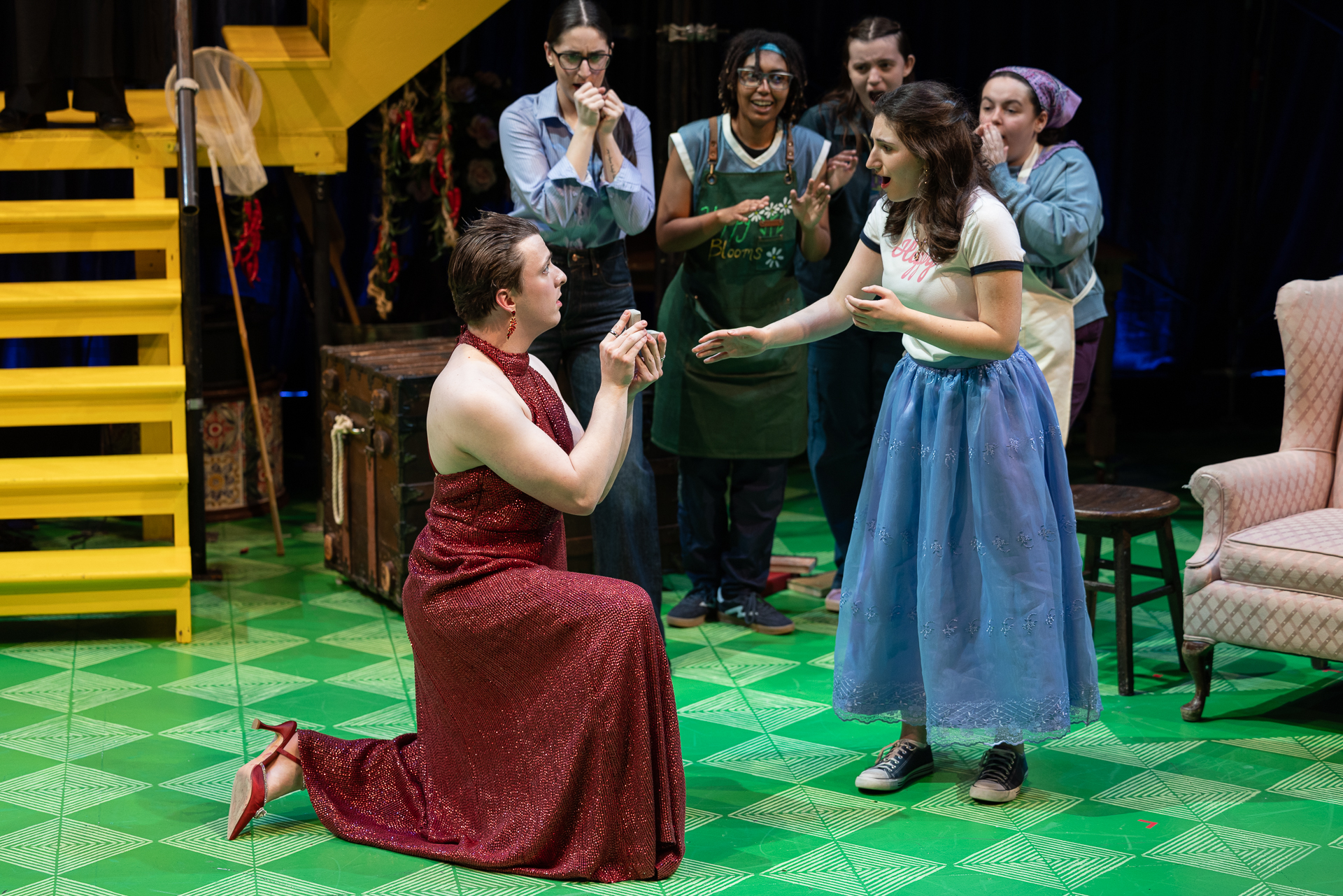
This past weekend, a new devised play premiered in the Studio Theatre. “The Desire Project,” written by Nerissa Deschambeau ‘28 and Professor of Theatre Beth Schachter and devised by the company, is based on the 1668 play “The Convent of Pleasure” by Margaret Cavendish. According to the dramaturgical writeup in the playbill written by Elizabeth Downing ‘27, Cavendish was a prolific writer who was unique for her time because she “published under her own name” and “her talents and ideas were both recognized and preserved.” Deschambeau wrote in the playbill that “‘[The Desire Project] challenges the binaries that women and Queer people are forced into, whether it be marriage or childbirth, or the status quo of being straight, despite the original play’s heteronormative ending.” The company was not satisfied with that ending, so they took inspiration from Queer identity and culture. “Cavendish probably didn’t know it at the time,” Deschambeau wrote, “but she had created the perfect blueprint for a Queer utopian comedy. The company just had to turn the implicit subtext into explicit context…”
Schachter has been thinking about adapting “The Convent of Pleasure” for a while. “[It] started with me watching the Red Bull Theatre free Zoom reading of the show.” Schachter took a sabbatical last spring in order to work on developing the project. Originally partnering with an outside playwright, the project held auditions this past fall semester and began rehearsals in the spring. But between auditions and the beginning of the rehearsal process, the original playwright left. The creative team and the cast had to pivot to creating a devised piece, which for many was very intimidating. While it was difficult, everyone rose to the challenge.
Scenic designer You-Shin Chen said, “After we shifted gears, I was hoping to build an environment that we could continue building on… I was trying to provide opportunities for the devising to happen onstage. The design is mostly [about] crafting opportunities.” For Deschambeau, the most challenging part was “how last minute everything was. There were a lot of random changes and additions, cuts and all that. I never knew what to expect the next day until we ‘froze’ the script.”
Deschambeau never intended to be a writer on the project. “It was honestly on accident,” she said. According to Schachter, “We started to rehearse as the spring semester started, and I would write a scene draft based on the original play, and actors would improve it through improvisation. Then, one day Nerissa said something like, ‘They should play Truth or Dare’ and I said, ‘Great – will you write it?’ And she said something like, ‘Yes! Because I am a playwright.’ And she is a remarkably talented writer who took on more of the writing as we continued… Wonderful, funny and blazingly fast.”
While there were some bumps in the road, the team found a lot of joy in the process. Samantha Hoffman ‘25, who played Genevieve, said, “My favorite part of the process was meeting the people in this cast and getting to play with them in rehearsal and then onstage. They are all so talented and creative and hilarious, and I really enjoyed working alongside them.”
“I am used to and am most comfortable with acting in the realm of realism, so the challenge of being big and over-the-top silly was something I embraced in this process. I learned that I am capable of working within that genre and that I had a lot of fun doing it. There is a sense of freedom I found in it and it brought out a lot of creativity I hadn’t necessarily realized I had inside of me,” she continued. Deschambeau shared a similar sentiment. “All the improv [the cast] did and their wants for their characters I tried to take into account. We wouldn’t have a script if it wasn’t for the brilliant character work of the cast.”
Schachter’s favorite part was the “collaboration with an incredible group of designers who helped create the narrative arc and who spent several discussions brainstorming how we could find our way to the new ending! Everyone, designers and company had terrific comic ideas. And, it was only possible because all the creators, including the stage manager team, found funny (as well as heartfelt) ways to build the imagined world with quirky compelling figures.”
“I[‘m going to] sound very much like a nerd,” Chen quipped. “My favorite part is how I challenged myself to do a comedy and to use bold colors, and bold colors that I liked. I love the floor – the show looks so much better with that floor. I think my favorite part was the color. I had never used that combination before. They looked better than I thought it would be.” Chen also enjoyed testing the mattress sliding down the stairs herself (yes, people slid down the stairs on mattresses in this show!).
This show has taught everyone involved a lot of lessons. For Deschambeau, it was about using what you have to make the show great. “Sometimes things that are planned don’t turn out the way you want them, and you have to make the best with what you have. Oh, and if the cast is having fun, then the audience probably will as well.” On a similar note, Chen persevered through uncertainty. “So the scenario is that we are in a time crunch. After the designer run, I was like, ‘how scenically can I make this funny?’… No matter how tight the time and the panic might consume you, you still have to think about how I can contribute and make the moments work and make suggestions. Speak truth no matter how much pressure there is.”

