




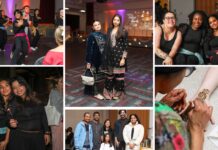
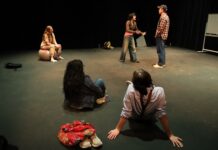
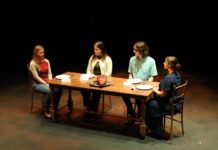



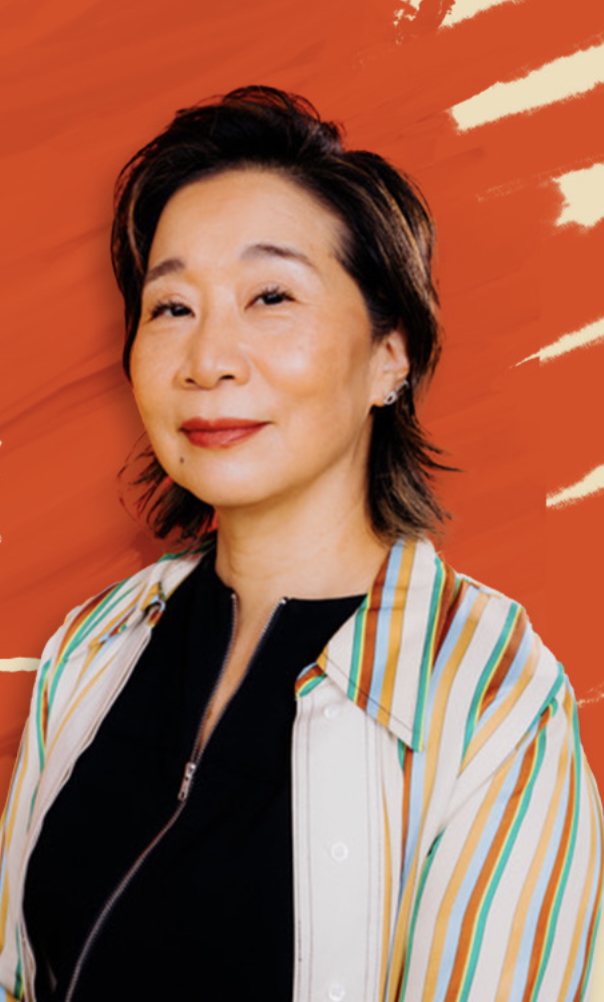
Empie Theatre came alive on Nov. 11 when Emmy-nominated TV producer and playwright Diana Son visited. She had first arrived on campus on Nov. 10 to host a writing workshop, Opening Pandora’s Box: Generating Story Engine for TV, for selected students, which took place over the course of two days. Her visit wrapped up with a free public talk in Empie, in which Assistant Professor of English literatures Gabriel Dean interviewed her and did a reading from an untitled play that Son is currently working on.
Son was born in Philadelphia but raised in Dover County, Delaware, which was largely bereft of Asian Americans. Her parents had immigrated to the United States from Korea separately and met in the U.S., eventually opening a drug store which Son grew up working at. She stated that her teachers drove first her passion for writing and later her passion for the theatre, particularly in her senior year of high school in 1983 when her school saw a production of “Hamlet.” She later attended New York University and went on to write and produce short plays. She debuted her first full-length play “Stop Kiss” in 1998 Off-Broadway, which notably featured Sandra Oh. Acclaimed screenwriter, playwright and filmmaker Aaron Sorkin picked her up for “The West Wing” in 2000 and she has been a television writer since, primarily working on crime shows like “Blue Bloods” and “American Crime.” She has also worked as a professor, and is the playwriting program chair of the Dramatists Guild of America’s Fellows Program.
At Son’s Opening Pandora’s Box: Generating Story Engine for TV student workshop, Son placed emphasis on the differentiation between story engine and plot–interrogating the heart of the story, what drives it to continue on and character dynamics. Son guided students in how to create an efficient and intriguing logline, which is a brief summary of the film or show often used to pitch the concept to producers. Han Nguyen ‘29, who had participated in the workshop, stated that Son preached that it is imperative to “make sure your main protagonist is the person who’s proactive … and not being led somewhere.”
Nov. 11’s public talk began with Dean’s introduction of Son, including their first time meeting. Dean had previously been mentored by Son in a fellowship and shared a story about a time that she had invited him to the set of “American Crime,” to be repaid in barbeque. She stated that her current play, which contains themes of family, Korean heritage, Americanization, struggle with queer identity and familial expectations, specifically of heteronormativity, is semi-autobiographical.
The event ended with a Q&A section, which lasted almost an hour. Students were able to inquire about Son’s process, and she shared that she views writing as “a way of working out life” and revealed that she often paces or separates herself from the work in order to continue it. She included that often while writing she will look anywhere but the page while she types. She spoke about accepting the process for what it is, advising that writers ought to and must “work with who [they] are.” She credited her love for mentorship to her parents, who were guides for immigrants that followed them to America. Son also imparted some industry wisdom for curious students: It can be quite heartbreaking to write a script and see it go nowhere, which is a regular occurrence. She lent some advice regarding industry standards and how she goes about some of the complexities of writing.
Kirsten Ward ‘27, who is currently enrolled in Intro to Writing for Stage and Screen, stated: “It was really great to have someone who’s so within the current industry here and talking and as a touchpoint and a reference, and as both playwriting and screenwriting.” Ward also shared that it was helpful to see how entwined the two forms could be, especially given that this is the first semester they have been in one combined class. She “admired [Son’s] commitment to storytelling and her certainty in that being an important thing that the world needs right now.” Ward emphasized her connection to what Son was communicating given her own love for the arts.
River Levy ‘28, who is taking the same class, found it inspiring “that [Son] almost had full confidence that AI could not replicate the human experience and lived experience, it was such a fresh perspective to be able to be so confident in your work, and it felt really inspiring to see.” Levy connected with Son’s statement that “Why do you need so much to just tell a story?” in reference to waiting for production on the set of a television or movie.
Dean shared that it is “rare to be able to get a screenwriter at all, they’re so busy, and somebody of her caliber, to be able to spend that much time with her, I would dare say life-changing for some of the students in that workshop.”
Following the Living Writers program last year, it is an accomplishment to have Son visit outside of the course’s limited run, and the people have spoken: it was more than a success.

Maren Robins ’29 is an English & Creative Writing and Theatre double major. She is a member of the Alpha Chi Omega sorority and loves to read, write, and watch movies.