


















“Because the phone is so integral to the plot and the characters, I think it is important to show that what happens to Jean is a real thing that is happening to everyone, and that it’s the phones in our pockets that are causing this divide,” remarked Tim Gaffney ‘28, the director of “Dead’s Man’s Cell Phone.”
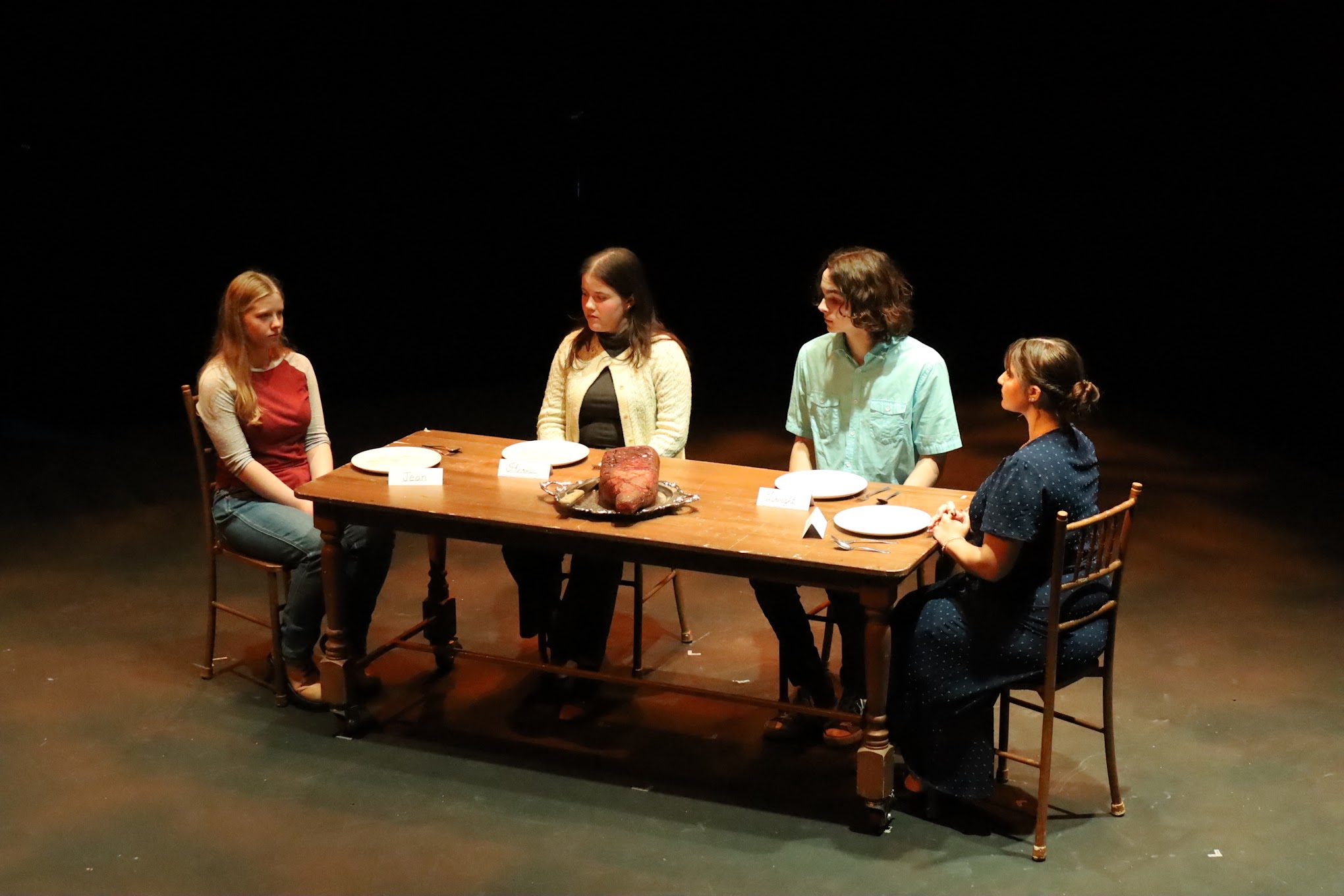
Over the last weekend, the Muhlenberg Theatre Association (MTA) showcased “Dead Man’s Cell Phone” in the Baker Center for the Arts’ Studio Theater. Tickets were free for students and community members alike, offering an opportunity to support student-run theater on Nov. 13 at 6:00 p.m., Nov. 14 at 7:00 p.m. and Nov. 15 at 1:00 p.m. The MTA Studios are completely student-run in direction, production, performance and all other aspects.
The story focuses on technological communication and how one person’s interference can completely change the course of a disturbing narrative.
“Dead Man’s Cell Phone” features a woman named Jean who finds herself in a cafe, annoyed by a seemingly unconscious man’s phone ringing. After a few rings, Jean decides to answer it for him– an action that has unforeseen consequences. The story focuses on technological communication and how one person’s interference can completely change the course of a disturbing narrative.
The cast worked hard to understand the full scope of their characters. Emma Friedlander ‘27, who plays The Other Woman, Carlotta, stated that “stepping into this role, [she] realized that there’s always something underneath … Carlotta is a mean girl, but that’s not all she is.” Taking the time to put themselves in the shoes of the characters is a skill, one that goes to show the importance of acting at the College.
Samantha Hoffman ‘27, who played Jean, also commented, “I really loved getting to work on the play and I found the themes of connection to be incredibly meaningful to me. While Jean’s actions are not always the most ethical, her heart is in the right place and at her core she’s trying to connect with the other people in the play and help them connect with Gordon [Justin Medina ‘29] through her interactions with them. The cast and crew were so wonderful to work with and I’m really proud of what we created together.” This cast also included Julia Gitelson ‘29, who played Mrs. Gottlieb, Elise Waters ‘28, who played Hermia Gottlieb and Griffin Neilsen ‘27, who played Dwight Gottlieb.
Overall, both cast and crew worked together to ensure cohesive performances. Ruby Waldo ‘30 was the lighting designer and board operator, who “hadn’t done lights before” expressed that the show “was a fun learning experience.” Costume designer Emma Howson ‘27 recalled that when running into technical difficulties, she had “a great creative team who gave [her] a lot of grace, and the people who work in the costume shop helped [her] out quite a bit.” Connor Squires ‘30, who was this play’s prop designer, stated that the production taught them “how every minute detail that goes into a production affects its believability and how the collaboration between stagecraft workers and the director are so integral to bring the vision of a production to life.”
Gaffney is a student director who also worked on fall 2025’s Red Doors Play Festival. A decision was made to produce “Dead Man’s Cell Phone” in the Baker Center for the Arts’ black box theater because the story focuses on physical human connection and Gaffney believed the story “flourishes in a space so close to the audience where you can’t hide anything from them.” Putting the viewers so close to the production’s message allows for better critical thinking regarding the dynamic of technology and social interaction. The play was written almost two decades ago and still continues to grow more relevant with each day passing. “Society becomes more tied to technology and less to the people around us,” according to Gaffney. He believed that it is the youth who become the most involved with modern technology, and so they must “at the very least acknowledge how much technology has taken the place over genuine connection.”
Audience members enjoyed the play, which Athena Matthes ‘30 described as an “absurdist, dramatic satire … it’s very reflective of what society is now.” The intended audience received the message; Moxie Barrow-Somers ‘30 felt that the show was “trying to compel us to foster real, healthy intimacy with the ones we love and not give into the fallacy of effortless communication.”
The success of “Dead Man’s Cell Phone” can be attributed to each and every member of production, with the cast and crew alike praising the director. Friedlander remarked that when joining the play, she “really wanted to work with [Gaffney] again because he gives great acting notes.” Waldo mentioned Gaffney regarding lighting design: “[Gaffney] is a really good director and he makes sure that there’s clear communication with all the departments.” Likewise, Gaffney noted appreciation for the cast and crew. “It’s a really special moment seeing how much everybody cares for this show and how passionate they are about creating their elements to elevate the production into the best state it can be.”

