



















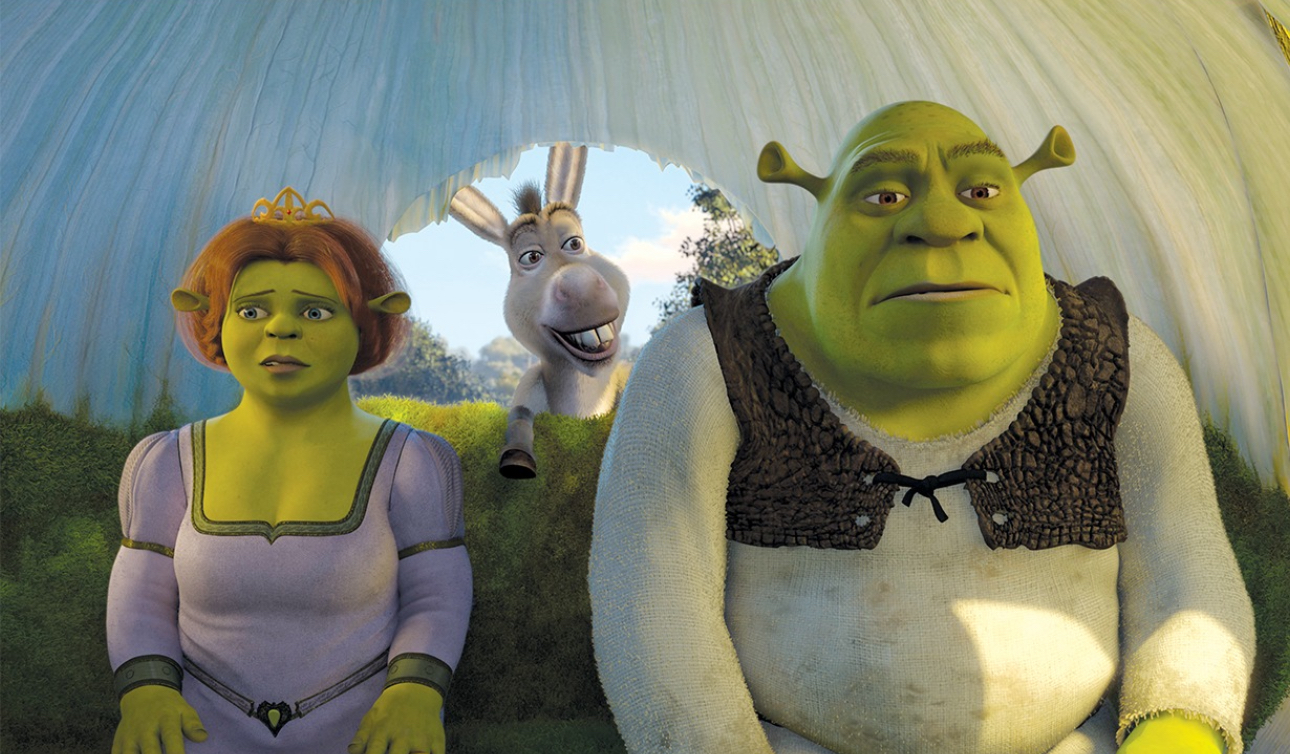
To assist a recovering nation after the terror attacks on September 11th, 2001, DreamWorks animation studios released the sequel to 2001’s “Shrek,” in 2004, with “Shrek 2.” Despite only earning 1% higher on Rotten Tomatoes than “Shrek,” “Shrek 2” proves right out of the gate through better dialogue, better character motivation and far grander cinematography that it is the best installment in the franchise.
The film opens on a storybook that is telling the tale of a young princess locked in a tower, awaiting her rescue from a handsome prince– the same way I’ve always imagined Melania Trump spends much of her day. This fairytale is both narrated and parodied by Prince Charming. As the film opens, Prince Charming is charging on horseback through a lush green forest, a barren and frozen mountain and a red lifeless desert. Though each shot is drawn to be serious, Charming’s narration makes the entire sequence border on the absurd. Once Charming arrives at the castle, The Dragons Keep, he finds not a princess, but in the words of the fairy godmother, a “gender-confused wolf” reading “Pork Illustrated.” The opening sequence of the film communicates the film’s strongest quality, its awareness as a parody, brilliantly.
On the flipside we arrive at Shrek’s and Fiona’s swamp where Donkey has, in usual fashion, shown up and made himself at home. Donkey’s less than ideal relationship with Dragon is then revealed through Marvel-film-beating dialogue. One thing I think this movie did very well, as seen in this scene, is evolve the dynamics between the characters across the movies, showing how they changed between the installments. A dispatch from the royal palace informs the newlyweds, and Donkey, of an invitation to the palace to see Fiona’s parents, the King and Queen. Shrek is nervous as he debates whether this is an invitation to dinner, or to be dinner. After relenting, Shrek and crew depart for the palace. This scene also gives us Donkey’s rendition of the theme from the TV show “Rawhide,” providing both comic relief and distraction from the foreboding task of meeting the in-laws. Once arriving in the land of Far Far Away, the audience gets to realize just how much of a parody of 2000’s Hollywood it really is.
Shot and cut like a scene from HBO’s “Succession”, the dinner sequence is central to the movie’s plot, abandoning humor and leaning purely into conflict. Ending in a large family fight, Fiona leaves to her room and goes out onto the balcony to cry. At that point we are introduced to the film’s antagonist– the Fairy Godmother. Serving as an optional “escape” for Fiona, the Fairy Godmother shows that her real craft is in imaging and optics– making fairytale stories, if you will. Thus, her problems with Shrek are less personal and more visual. Once demanding a meeting with the king, the Fairy Godmother’s pressure shows that King Harold is not a tyrant king, but a cowering pawn to her. Later, when fulfilling the Fairy Godmother’s request, the king says he needs to “have someone taken care of,” his maintenance of plausible deniability and distance to the crime resolidifies that he is simply a coward. His George W. Bush level weaponized incompetence throughout the film establishes it as something recognizable and admirable.
In the film, Puss in Boots is introduced the same grand way. Jumping out from the forest sword in hand, with his cape, boots and hat perfectly fitting, Puss comes across as all charm and skill, only to then chicken out on killing Shrek and Donkey. When Mr. in Boots’ ambush fails, he takes down his cap and gives Shrek a cute wide-eyed stare, resulting in him joining the gang.
As Shrek, Donkey and Puss arrive at the Fairy Godmother’s cottage, it shows just how clear the film’s commentary can be. Though she sells her cures and potions as magic, we see that the process is more akin to an exploited labor force, without dental assistance, overseen by an indifferent bureaucratic overlord. In an attempt to show his humanity, Shrek steals a potion to make Fiona “truly happy.” Shrek shows that he is willing to go to great lengths for her, but does not realize that it is the reason she loves him.
The potions effects of turning Shrek into a prince, Donkey into a stallion and Fiona into a human could have been a way to end the film. However, it would have cut through the message of love being unique and unpredictable. Thus, Shrek and crew becoming yassified creates more problems than solutions. At this point, the Fairy Godmother’s plan is in full effect to replace the new human Shrek with Prince Charming and give Fiona a life that is happily ever after. Shrek, Donkey and Puss are captured by the fairy godmother and thrown in prison.
The film’s finale, set against the Far Far Away Royal Ball, embraces the flashy ridiculousness of the villains, and highlights the virtues of our heroes. The prison break of Shrek and crew is set to the background music of “I Need A Hero,” which makes this absurd plan seem possible.
In the final confrontation between the characters, Fiona decides to remain an ogre with Shrek. This is not framed as a burdensome sacrifice, but rather a decision of clarity and love. The Fairy Godmother’s ending at a mistimed wand strike feels like an apt metaphor for our society: top down control lost in a momentary accident.

Seth '28 is a Sustainability Studies and Business Administration major. He is part of the Muhlenberg Weekly, SGA, and Chapel Council. When he isn't writing, he is usually going for a walk, drawing, or doing work.