



















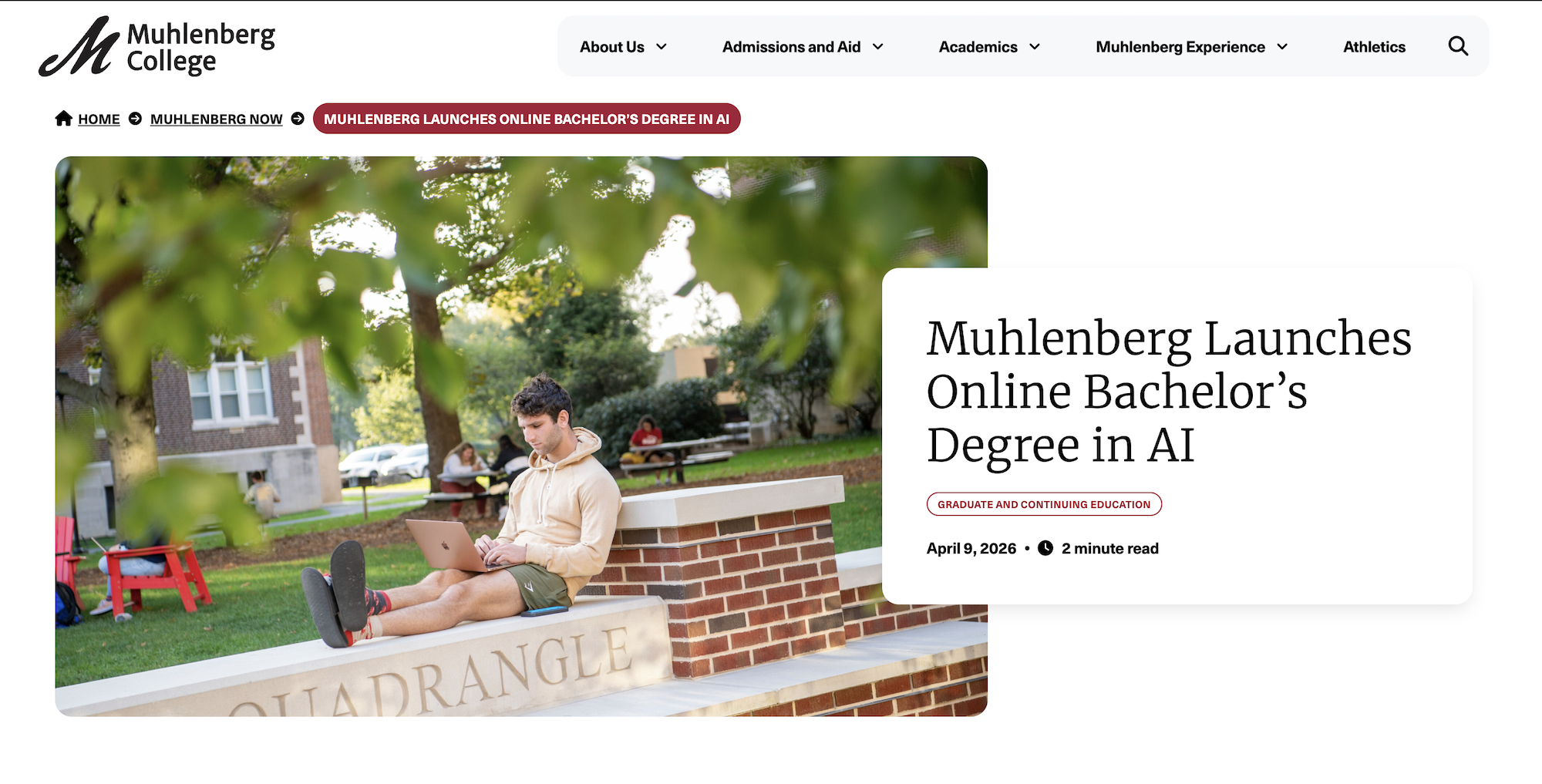
Nothing can exist if it cannot adapt. Articles have been written repeatedly and conversations have been had at length about our college’s adaptability and I need not tell you the feelings of students who feel like our college is not “up with the times.” From offered severance packages to professors, cutting of academic pathways, Brown Hall not being Americans with Disabilities Act (ADA) compliant or an expansion mainly for administrative office space- students, thoughts are many. As such, when present contexts are weighed against Muhlenberg’s adaptations before, we can answer and get a clearer picture about how things look. Like, for example, is the best new degree really a Bachelors of Arts (BA) in Artificial Intelligence (AI)?
Starting with the 1980s, as that is when my parents graced Muhlenberg with their presence, things today are, shall we say, a far cry from what mom and dad knew. Both members of the class of ‘85, my mother and father saw a lot of good change at this school. Under the Presidency of John H. Morey, Muhlenberg excelled into the 1980s quite smoothly. In the spring of 1982, President Morey approved the new “Gay Students Union,” formalizing Muhlenberg as an LGBTQ safe haven at a time where the Reagan government turned their backs. In the late ‘80s, Muhlenberg had established its Africana Studies minor, adding to the success of ‘Berg’s Educational Opportunity Pilot Program. After the Aid Association for Lutherans (AAL) donated $30,000 to the College to recruit 15-20 minority students, the College welcomed its first minority professor– Professor Daniel Tate of communications. In 1988, President Jonathon Messerli appointed Edgar Barry as Director of Minority Affairs with the objective of, “heighten awareness of minorities on campus.” Barry said, “Diversity here on campus is the way of the future, and we plan to get involved in all aspects of college life.” Furthermore, a success like few others was one of Muhlenberg’s first black students from the 1950’s, Julius Becton, who went on to become a Lieutenant General for the United States Army.
Finally, in 1983, Muhlenberg opened its doors to sorority life, establishing women’s presence in Berg’s social spheres. The College’s success and advancement in the 1980s laid groundwork for even bigger projects the following decade.
In 1991, Muhlenberg College displayed a section of The AIDS Quilt, marking its arrival in the Lehigh Valley. In ‘91 and ‘92, Mayor Wilson Goode of Philadelphia, the first African-American to hold that position, came to our college to hold the talk, “The American City in the 1990s- Prosperity or Chaos?” In 1993, our college appointed its first Director of Multicultural Life, Ethel Drayton-Craig. Later, in response to the growing world of science and technology, Muhlenberg College established the New Science Building for biology, neuroscience and related courses.
Academically, the removal of over twenty available courses across departments doesn’t exactly convey adaptation and survival. And no matter what ChatGPT says, neither will a Bachelors of Arts in Artificial Intelligence. To clarify, a Bachelors in Arts is very…very different from a Bachelors of Science, even more so in the field of AI. Whereas a Bachelors of Science (BS) in AI has you take a large amount of in-person courses, 23 at Perdue, Muhlenberg’s fully online BA in AI offers twelve pre-set courses. Additionally, if you are looking for a job strictly as a programmer, especially an AI programmer, a Bachelors ofin Science will set you much further ahead than an applicant with a BA. My final issue is with the structures required to support this degree. Specifically, data centers.
My parents, along with a majority of Muhlenberg grads, continue to live in Pennsylvania. Being from the Northern part of the state by Scranton, news of the proposed Wildcat Ridge Data Center has been quite concerning. Data centers have become an inflection point all across the country as they take water and electricity from residential neighborhoods to power their systems. Data centers have proven to be an environmental disaster and despite massive community pushback, they undemocratically continue to pop up everywhere across the nation. Hell, they want to put data centers in wind turbines and in space now too. Wildcat Ridge, if built, would be the second largest data center in the nation and fourth largest in the world. 17 separate storage centers spanning 574 acres, using 3.3 million gallons of water per day for cooling. This data center would dry out Lake Scranton, need 1,600 megawatts of power, more electricity than the whole part of the state and force dozens of communities to sell their homes for pennies. I, and my Muhlenberg graduated parents, live 20-25 minutes away from this site and would likely be able to hear its fans running. This is the infrastructure required for this new program.
When the College attempts to adapt now, it comes as a Bachelors of Arts, not Science, in AI. A degree completely dependent on structures like Wildcat Ridge and their ilk. Dependent on structures that will undoubtedly cause far more harm to their former and current students than good. They give us a degree that dumbs down the populace, limiting future enrollment to their own school. We could have instead established a degree in kinesiology, aerospace, astronomy, NURSING. They give a degree on a technology built through theft, exploitation and rushed production.
They charge students to learn how to train what will replace them all.
This is not about whether AI is good or not– AI has pro’s and con’s. However this degree both fails to prepare its graduates for competition from a Bachelors Science in AI, Incorporated and is dependent on structures that are harming our world to a previously unknown level. Hopefully when we pick up next year it’ll be on a lighter topic. I personally am very excited to report on my time in Europe next semester and am grateful for yet another year at The Weekly. I want to say thank you to senior Megan and Emily for focusing me into the reporter I’ve become, and thank you Amy for setting this all in motion, it has meant the world. Stay woke, stay oh-so-fresh, and if you care about humanity, don’t waste your time on a BA in AI.

Seth '28 is a Sustainability Studies and Business Administration major. He is part of the Muhlenberg Weekly, SGA, and Chapel Council. When he isn't writing, he is usually going for a walk, drawing, or doing work.