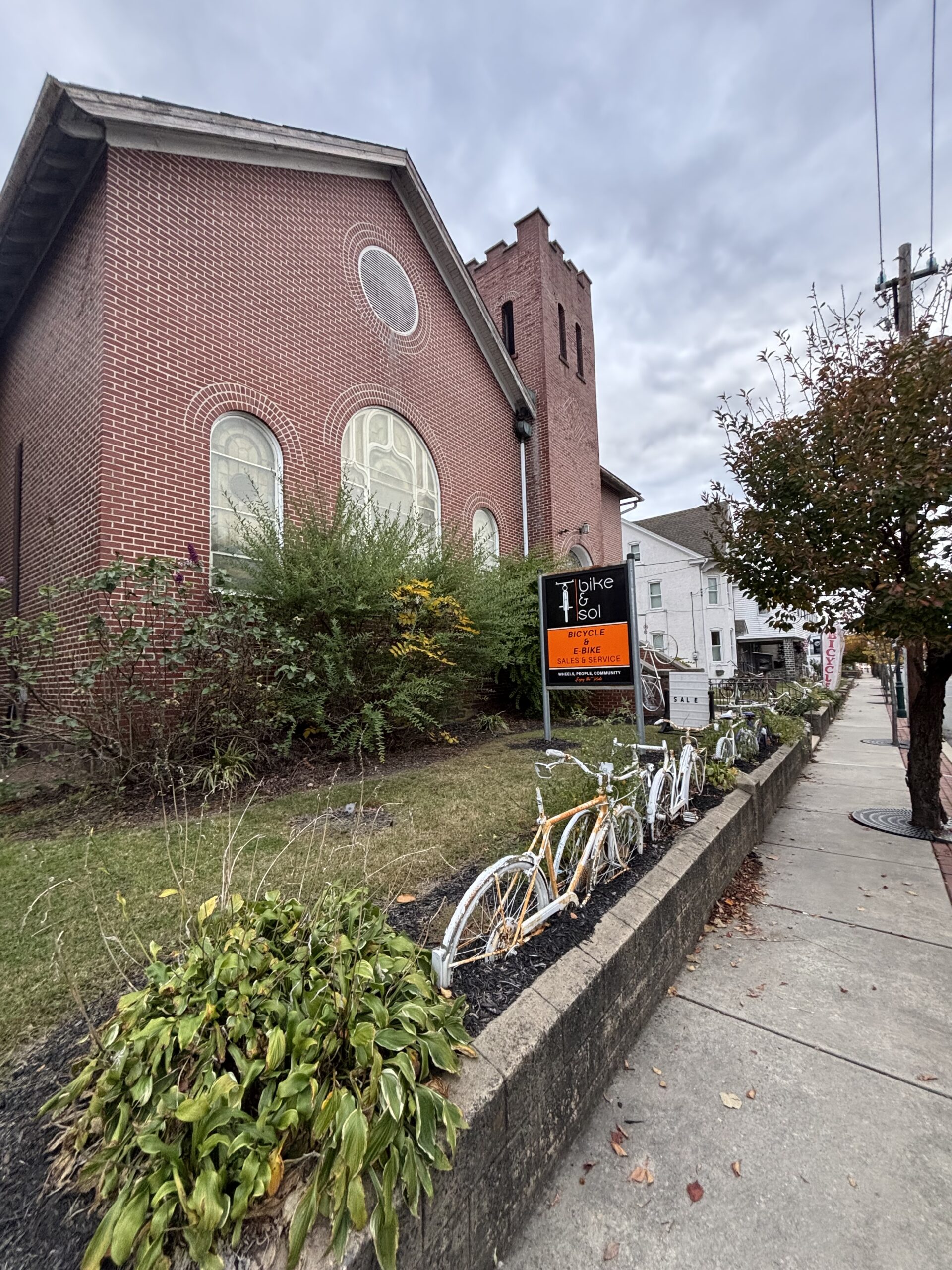
On the outskirts near Quakertown lies the small town of Pennsburg. There’s a bit of scenery along the John Fries Highway. The closed Rite Aid, with its lack of shelves and buzzing fluorescent lights that won’t reach every corner of the building. Each back road runs behind white houses with peeling paint and wood rotting, rusted, and covered cars parked outside. A father with a farmer’s tan works on his truck with its engine rumbling with the symphony of chained mangy dogs barking. Those same roads are covered in the most Pennsylvania potholes anyone has seen. Train horns wake the town at 8:00 a.m., as troubled teens hike down the same railroad tracks carrying their beer bottles and weed. On Main Street lies Bike&Sol, a small local venue and bike shop. A retired church with tall, colorful stained glass, an outdoor garden with fences made of old painted bicycles, is what first greets you. Through the front door, a volunteer with a Ramones t-shirt, long hair, a beanie, and a septum piercing hands wristbands out to patrons. Today, punks will flood the scene in their Dr. Martens and their ripped and mended patch pants, ripping up the hardwood floors and getting noise complaints from neighbors.
In the late seventies, the energy of the first wave punks appeared to be waning. As they jumped for labels and to capitalize on their image, Penny Rimbaud of the band Crass wrote the incredible song “Punk Is Dead.” He saw punk as a corpse or as Frankenstein’s monster and thought it was held up with branded guitar strings and vivified with the electric power of enterprise. Though the sentiment remains, it is hard to see punk as such.
Today, Punk is very accessible, thanks in part to social media. What used to be a niche culture that attracted visitors through flyers on telephone poles or another tacked to your local record shop’s board that says for location, “ask a punk.” That still exists today, but now there are Instagram pages for bands that are followed by thousands, or punks teaching about the history of the subculture on TikTok. Things that once died, like lace code, a way of telling someone’s political beliefs through the way their boots were laced, are now resurfacing on social media. Laced straight across gave a certain meaning, but colors also have their own meaning. Yellow is anti fascist, black is unaffiliated, red cross laced can be communist, but red straight laced can be a nazi, same with white. Creators post videos of moshing school teaching young punks how to two-step (an evolution of skanking), throwing your legs back and forth like running with a little skip in between. With more accessibility comes judgment and people who like the scene for its black shiny boots or tall spiked mohawks, with little to no appreciation for the actual music or what values lie beneath that hard exterior.
The movement has made it more accessible to many and serves as a community of change, both on and offline. Punk’s methodology has changed with rites of passage like a broken nose or missing tooth are no longer necessary for admission, yet the ideal of community has remained the same. In the United States, especially since the COVID pandemic, there has been an isolation epidemic. In 2022, a study found that “only 39% of adults in the U.S said that they felt very connected to others.” Punks, both performer and consumer, uniting under venue roofs or to play out in the open in the park, has been a way to foster community, especially in small towns like Pennsburg, where community is only made by those in it.
The show starts slowly as Dr. Martens boots without their tread slip and step in circles. But the motion picks up as a few forces of nature throw their arms as if they were going to pop out of their sockets and kick their legs like their life depended on it for survival. One man dressed in a clean suit, a plastic chainsaw swinging in his hand, also wore a Spirit Leatherface mask. I had seen him before at another show here, and still, he caught my eye. As the band wrapped up their set, the scene roared with applause, whistles, and shrill shrieks of fans. Leatherface stood aside with his mask off, revealing a long beard, and awkwardly looked around the room.
“I’ve been in the scene as long as he’s been doing shows,” he said sheepishly.
He was talking about his friend Tony. He didn’t explain who Tony was other than that he did shows and was a friend from work, sharing similar tastes.
“How long has Tony been doing his band stuff for?” I beckoned, searching for more.
“I don’t know-” Silence held the air for a moment as people funneled out of the building for a smoke in the gravel parking lot.
Familiar faces surround us, yet this show takes place somewhere new. Usually, at Pennsburg’s Bike&Sol, shows are hosted in their basement. You make your way down through the steep steps low ceiling that opens up once you get to the bottom. Green checkered tile floors, white walls and fluorescent lights on the ceiling were turned off in favor of the warm glow of orange string lights with blue spotlights.
For STPFEST, the first festival held there, the upper part of the church was used. Bike racks are on the walls, tools along with bicycle shells are in the workshop and with Jesus staring down at two stepping young rebels., tools along with bicycle shells are in the workshop. Leatherface’s eyes stopped searching for answers in the sky and returned to mine.
“Just a while,” he answered sharply. Standing there for a moment, we swayed back and forth. Why does he come here, helping his friend organize the event? What did he like in the scene?
It seemed like with every answer, there was a tone of voice that rose at the last word, like there was going to be more to come with it. But there was nothing, and yet the little he said and the silence he made room for spoke volumes of its own. Was he helping organize?
“No.” People walked out carrying a guitar case, amp head, and a large guitar pedal board comprised of plywood and woodscrews.
“For the music. It introduced me to newer, smaller bands that I can easily communicate with.”
“I wear the costume for fun,” recalling back to him waving the plastic chainsaw high above the crowd. Each answer to every question had no breath wasted. We parted with a fist-bump and a smile, and for the rest of the evening, there was the occasional moment of recognition.
The sun had fallen from the top of the sky to its side, casting its red and orange glow down on Pennsburg. The parking lot of the venue looked quite similar in color, with many people sitting outside having a smoke break while the bands broke down their drum kits and set up, and the next band walking in with heavy, yet excited faces. I was sitting on the cracked curb of the neighboring church’s parking lot, stomping my American Spirit. Walking back, a cloud of gravel and dust filled the air. The dust followed a local kid, Benny, with his ape hanger bicycle. He asked me if I wanted to ride it; I’d have been a fool to say no.
As it turns out, the bike shop ran a community outreach program. Where local kids could come and learn how to use tools and build life skills, breaking down a bicycle to its bare parts, then, with a new coat of grease, rebuilding the bike. After all the work is over, the blood and sweat they’ve put into the project are enough to cover the cost of the bike.
“We’ve always had music playing in the shed. So I was always given space for music,” said Scott Roth, Bike & Sols owner. He towered over his grill with some sweat dripping off his beard as he spoke. The venue took part in an event called ‘Make Music Upper Perk,’ set on June 21 where artists filled the Perkiomen Valley with music everywhere within earshot. Scott continued, “There I met Tony,” the events manager. A small long long-haired fellow, Tony booked shows and venues for bands all over the area. He was hard not to notice at the show as he handed out ear protection, fist-bumped friends and patrons, and taught people to do the Macarena to blast beats. He did all of that and managed sound, but he didn’t manage the load alone, as his mother helped sell food, snacks, and refreshments.
“And Tony’s like, we should throw more shows, and I said, let me show you the basement,” Scott pieced together his next thought, trying to think of how to introduce it.
Scott recognized the church as a place that could help foster community through local music and outreach. “Fourteen years ago, a kid committed suicide in town. I didn’t know him, but I knew people who knew him, and that messed me up. But this kid had a lot of support systems around him, and I’m like, I don’t want to see anybody go through that again.” His voice lowered at the mention of it, in reverence. but still remained triumphant at the mention of change. “There was no place for kids to hang out, and nobody really had a plan for this place.” With the help of the local school council, he started an after-school club of volunteers to help renovate. The majority of the football team fixed floorboards and assembled bike racks, laying a new foundation for the neighborhood to build off of.
Back in the venue, Jim ‘Jimmy” McMonagle stood in the corner. A heavier set man with a baseball cap and a hoodie, with his hands tucked into his faded jean pockets. His son Kieran stood by as the next band took the stage and rocked the room with a flurry of sound. One may never suspect that a private school chef would have been the guitarist and vocalist of one of the most legendary Philadelphia hardcore punk bands, Flag of Democracy. With a firm handshake and pat on the back, his trainers, he walked outside, kicking the gravel, hitting the tires of parked cars.
He spoke of his son’s hockey practice they had to go to once the show was over. He was in quite a hurry to see the band Chemical-X, then make a move on.
“The Lehigh Valley Polarbears, it’s for like autistic kids, kids with other developmental disabilities. That sorta shit.”
“He actually like goes and plays a hockey game, whereas before he was on these soccer teams where they go- okay, kids, let’s go on a field and kick a ball around,” he said in a zany mocking soccer-mom voice.
Small shows like this one are a cornerstone of what punk is. Back in the day, shows were smaller, and the scene was smaller, Buff Hall, the Airport Music Hall, CBGB– all small venues that stood as pillars of their punk communities. “You had all the oddballs gathering together,” says Jimmy. “Whereas now things are bigger. It’s like, oh, I’m only gonna go to a show that plays darkwave or this particular sub of floorpunch hardcore to folkpunk.” He’s talking intently with his hands, and it feels like talking to a historian about Greek theater or la commedia del arte. It’s because I was talking to a historian with a valuable history to tell, like any other.
“ Back in the day, it was a smaller scene,” he continued. A show would be a combination of the speed and power of a hardcore band’s electric ensemble, followed by finger-picked folk punk. “You get out into areas like this. And you begin seeing this because everybody’s just gotta make it happen.”
“The punk rockers hang with the hippies and deadheads, the cops are hassling us, well, they’re hassling us too.”
“We’ll play bigger shows too, and it’s really cool to play the big crowd, and a lot of people get into it.”
Something he said went back to a previous conversation we’d had that day about playing over into Europe. “We played big shows all the time while touring.” The band playing before was another hardcore band, their lead singer an unfit, decently kempt man with only a gimp mask on his head, and the rest was as bare as the day he was born. During the set, he would sing and crouch down, hitting his head against the bare concrete floor that many hips and teeth must’ve crushed against that day.
With a moment of appreciation and hesitation in regards to those shows, Jimmy continued, “but I kind of like the vibe of our smaller shows… I think our sound sounds better in a smaller show or a VFW hall.” He thought for a moment, “What you’re looking at is where this music is– out of a basement.” Music crafted out of the frustration of youths made do with what they could do, recording music at home, patching and repairing clothes at the kitchen table, hosting many a show in the basement, and that’s where they developed their sound. The very same reason the most exhilarating hardcore song with the most punchy guitar and our drummers’ fastest bass hits sounds completely different when listening to it recorded in a pin-drop quiet studio.
The venue door swings open with the sound of a bass intro coming through, quietly being shushed as the door closes. A sign next to the door states the rules for the old building, including “use positive language, no foul language” among other things.
The song raged and continued on as people gathered their strength from their moshing break, throwing themselves back into action. “There are people who will just go for the sake of violence. There’s always been those people.” Jimmy retold a story (now a song) of his involvement with someone like this. At some show, a guy was just randomly going around slamming into people and punching them, just being a right asshole. Finally sick of his shit, a ton of people piled onto the kid in a cartoonish cloud of dust to kick his ass. Jimmy grabbed him by the scruff of his neck, dragging him out as people searched through the dingy chaos looking for him.
“Hey man, chill the fuck out man,” he recounted saying to the kid outside. His friends drunkenly stoupered outside, like little dogs with loud barks saying, “Yeah, we gotta get those people, man, we got to go back,” with their fists beating their palms.
Jimmy wiped the sweat off his forehead and turned the kids back to his companions. “Don’t listen to your stupid friends.” Hands on both shoulders he said to them,“chill the fuck out and have some fun, or just leave.”
“Ya know?” He said with a little smile. adjusting his glasses, then gazing upwardly at the brim of his hat, ready to part ways. With his cheery smile and a friendly handshake, we parted ways, and I went to walk the corner and have a smoke.
As people were funneling out, I got a sudden phone call from a friend, and from there, I went to another show, leaving early from the small town of Pennsburg to go to the bustling city of Philadelphia. Driving into Bridesburn, I noticed the tall townhouses, some with doors open and lights on, and some others with the light of a TV, a La-Z-Boy, and a bottle in hand. Houses with orange and purple lights and carved pumpkins flickering in the cold night. The new venue was a totally different vibe. Being greeted by and wrist-banded by the red devil, part-owner, and a member of The Rocker-Show. Outside was a lot, including but not limited to a full-sized school bus packed with cans and cups in windows, a wario tricycle, carved pumpkins, and patterned chair pullovers, fake cobweb-filled air, with tables in the middle of the space, and merch took center. Inside the garage, where the band played, was even more eclectic. Even on the door and into the tiny hallway, inside jokes with photos and tags were all over the walls. A fallout shelter sign, a rocker show poster “est.2021,” half of a skull looped through string lights, old hosted shows, and a comically large poster saying “if you see these men do not give them beer. They are evil and are probably up to no good schenanigans,” with the rocker show’s website below and a picture of the two owners.
The show began and ran through the night. Having driven hours to be here, I asked the first band’s lead singer if I could do an interview, and I was met with a hasty yes. Outside at the merch booth, he stood organizing and selling merch. Short with long hair and a backwards baseball cap, NO/MAS’s singer was a presence to be seen.
“We drew straws, and Henry drew short, so he’ll answer any questions you got; you can find him around.” Their singer answers me curtly while focused intently on merchandising. I never did manage to find them around. There’s always going to be people like that, I was told.
Sitting on the sidelines of the show, along the bare concrete wall, leaning against the bar, I sat drink in hand, observing Jimmy’s words coming to life in front of me. People crashed into each other and bruised their hips, and knuckles flew and cut their brows. The bands swapped gear, and between sets, the venue owners came out. A violent intermission began with gusset plates being rammed into their heads, and dollar donations being stapled to their chests in sadomasochistic excitement. But that money went to the venue. And for all those bruised hips and fallen folks in the pit, there was always someone to pick them up.
“This scene doesn’t need to be angry. There’s enough external stuff to make us all angry.” Jimmy’s words tolled in my ear. Watching everyone in that room, you could see anger in their eyes; it was evident in their moment of reprieve, when they stepped out of the pit and breathed heavily, like an animal in pursuit, with the look of a hunter in their gaze.
“But if you find community and fun while still being aware. Just don’t be stupid about the world around you, but don’t live a life of misery.”
The pit began to circle like a storm, and there I stood with a foamy solo cup, in the eye of it. The rippling tides around me turned, but in that room held together by flyers and memories and blood and bootlaces, we held strong against the much stronger tempest outside. Outside was the crushed cigarette that became of us.