Tierney Field wakes early.
By midmorning, the sun has already settled into its place above the turf, spreading a steady light over the white lines painted at midfield. The soundscape builds slowly, lacrosse sticks clacking, quiet laughter, snippets of conversation carried by the wind. It’s a place made for motion, for competition, but today it holds something stiller.
Across the bleachers, clusters of players gather in purple shirts marked with yellow angel wings and the number 43. Coaches, trainers, and even media staff wear them. The number repeats everywhere, on chests, on sleeves, on the back of a jersey lying neatly across a bench.
Only a month ago, that same number had streaked across a field in South Korea. Noah Snyder, wearing No. 43 for the Haudenosaunee Nationals U20 team, had been a force in the Men’s U20 World Championships. His performance earned him an invitation to join the senior men’s team, a rare honor for a young player still mapping his path forward.
Then, on September 5, everything came to a halt. Snyder, who was also a sophomore on the men’s lacrosse team at Marquette University, and his collegiate teammate, Scott Michaud, were killed by a drunk driver. In the weeks that followed, grief permeated the Haudenosaunee, Marquette, and lacrosse communities. A grief that carried not only loss, but legacy.
Noah Snyder was a rising star in the lacrosse community. He first picked up a stick at five years old, playing box lacrosse with the Newtown Golden Eagles at the Cattaraugus Community Center on the Cattaraugus reservation, part of the Seneca Nation, where he grew up. A few years later, he began playing field lacrosse with Buffalo Youth Lacrosse. He then went on to graduate from Westtown School and help them earn their first-ever championship titles in program history. He then went on to become a Division I lacrosse player at Marquette University.
Snyder had a standout freshman season with Marquette, playing in 13 out of the 14 games, including three starts. He earned BIG EAST Freshman of the Week after putting up 5 points that week against Cleveland State and was named to the BIG EAST All-Academic team. He had a total of 16 points for the entire season, ending the season on a hot streak, which carried over into the summer and international play. He spent the summer training to compete with the Haudenosaunee U20 Men’s team for the 2025 U20 Men’s Championship on Jeju Island, South Korea.
While in South Korea, he racked up eight points, including five goals and three assists. Despite the team going 0-3 in pool play, they were in arguably the most competitive bracket, with all four teams competing for gold and bronze. Canada beat the USA 6-5 in a competitive match and a nail-biting end. Haudenosaunee battled against Australia for bronze. Unfortunately, they fell short, losing 13-7. Despite their loss, Snyder put up a goal and an assist during that game.
But lacrosse is more than just a recreational sport that students play in college – it is a medicinal game with deep cultural and spiritual significance that can be traced back to the Indigenous people of North America.
For international lacrosse, the Haudenosaunee Nationals represent the Native American communities. Their first National lacrosse team was created in 1938. Their purple flag features a Hiawatha Belt, consisting of four boxes and a tree in the center, all connected by a line. The belt represents the five original Haudenosaunee that came together in the 12th century. The four boxes, left to right, represent the Seneca, keepers of the western door; the Cayuga; the Oneida; and the Mohawk, the keepers of the eastern door. The tree in the middle represents the capital of the confederacy, the Onondaga. The Tuscarora joined in 1722, but were not added to the flag.
When the Grand Council of Haudenosaunee sanctioned a national lacrosse team, they chose a French variant of the word “snake” to name their team. This was a name given to them by their longtime enemy and rival tribe, the Huron. As many Native Americans were forcefully assimilated into American culture, their language was lost, and the name stuck despite being derogatory. However, as Native Americans started to regrow and revitalize their language and culture, they changed their organization’s name from the derogatory term to the Haudenosaunee Nationals, meaning “People of the Longhouse,” in 2022. This was a way for the Haudenosaunee Confederacy to regain its identity and culture in the lacrosse community, which had been ripped away by colonialism.
Now, as the Haudenosaunee Nationals delegation arrives at USA Lacrosse Headquarters in Sparks, MD, they bring more than sticks and jerseys. They carry an absence.
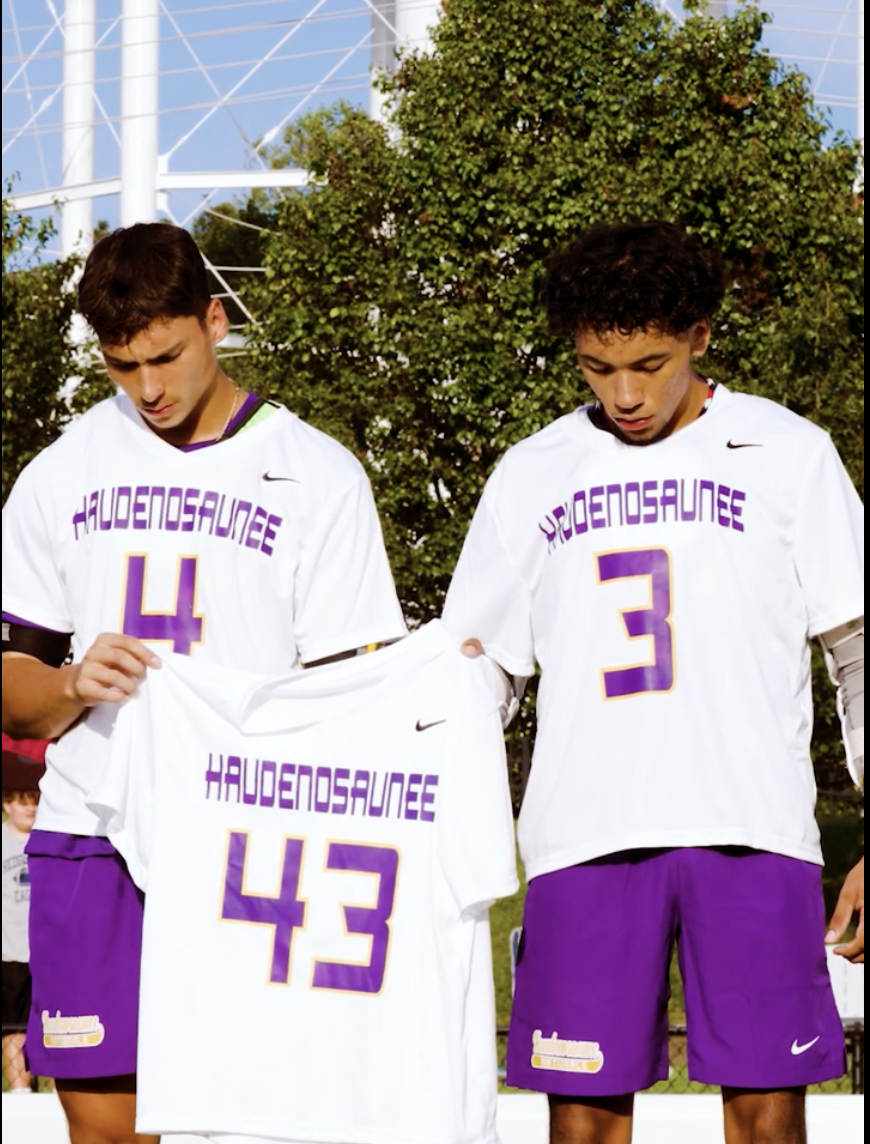
When the Haudenosaunee national anthem began before the men’s first game, two players held Snyder’s No. 43 jersey for all to see. The chatter hushes. A moment of silence falls long enough for the air itself to seem suspended.
During the Opening Ceremony, two leaders in the Native American community – Lance Fisher from the Northern Cheyenne Nation and Giovanna Gross from the Oglala Lakota Nation, who is also Northern Peruvian – step forward to bless the field, singing in their indigenous language that ripples through the stillness. Before the blessing, Fisher called for a moment of silence for Noah Snyder and Scott Michaud. Noah’s stepfather, now an assistant coach with the men’s team, stood with the team wearing his son’s jersey.
Only then does the field seem to exhale. The whistle blows, and the tournament begins, the Atlas Cup, where the Haudenosaunee Nationals senior men’s team faces some of the best in the world. But the competition feels secondary, almost incidental.
Throughout the day, the field hums with small acts of connection: players signing autographs between games, fans leaning over the rails to offer encouragement, children chasing lacrosse balls through the fan zone, their laughter rising above the low thrum of drums and music. The jersey on the bench remains untouched, moving only when the wind catches it, a quiet sentinel watching over the game.
By dusk, Tierney Field has become something more than a stadium. It has become a gathering place, a vessel for memory and continuity. The scoreboard may track goals, but the day measures something deeper, the persistence of a community that plays not just to win, but to honor.
Here, the game is never just a game. The field listens.