


















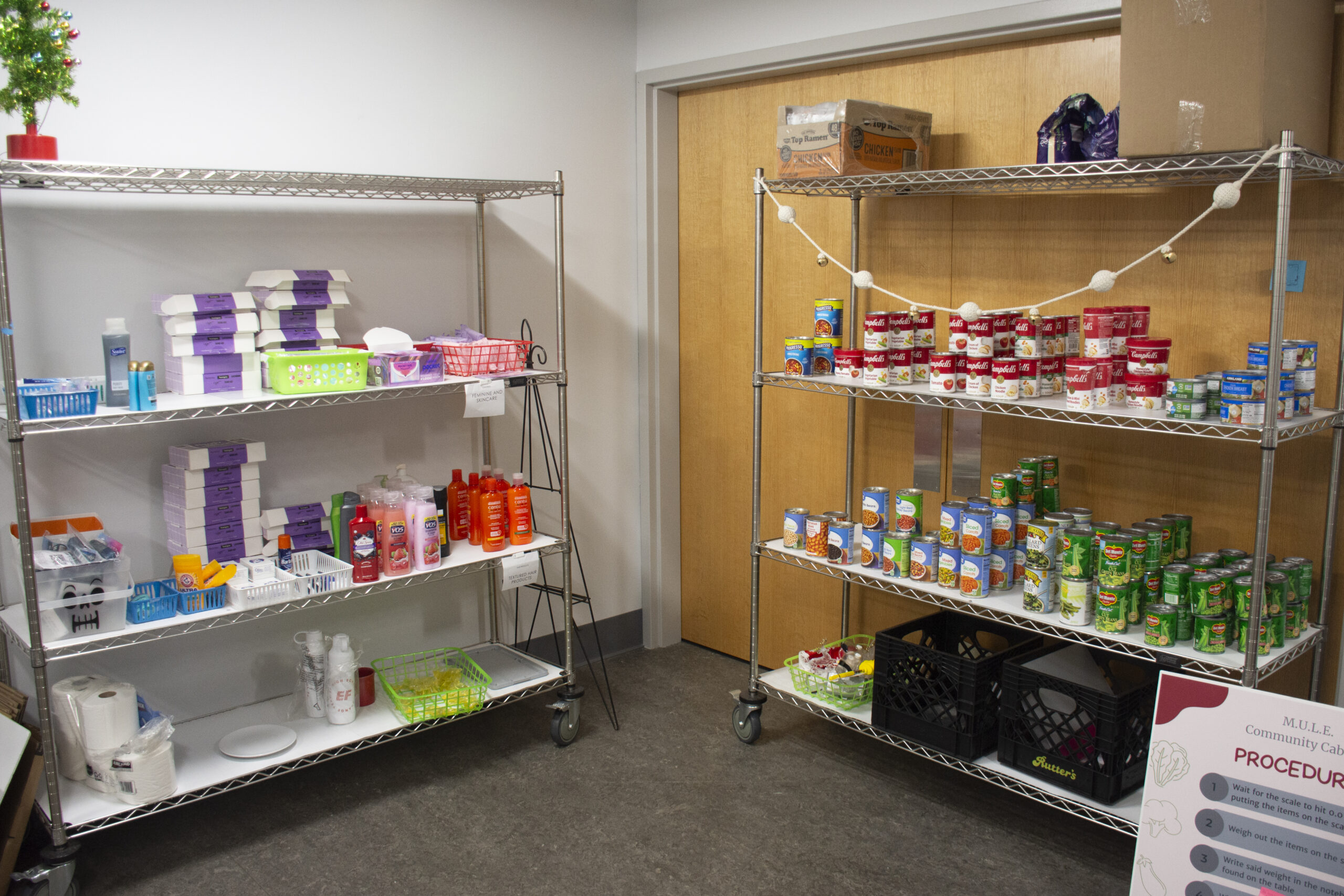
With new buildings rising, first-years arriving and the fall semester underway, it’s important to recognize some of the resources that keep us moving. Right around the corner from ‘Berg Outfitters is a small room with metal rack shelves, a fridge, a scale and a mission. The Muhlenberg Useful Living Essentials (M.U.L.E.) Community Cabinet, a recent initiative founded in 2019, provides all students experiencing need with free essentials like food and hygiene products. Managing classes and life while staying on budget can get really stressful; one of M.U.L.E cabinet’s goals is to help lighten that load.
The M.U.L.E. Community Cabinet relies heavily on community and student involvement. Run by a dedicated team of three student volunteers, they monitor the space, help visitors find what they want and weigh their goods. Other responsibilities include keeping inventory and promoting a friendly, judgment-free environment. “I once went with my friends for fun,” said Zionne Toppin ‘28. “I thought it was really cool that you could just pick up what you want and you don’t feel watched or judged.” Though it’s not stated in the Cabinet’s official mission statement, it also serves as a “place for friendship too,” as Isabella Calamia, the administrative assistant to the Office of Religious & Spiritual Life, put it.
All of what’s offered comes together to achieve their ultimate goal of making sure every student has what they need to live, learn and feel supported.
“The M.U.L.E. Community Cabinet was established in an effort to combat food insecurity among students,” says the Cabinet’s landing page. As the program has grown and developed, the things they supply have also changed. With the addition of a fridge and freezer as of last semester, they now supply a new range of healthier foods, frozen meals and bagged vegetables. The dry foods and snacks section is one of the most picked-over sections of the Cabinet. A personal favorite item of Leidys Recio ‘28 was morning snacks or quick meals, which were “great for when you can’t wake up early for the [Dining] Hall,” a situation that is all too familiar to most students. On the other side of the room, their self-care and toiletry shelves house everything from shaving supplies to shower and menstrual products. All of what’s offered comes together to achieve their ultimate goal of making sure every student has what they need to live, learn and feel supported.
When asked, Cathy Tran ‘27 said, “I love it. I think it’s very convenient that it’s on campus and the stuff is free, which is great for college students on a low budget.” Even with the Cabinet’s convenience and warm atmosphere, there is still a lack of awareness surrounding it, and some sort of stigma persists around taking advantage of its resources. When asked if they had used the M.U.L.E. Community Cabinet, many students simply shrugged their shoulders. Very few first-year students were even aware that the room existed. The main culprit of both of these problems appears to be physical visibility. Since the ongoing remodeling of Seegers Union, the Cabinet has lost some exposure, and the removal of the mural of a mule pointing to the room has not helped. It being tucked away on the basement level can make it seem like it’s only for students experiencing extreme need– making potential users feel ashamed or hesitant to use the Cabinet. Recio observed that “people avoid it because of judgment from others or self-doubt or feeling poor.” But Recio perfectly captures the spirit of the Cabinet when she says, “Nobody here is going to judge you.”
This is where a community can come together for the common goal of ensuring that each student has their most basic needs met.
Still, there is the issue of awareness. This is where a community can come together for the common goal of ensuring that each student has their most basic needs met. Flyers and tables on the upper floors of Seegers help spread awareness, but it takes word of mouth and a collective effort to overcome stigmas and show students that getting help is okay and that there are resources available on campus to assist you.
The Cabinet’s success does depend on word of mouth, but it also benefits from direct action. There are numerous opportunities for students to get involved by volunteering, donating or checking out their Amazon wishlist. Student organizations can try to help increase visibility by advocating for a more visible spot for the Cabinet or even painting a new mural. Calamia also emphasizes the importance of a larger campus and group collaboration, stating, “We would love to partner with student groups. If there are any student groups that would like to do donation drives, and if there are any individual students, they can always email!” Visit their landing page on the Muhlenberg website to see their weekly hours and their donation resources. For questions, suggestions or feedback, email mulecabinet@muhlenberg.edu.
Photo by Sierra Addy ’27

