



















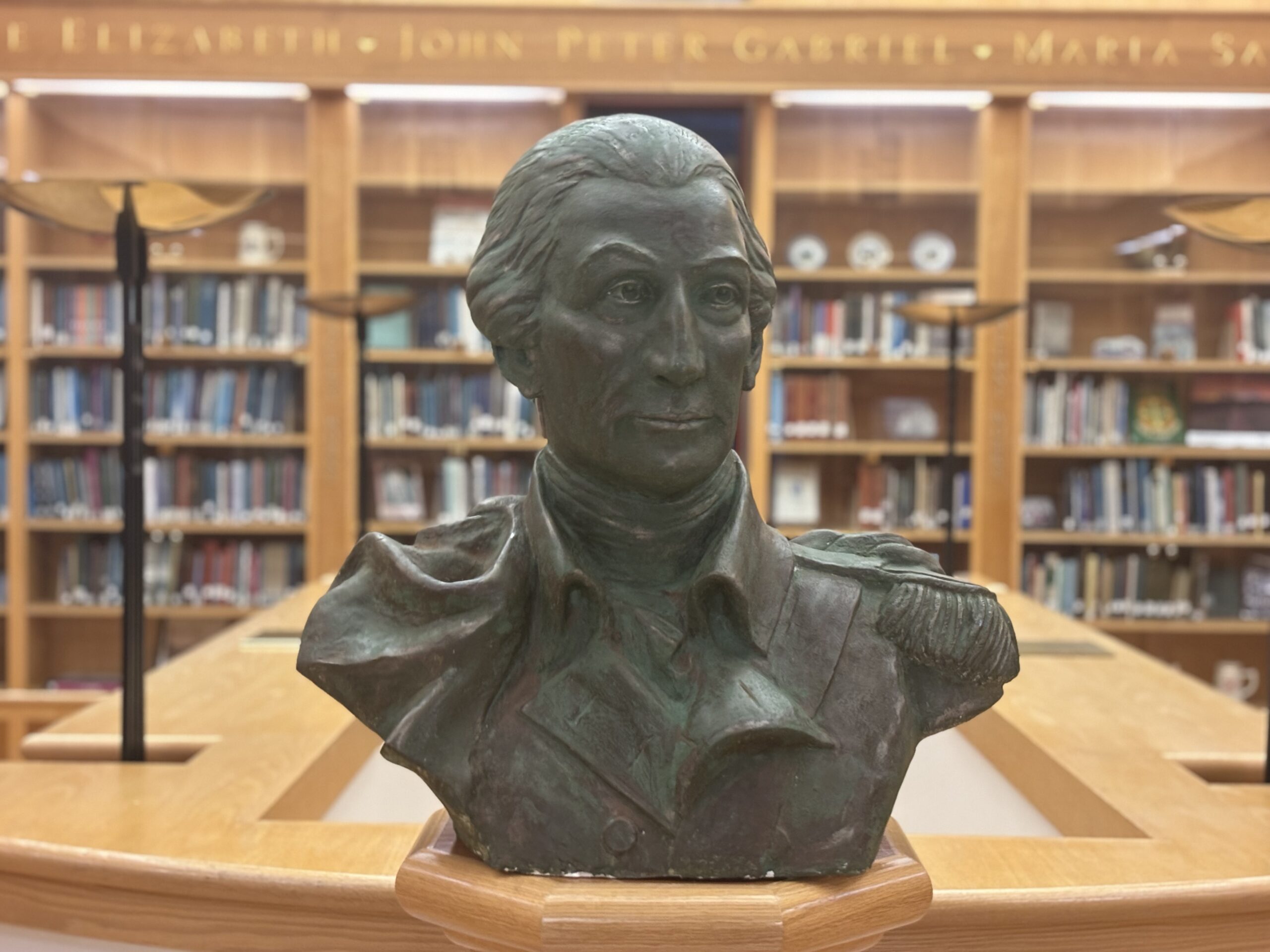
A rising social awareness of the United States’ complicated history have led Americans to question how to approach monuments and monikers dedicated to historical figures who have documented connections to the Confederacy or the slave trade. Similar to the House of Representatives’ move to remove all statues depicting those who supported the Confederacy, in 2020, the Shenandoah County School Board in Northern Virginia voted to remove Confederate monikers from their schools. This included retiring the names of Stonewall Jackson High (named after Thomas Jonathon “Stonewall” Jackson) and Ashby-Lee Elementary (named after Robert E. Lee and Turner Ashby). Another school in this district whose name was left untouched was Peter Muhlenberg Middle School, named after the son of Muhlenberg College’s founder, Henry Melchoir Muhlenberg.
Muhlenberg students may be aware of the history of the Muhlenberg family: Lutheran immigrants from Germany who spread the word of the Lutheran church across the state of Pennsylvania and eventually, across the country. Statues displayed across campus stand as a testament to the Muhlenberg family’s impact. John Peter Gabriel Muhlenberg currently has a statue in Muhlenberg’s Trexler Library.
But who is John Peter Gabriel Muhlenberg? Born in 1746 in Trappe, Pennsylvania, Muhlenberg received his education at Philadelphia Academy, which is now the University of Pennsylvania. Before settling in Virginia, Muhlenberg became an ordained minister in the Church of England. He eventually came back to the states looking to serve in the Revolutionary War. According to the Architect of the Capital, Muhlenberg “quickly commissioned a brigadier general in the Continental Army and was active in many battles.” After the Revolutionary War, Muhlenberg had many stints in the political field including being a congressman, a senator, and the vice president of Pennsylvania.
During his time living in Shenandoah County in Woodstock, Va., Muhlenberg accepted the job in supervising the finances for the city of Philadelphia. In the duration of this time up until his death, it is reported on multiple Virginia census and Revolutionary War Pension and Bounty-Land Warrant Application files that John Peter Gabriel Muhlenberg owned a great amount of slaves. Rev. Judith Meier of the Historical Society of Trappe, Pennsylvania states, “He [Henry Muhlenberg] had trouble with the fact that one of his sons, the restless Peter, was able to lay aside his preaching gown in favor of the uniform and sword of a rebel officer. How must he felt when he first learned that Peter, long-time resident of the Shenandoah Valley of Virginia, had Negro slaves?” With just one individual’s information on record, a little over 200 individuals went undocumented due to Muhlenberg documenting each slave under his own name, possibly leaving many present-day African-Americans with no ties to their lineage.
Assistant Professor of Education Hunter Holt suggests that this may be a part of history the institution would want to acknowledge. Holt says, “Representations of these figures from a historical perspective, it is important to recognize these legacies and histories even though in this present moment we are seeing that history being stripped away.” Additionally, Holt notes, “I think that it is important for us to grasp these complex issues from people of the past and how they offer us lessons for us to learn in the present.”
President of Muhlenberg College Kathleen Harring declined to comment about John Peter Gabriel Muhlenberg and his past. However, Muhlenberg’s Vice President of Communications and Marketing Todd Lineburger explains how the senator’s judgement may have been clouded. Lineburger states, “Peter Muhlenberg’s story is similar to many of our founding fathers like Washington, Jefferson and Madison– he was visionary and courageous, but at the same time complicated and imperfect.” Lineburger continues, “He came into adulthood in a Virginia culture where slavery was not uncommon and he owned several enslaved people.”
Furthermore, some students at Muhlenberg believe acknowledging this history is long overdue. President of Muhlenberg’s Black Student Association (BSA) Amina Dia ‘27, who has been involved with the club since her first year, encourages the institution to recognize and accept the flaws of the Revolutionary War veteran. Dia states, “Remembering Muhlenberg should involve acknowledging both his public accomplishments and the harm he caused, without minimizing slavery or framing it as an unfortunate but forgivable flaw.” Dia adds, “Muhlenberg keeping up the statue is the perfect example of ‘even though he owned slaves, he is still a hero.’ However, that is a narrative that only people who were not affected by his actions see.”
The RJ Fellows First Year Seminar (FYS), titled Monument Wars: The Politics of Public Space, focused on discussing the complicated history of American monuments. Ansley Asche ‘28 shares, “Monuments are established to celebrate or memorialize. They answer the question of who or what should be put on a pedestal. They can remind us of moments in history that cannot be forgotten and of those who overcame them, but monuments on a college campus should honor things that align with the institution’s values. A statue of a slave owner does not build community, make all students feel welcome, or represent a diverse student body.”
Bianca Girlya ‘28 also notes, “Dr. Gambino’s RJ Fellows course, Monument Wars, has taught me why monuments were built, why monuments continue to be built, and what significance monuments offer. I think that the topic of monuments in modern America is complex, since on one hand, they serve as a vessel to teach future generations of our nation’s past; on the other hand, the presence of these monuments do not align with the opinions of many Americans. I think that this topic definitely should be further explored.”
As the College acknowledges and honors the family’s accomplishments, the Muhlenberg community is left to contend with controversial aspects of the college’s history and legacy as an institution.

Erin Punter ‘28 is a media & communications and political science major at Muhlenberg. When she is not writing for the Weekly, you can catch her on the court playing basketball or rewatching Dance Moms.