



















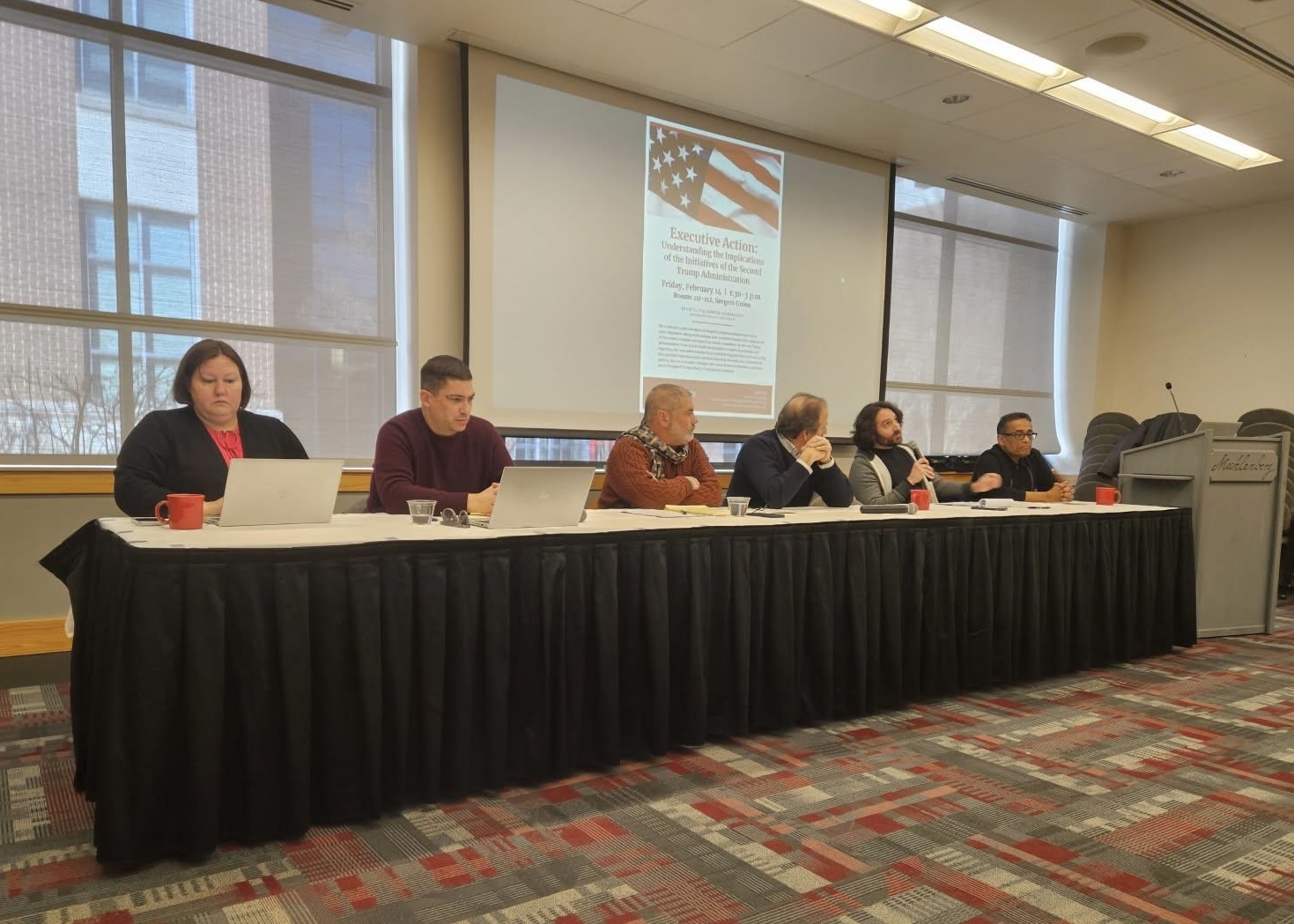
This past Friday, the College held a panel on the explanations and impacts of the numerous executive orders handed out so far by President Donald J. Trump. The panel, entitled “Executive Action: Understanding the Implications of the Initiatives of the Second Trump Administration,” was held in Seegers Union by the Muhlenberg College political science department. The event was structured such that each executive order was introduced and elaborated upon, and then there was time for questions after.
President Trump’s executive orders have been vast in size and scale, drawing both praise and criticism from many American politicians and citizens throughout his term thus far. They have ranged from economic orders such as the new “Reciprocal Trade and Tariff Order,” which President Trump claims will “stop nations from ripping us off,” to orders more focused on domestic security issues such as the new “Imposing Duties To Address the Situation at Our Southern Border” which is meant to clamp down on border crossings.
The opening focus of the event was on the state of our democracy. Specifically, how it stands now and how it moves forward after being put under stress. The panel consisted of all political science professors, including Chair of Political Science Department Mohsin Hashim Ph.D., Ross Dardani Ph.D., Christopher Borick Ph.D., Jack Gambino Ph.D., Lindsey Burt Ph.D. and Associate Dean for Faculty Development Brian Mello.
Firstly, each professor on the panel spoke on select topics that most closely matched their area of focus. These opening comments covered areas including how Americans speak about politics and have been since 2015, how the American electorate can move forward after this administration, how tariffs are handled and reacted to, deregulation, diversity, equity and inclusion (DEI) and international diplomacy with our allies and adversaries.
The first executive order discussed at the event was President Trump’s order on trade and tariffs. Hashim stated, “It goes back to a broader mindset of President Trump seen throughout his life. He has a very transactional approach to life… it severely undermines governments and regimes. Tariffs and deregulation will totally benefit the elites in the era of financial capitalism, it will cause serious damage to our allies in East Asia. This is self-defeating.” Burt added, “It reflects the short-sightedness of the ‘America First’ policies President Trump supports.”
An attendee then asked a question on the topic of the growing oligarchical class in America today and how their power is increasing and expanding. Borick responded, “Might tariffs in the end help certain industries? Yes. On the other hand, deregulation historically does have an impact on concentrating wealth within higher socioeconomic groups. That is what we see. ‘How is that received?’ is what we have to ask. People will be pissed.” Gambino added, “In response to the question about breaking through dialogue… these talks I was at largely concentrated on their [personal] values. Places like Rotary Clubs are the places we have to connect with each other at,” he continued. “The next thing to say in regards to our discourse is this: let’s understand our Constitution.”
“President Trump’s executive orders have been vast in size and scale, drawing both praise and criticism from many American politicians and citizens throughout his term thus far.”
The next question was on foreign policy with our European allies. “Actions have consequences beyond the temporal administration, a commitment to international liberalism. Every midterm, if the Republicans come into power, they cut funding for international groups. In international relations we have a stopgap on these policies,” stated Hashim. “There is a want for greater power in the executive… the problem with the ‘unitary executive’ theory is that our democracy can do full whiplash. These domestic changes have foreign policy implications…they exist in parliamentary systems,” added Mello. There was then a follow-up question on the war in Gaza. “The legal definition of genocide is the deliberate destruction of a national, ethnic, racial, or religious group… Donald Trump expressed the intent to destroy a specific race… violating the law of international genocide by advocating for the removal of Palestinians in Gaza… the idea that the Egyptian government would be complicate in the depopulation of Palestinians and remain in power in their country is impossible,” responded Mello. “To hear the POTUS [President of the United States] advocate and take American ownership of this was shocking to me,” he continued.
Finally, on the topic of birthright citizenship, Dardani stated, “Birthright citizenship is one of the few times you had an amendment designed purely to overturn a Supreme Court decision. The administration’s definition is very broad – it is written to where it even applies to people who even have a temporary status, banning birthright citizenship for people such as that. This has been settled since the 1890s… people have mentioned the importance of an independent judiciary, the phrase ‘constitutional crisis’ was challenged almost immediately and said there is no legitimate argument here.”
The event proved to be an informative analysis of these complex orders, illuminating the causes and effects of the second Trump administration. All professors on the panel provided in-depth explanations and context on how we, and our democracy, are affected by the new administration.

Seth '28 is a Sustainability Studies and Business Administration major. He is part of the Muhlenberg Weekly, SGA, and Chapel Council. When he isn't writing, he is usually going for a walk, drawing, or doing work.