



















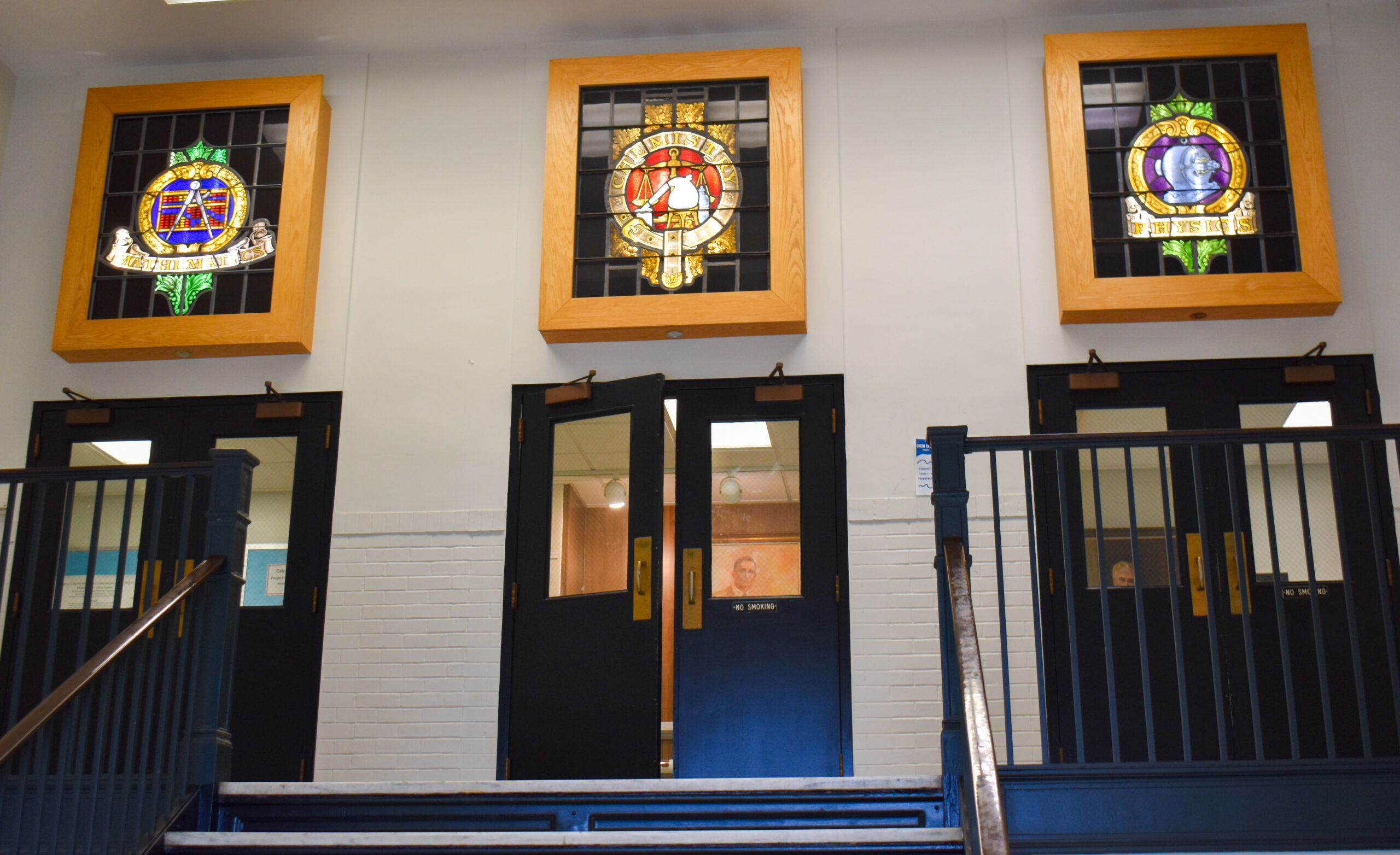
Starting last fall, Muhlenberg debuted a new curriculum Pathways for Discovery (Pathways) for incoming first years. This change was introduced as a way to fulfill Muhlenberg’s promise of leading students “from exploration and discovery to depth, integration and application” by focusing on core themes rather than specific academic fields, as per the College’s website. Overall, Pathways has a total of seven content areas known as the Explore Core that span across disciplines in addition to the First Year Seminar (FYS), one Writing Intensive (W) and one Quantitative & Symbolic Reasoning (RG). For instance, Humans, Histories and Social Structures (HS) could potentially be fulfilled with courses in the Media & Communication, Anthropology or Sociology departments. Upperclassmen following the old General Academic Requirement (GAR) curriculum must complete 18 courses. Now that the new curriculum has been in effect for a full semester, students and faculty are able to reflect on the differences between the required curriculum for first-years and upperclassmen so far. It is worth noting that there are still aspects of the curriculum–such as what will or will not count towards the Integrative and Experiential Learning (IEL) requirement–that are being developed.
The Curriculum Committee (CC) oversees structural changes for courses, majors and minors, with their primary focus for the 2024-2025 year being the integration of Pathways for the class of 2028. Christine Ingersoll Ph.D. and Ross Dardani Ph.D. serve as co-chairs of CC, jointly sharing their hopes for the program. “While it is early to determine how the new curriculum is impacting first-year students, currently a formal plan is being developed to assess the Pathways curricular elements. We are hopeful that the decreased footprint will give students more flexibility in their schedules for exploration (beyond required curricular elements), making it more doable to double major or minor or take advantage of other exciting curricular elements.” They noted that CC has approved over 240 Explore Core designations thus far. Frederick Wright Jones, who also serves on CC, agreed that the program offers students an opportunity to explore: “I think it provides most students with more flexibility and diversity of subject matter while also hitting key educational points.”
One of the most notable changes to the requirements is that the class of 2028 and beyond only has one required W course rather than the two credits upperclassmen must fulfill. Joshua Barsczewski, Ph.D. serves as director of the Writing Program and member of the Curriculum Committee. He shared his experience contending with the new curriculum as he created the content for his courses this year. “I have optimism that the Pathways Curriculum will create opportunities for teachers to rethink their courses. Making the requirements not discipline-specific can be very freeing. For example, last semester I taught my English language class as an HS even though most of the Explore Core courses offered in my department are CE [Representations and Creative Expression]. As I designed the syllabus, I paid a lot of attention to how my course content and the course design were hitting the goals of the HS. I could have taught that topic as a CE or even an MV (Meaning and Value), but it would be a radically different experience, a radically different syllabus. That’s what’s exciting here – as teachers, we get an opportunity to think not just about our content, but about how our content is contributing to the larger curriculum in an intentional way. My only complaint about the new curriculum is that it doesn’t have enough writing for my taste.”
For some first-year students, the changes have impacted their academic plans. Vridhi Chhabra ‘28 expressed her concerns: “I was planning to [graduate early] before, but then after I got here and I found out about the curriculum change, I found out that I’m not able to anymore because of the [requirements] and how they don’t accept my AP [Advance Placement] credits. Even if I take summer classes and stuff, it just doesn’t work out in any way.” While researching the intricacies of the Pathways program, it should be noted that the College does accept AP credit, but they do not fufill Pathways requirements. Similarly, Zachary Cohen-Neamie ‘28 shared his experience: “I came into Muhlenberg with a lot of AP and IB [International Baccalaureate] credits, but I wanted to study abroad and also graduate early, but I can’t do both because of the [requirements].”
Beyond course content, the new curriculum structure has also changed the advising process. Speaking on the course of action for students attempting to graduate early, Associate Professor of Biology Giancarlo Cuadra, Ph.D. noted, “We’re not trying to get students to pick courses that fulfill more than one general academic requirement, because we can’t do that anymore.” For example, a first-year student who took Cultural Anthropology shared that while the course was marked as both a GP (Global Perspective) and a HS, Workday only counted the credit towards GP. If a course is marked for more than one Explore Core credit, it is unclear how Workday determines which credit it counts towards. Cuadra also pointed out that while in the previous GAR system some courses count toward multiple requirements, their availability varies by semester and that in most cases, the newer curriculum makes graduating early easier.
“That’s what’s exciting here—as teachers, we get an opportunity to think not just about our content, but about how our content is contributing to the larger curriculum in an intentional way.”
Associate Professor of English Linda Miller, Ph.D. sees the shift as an opportunity for more academic freedom: “There’s more opportunities for students to play as they move through their four years here because there are fewer graduation requirements. Overall, the advising focus now is on enrolling [in] courses that you are truly interested in and less on merely completing graduation requirements. As an adviser, I would want my students to take courses that align with their interests, their curiosities, areas that they’ve never explored before and want to explore.”
There are many students who appreciate the curriculum’s emphasis on exploration. Jonah King ‘28 is supportive of the change, saying, “I’m a fan of the [requirements] – they encourage us to explore different disciplines that we wouldn’t otherwise study, and it’s good to be a well-rounded student.”
Upperclassmen, on the other hand, do not see a major shift despite how different Pathways seems compared to the old GAR curriculum. Cathy Tran ‘27 shared, “With the new system having no overlapping [requirements], I think it just makes it easier on being able to register for classes most likely, since students won’t be trying to fight for the ones with multiple [requirements] in order to try to finish them all.” She continued, “I’m not too sure [about] preference on my part, but I feel like it kinda balances out with each [requirement] only fulfilling one course, as opposed to one course fulfilling multiple requirements with the old curriculum. So to me, I feel like time to dedicate classes towards one’s major hasn’t really changed in that regard.”
With the new system emphasizing thematic exploration over specific disciplines, students may enjoy more flexibility for double majors, minors and electives. As a result, advising has shifted toward prioritizing student interests over fulfilling multiple GARs at once. Opinions on the new system vary, with many students and faculty seeing the curriculum as a positive step toward a more well-rounded education and others expressing concerns about credit limitations and early graduation challenges.

Alexandra Downey ’27 is an English & Creative Writing and Media & Communication double major. She is incredibly excited to be Editor-in-Chief! She enjoys playing tennis, rereading everything on her bookshelf, and showing off pictures of her dogs.

Tony '28 is a biology major. When he's not in class or writing for the Weekly, he's usually doing some research, reading a book, or lowballing on Grailed.