



















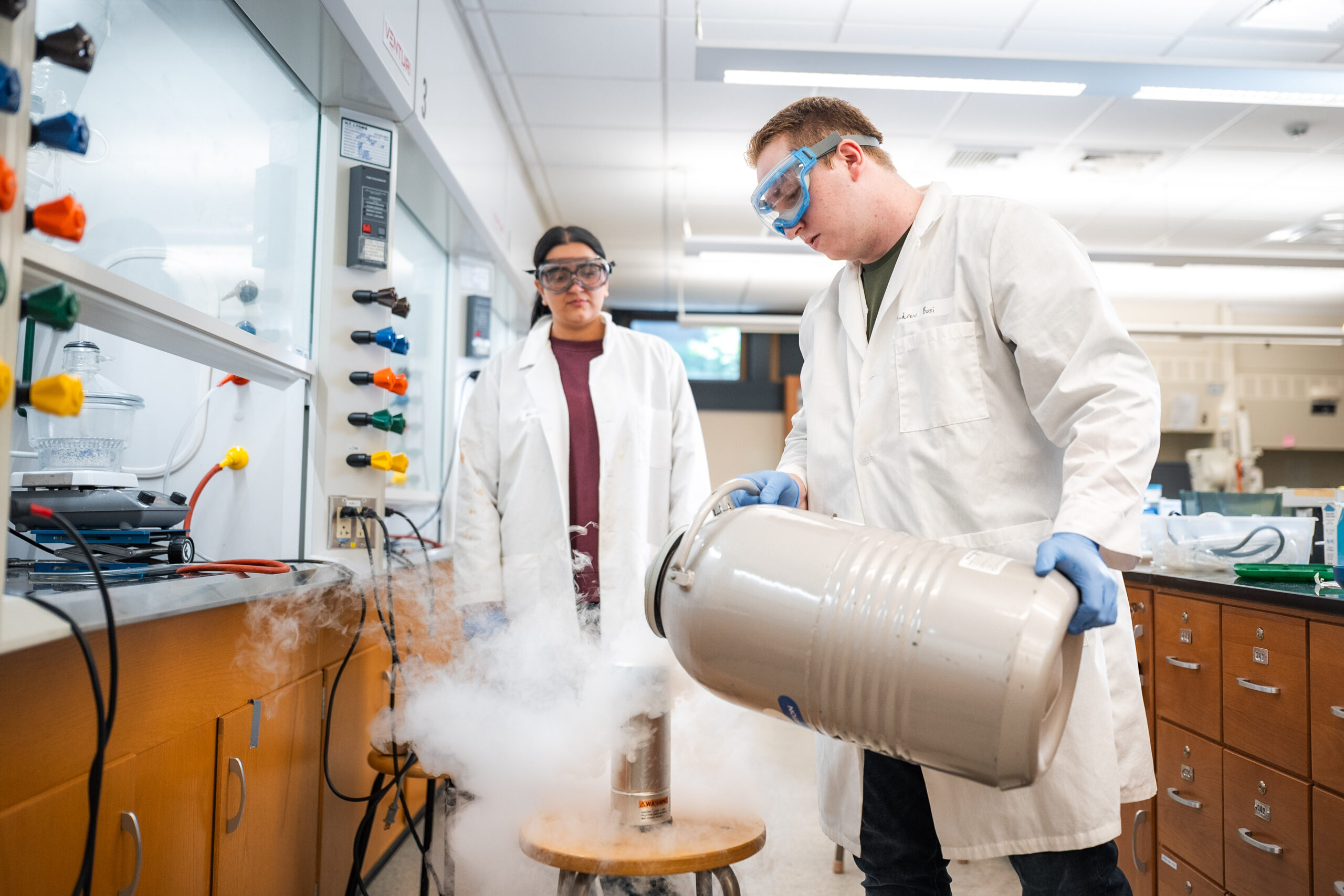
The eighty-ninth Intercollegiate Student Chemists Convention (ISCC), held at Ursinus College on April 18 brought together undergraduate researchers from over 35 colleges across the region for a day of formal presentations and scientific exchange. Held annually, the conference offers students the opportunity to present original research in what participants described as a “welcoming but competitive environment,” blending the rigor of science academia with a supportive undergraduate environment.
This year, student presenters Nicholas Servidio ‘28, Andrew Bosi ‘27 and Monica Mulhern ‘26 represented Muhlenberg College alongside Adjunct Professor of Chemistry Robert Fuller. Additionally, Assistant Professor of Chemistry Juan Duchimaza served as a conference judge. Together, their experiences highlight how the ISCC functions as a space where technical research meets one of the most essential scientific skills: communication.
For many students, the ISCC represents a shift from classroom learning and presentation to professional scientific discourse. Fuller explains that at such a conference, audiences range from experts in the field to peers with little background knowledge, and “you have to be able to communicate with people who understand the subject minimally,” while also communicating with “people who directly know that kind of work and can ask very detailed questions. They say if you really understand a subject, you should be able to explain it to a person who doesn’t know the subject.” He lauds that “Muhlenberg is a liberal arts college, so students tend to be very good at presenting whereas some of the other schools may be more scientifically specialized– so they may be more knowledgeable… but not as good presenters.” He expands on this, saying that when a Muhlenberg student enters the working world, their strengths may be noticeable.
This transition from classroom to conference was palpable in Servidio’s experience. A biology major conducting research in analytical chemistry, Servidio’s project focused on quantifying galaxolide bioaccumulation in earthworms under varying soil conditions. “We used analytical methods to determine how much of a certain chemical [galaxolide] is absorbed into worms,” he explained, describing a project that bridges environmental science and chemistry. Servidio became involved after Fuller invited him to join the lab, drawn by the opportunity to develop practical research skills. “Independently creating and testing samples, working with large data sets and conducting statistical analysis are all skills important for any student involved in research,” he said.
At the ISCC, Servidio found himself in the environment of a professional conference: “It was similar to a professional scientific conference, providing a challenging but supportive platform to showcase original chemistry research.” Unlike classroom presentations, where expectations are often limited to demonstrating understanding, conference presentations demanded both depth and adaptability. “This presentation required a much more extensive rehearsal, and required an overall deeper understanding of the content… Ensuring that I was prepared to answer difficult questions was also important.”
The feedback he received ultimately reshaped how he approached his own work. “It prompted me to improve how we are framing our overall project and explanations of complex topics,” he shared. Beyond his own presentation, the conference also offered opportunities to learn from others: “Interacting with students and faculty was a great opportunity because it allowed me to learn from more experienced upperclassmen and professors.”
Bosi, a biology major with an Italian studies minor, approached the ISCC from a different research background. Working with Professor of Chemistry Joseph Keane on organometallic chemistry, Bosi’s project focused on modifying molybdenum-based systems to better control reactions involving aromatic molecules. He explains, “We are designing a new tool that can be used by synthetic chemists to make pharmaceuticals… with greater control of stereochemistry.” Unlike Servidio, Bosi was recruited directly into the lab by Keane. “Dr. Keane reached out to me and asked me if I was interested,” he shared. “We were able to create new novel compounds that could be further explored in the future.” Additionally, as a biology major, he found it especially appealing to do interdisciplinary research in chemistry.
Bosi described the ISCC as a uniquely demanding format, where “it was a competitive solo presentation that only allowed for 12 minutes,” he said, forcing him to prioritize discussing his results over his background information. This transition from classroom to conference, for him, was stark. “In a classroom you are presenting to your friends and peers… At a conference, there is a large chance you do not know anyone in the room.” He adds that as opposed to a knowledgeable professor who teaches a student’s class, in a conference “you are being judged by people who may not know anything about your research.” Compressing eight weeks of work into a brief presentation was a real challenge for him.
Observing other presentations proved to be an intellectually rewarding experience for Bosi. He notes, “I immediately noticed similarities between my research and theirs… There were definitely new ideas that could be brought to the table.”
Both students emphasized the importance of mentorship in shaping their research and presentation skills. Servidio credited Fuller, saying he “taught me invaluable skills and knowledge that I will use throughout my academic career.” Bosi similarly highlighted Keane’s role in designing and guiding the project: “He really gave us the tools necessary to get started.” In addition, Mulhern played a key role as a peer mentor to Bosi in the lab, helping guide experimental techniques and procedures. Together, this layered mentorship structure reflects the collaborative nature of undergraduate research, where faculty direction and peer support worked together.
Tony '28 is a biology major. When he's not in class or writing for the Weekly, he's usually doing some research, reading a book, or lowballing on Grailed.