


In an era known for its technological advancements and societal opportunities, one might expect modern culture to openly move forward when addressing diverse ideas. However, discussions at the recent “Banned Books Panel” held at the Trexler Library suggest that we may be moving backward instead. This stark reality is reinforced as book bans continue to take over public education and the grounds for censorship are controversially disputed.
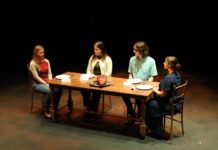
On Sept. 29, several panelists took to the stage to have a dynamic discussion and to share unique perspectives regarding the current implications of book censorship. The esteemed group of panelists included three Muhlenberg College professors: Professor of Philosophy Tad Robinson, Ph.D., Assistant Professor of English Joshua Barsczewski, Ph.D. and Associate Professor of Political Science Ross Dardani, Ph.D.. The other panelists were Molly Margo, a high school librarian, and Josh Berk, executive director at Bethlehem Area’s Public Library. The panel was moderated by Tina Hertel, the director of the Trexler Library, who facilitated a concise dialogue that addressed themes such as fear-mongering, government roles, intellectual freedom and prevention.
The panel began by establishing that book bans would be referred to as “book challenges” to remain open to differing perspectives. As the discussion unfolded, panelists articulated their views on why book challenges should be of concern for college students. Margo emphasized that college is the time we start deciding what is important to us, particularly in a society that suppresses certain ideas out of fear. “College students should care because we want to set out and correct these things and make a positive impact,” she states. Berk pointed out that many book challenges are financially supported by large corporations who aren’t actually aware of the content within the books they oppose. He urged college students to take initiative in reading these books and engaging in informed discussions with those less educated about the content.
The role of large corporations inevitably led to a discussion about government involvement in censorship and the preservation of intellectual freedom. Robinson emphasized that there are two spectrums of belief regarding governmental involvement: either they’d play a role, or play no role at all. Dardani then provides the perspective of the Supreme Court and concerns raised by states regarding students’ exposure to certain content. School boards are not only banning books but also entire school curriculums, such as critical race theory and sex education, which Barsczeweski asserts could serve as a cover for racist or white supremacist agendas with the statement, “You can’t say you hate gay people without ending up on Fox News.”
Then to further stimulate the discussion, Hertel probes the possibility of balancing censorship and intellectual freedom. Originally, book banning was a form of governmental control over what information was accessible by the general public. Robinson provides an insightful perspective on how everyone, to some degree, believes in censorship particularly when it comes to protecting certain age groups from information. For instance, no library will provide a kindergartener with access to pornography. Thus, censorship shouldn’t be viewed as a binary term but rather a discussion on when it becomes a problem. Margo stressed that it’s also important to acknowledge how, “We can never assume a person’s lived experience,” and to consider how some information might be relevant to one person and not the other. Instead of questioning the content of a book itself, she argued, the focus should be on understanding the importance of that content and its potential effects on different individuals. In fact, Berk shared that “One book that could give someone else nightmares could inspire someone else in the exact opposite way.” To prevent the suppression of intellectual freedom, Barsczewski notes that critical reading skills are essential to understanding the importance and nuances of different texts. He further points out that individuals who are concerned should read the stories and concepts being deemed as dangerous to have discussions.
“We can never assume a person’s lived experience” – Molly Margo
As the conversation neared its conclusion, attendees had the opportunity to pose questions. One participant inquired how the panelists’ librarians felt about their struggles when addressing individuals concerned about a book’s content. Margo expressed how uncomfortable she would feel when discussing banned books at her school again, noting that the COVID-19 pandemic contributed to a rise in book banning. Another attendee questioned how acceptable censorship would work against hate speech within books and gave examples of access to Hitler’s ideologies. Dardani responds by pointing out how there’s a difference in what information is accessible in libraries at middle schools, high schools and colleges. Once again, the importance of critical reading skills emerged as essential, as individuals must be equipped to learn from potentially harmful information.
After the panel, Joy Hanson ‘27 stated what had stood out to them most was the different perspectives the attendees were able to hear. For example, there were not only college professors on the panel but also librarians who have been impacted the most by censorship. Hanson had heard about the panel from a friend and left it feeling more “knowledgeable on the topic” and will further use said knowledge to “prioritize learning over confidentiality.”
Overall, the “Banned Books Panel” illuminated how complex and nuanced the current ongoing debate surrounding censorship in society. The diverse perspectives provided by the panelists emphasized the necessity of nurturing one’s critical reading skills, encouraging respective dialogue and remaining aware of suppression against intellectual freedom. Attendees were reminded of their own forms of personal censorship and how it’s important to understand that a book’s content might influence others differently depending on personal experiences and backgrounds. We live in a time where our culture boasts its freedom yet our access to information is being threatened by movements such as book censorships. The panel’s discussion served as a wake up call for students, educators, and community members to realize how to actively identify oppressive censorship. In hopes to ensure individuals can live in a society where stories and personal experiences can freely inspire others and change our culture for the better.

