



















On Sept. 2, the College Viability YouTube channel posted a video giving an overview of Muhlenberg College’s financial health. Through their website and for-purchase apps, College Viability provides financial health consultations for higher education institutions, using a database that consists of information collected from the public financial records of over 1,200 private four-year colleges and universities. Some of these financial records include the Integrated Postsecondary Education Data System (IPEDS), which gathers information from every higher education institution that participates in federal student financial aid programs, and the Internal Revenue Service (IRS) Form 990, which is required by federal law to be publicly disclosed.
The video Muhlenberg was featured in was one of nearly 100 episodes of the College Financial Health Show co-hosted by Gary Stocker, founder of College Viability, and Matthew Hendricks, founder of Perspective Data Science, a data analytics and consulting firm. In each episode, Stocker and Hendricks use College Viability’s website and the database that Hendricks built to compare higher education institutions to the national median, identifying areas of concern and improvement. All schools featured are submitted via request through the College Viability website that is open to the public.
In Muhlenberg’s episode, Hendricks identified the following concerns for the College’s financial health: “So we’ve got like seven indicators now that Muhlenberg has trouble. You know, we’ve got deficits for several years in a row, we have big endowment draws which make the deficits even bigger than what I’m showing. We have net asset growth that’s sluggish. We have endowment growth that’s sluggish. We have operating revenues that are declining. We have [capital expenditure (CAPEX)] depreciation that is not ideal. The value of their property and equipment is decreasing instead of increasing like the vast majority of higher ed[ucation]. So all of this is to say Muhlenberg needs to make some adjustments.”
In the video, the two hosts also discussed Aurora University in Aurora, Ill. According to Hendricks, Aurora has adopted the strategy of keeping tuition low and steadily increasing enrollment size. Stocker and Hendricks often feature two schools in the same video, but not necessarily to make a direct comparison. Hendricks clarified, “We weren’t really comparing Muhlenberg and Aurora as much as we were comparing both schools to the national median, twenty-fifth percentile, seventy-fifth percentile of all private four-year colleges in the U.S.”
College Viability was first formed in 2019 and initially focused on providing consultation for college administrations, but in recent years they have turned their focus towards a different audience that includes students, families, alumni and college counselors. Stocker previously served as the chief of staff for Westminster College, where he states that college consultation businesses like College Viability did not exist. “Students and their families need to be aware that there are many, many both private and public colleges whose financial health is perilous. Now that’s not the case at Muhlenberg, but that is the case in many other Pennsylvanian private colleges, and public colleges around the country.”
“Students and their families need to be aware that there are many, many both private and public colleges whose financial health is perilous. Now that’s not the case at Muhlenberg, but that is the case in many other Pennsylvanian private colleges, and public colleges around the country.” – Gary Stocker, founder of College Viability
However, Muhlenberg’s administration believes that the video is a cursory look at a much more complex issue. Chief Financial Officer (CFO) and Treasurer Curt Topper responded, “The uses only publicly available data and does not consider important context, such as the impact of one-time capital expenditures or the recent success of the Boundless campaign which generated more than $127 million in philanthropy for the College.” In the video, Hendricks also notes that Muhlenberg spends roughly $8,000 per student on dining services per year, which in his rough estimate places the College in the top five to ten percent of food service contracts for higher ed institutions in the nation. Hendricks claimed that in comparison, the average college spends around $1,500 on dining services.
Topper pointed out many of the changes Muhlenberg has made in the past few years. “Since 2023, the College has been working aggressively to scale its staffing and other resources to the College’s current and projected size. In 2024 the College restructured long term debt to take advantage of more favorable rates and improve cash flow. In summer 2025 the College formed two task forces to study and recommend innovations and efficiencies in the academic program and administrative functions, identifying a range of new cost-saving measures. In 2025 and 2026 the College is developing a number of revenue-generating efforts to augment income from tuition, fees and philanthropy.”
In fact, staffing was one of the primary areas for improvement identified by College Viability. Stocker stated, “Staffing is staying higher despite the fact that there are fewer students attending Muhlenberg.” According to their data, Muhlenberg is down 31% on net tuition revenue whereas the national median is up 1.5%. The College’s total W2 Employees Count is above the seventy-fifth percentile, spending $41 million on payroll in 2024.
President Kathleen Harring weighed in, stating, “While conditions for colleges and universities across the country are turbulent, the College retains the advantage of a $330+ million endowment with ample unrestricted assets. As many peer institutions are doing in these times, Muhlenberg is making changes to ensure sustainability now and for generations to come. I’m confident that the College will continue to evolve in fulfilling our mission to provide a powerful education for our students.”
“While conditions for colleges and universities across the country are turbulent, the College retains the advantage of a $330+ million endowment with ample unrestricted assets. As many peer institutions are doing in these times, Muhlenberg is making changes to ensure sustainability now and for generations to come.” – President Kathleen Harring
According to Stocker and Hendricks, College Viability’s work is meant to prevent institutions from closing by identifying possible areas of concern early on and making suggestions for financial improvement. Hendricks elaborated, “To be clear though, Muhlenberg is not at risk of closing. The school has over $260 million in unrestricted net assets as of FY2024 (fiscal year 2024). Even if Muhlenberg ran at a deficit of $8 million every year (which was its 2024 deficit), it would likely be able to sustain those losses for over 30 years. So there is no need to worry as a student at Muhlenberg. You may need to worry about Muhlenberg in the future though with its current trajectory.”
Hendricks’ main concern with Muhlenberg is the College’s longevity, pointing out that “the longer the deficits go on, the further Muhlenberg will fall behind peers and competitors that do have balanced budgets and are growing their unrestricted net assets.” However, Stocker was careful to stress that Muhlenberg’s financial health is also reliant on the state of the national economy and higher education as a whole. “Muhlenberg is a local symptom of a national problem,” Stocker stated. This is in light of federal policy changes that seek to alter the landscape of higher education, as well as initiatives specific to Muhlenberg College, like a task force being formed over the summer to make recommendations for academic changes in hopes of making improvements to the financial state of the College. These adjustments, also including changes to dining services and the offering of a voluntary early retirement program, seem to guarantee major institutional changes in the College’s future.
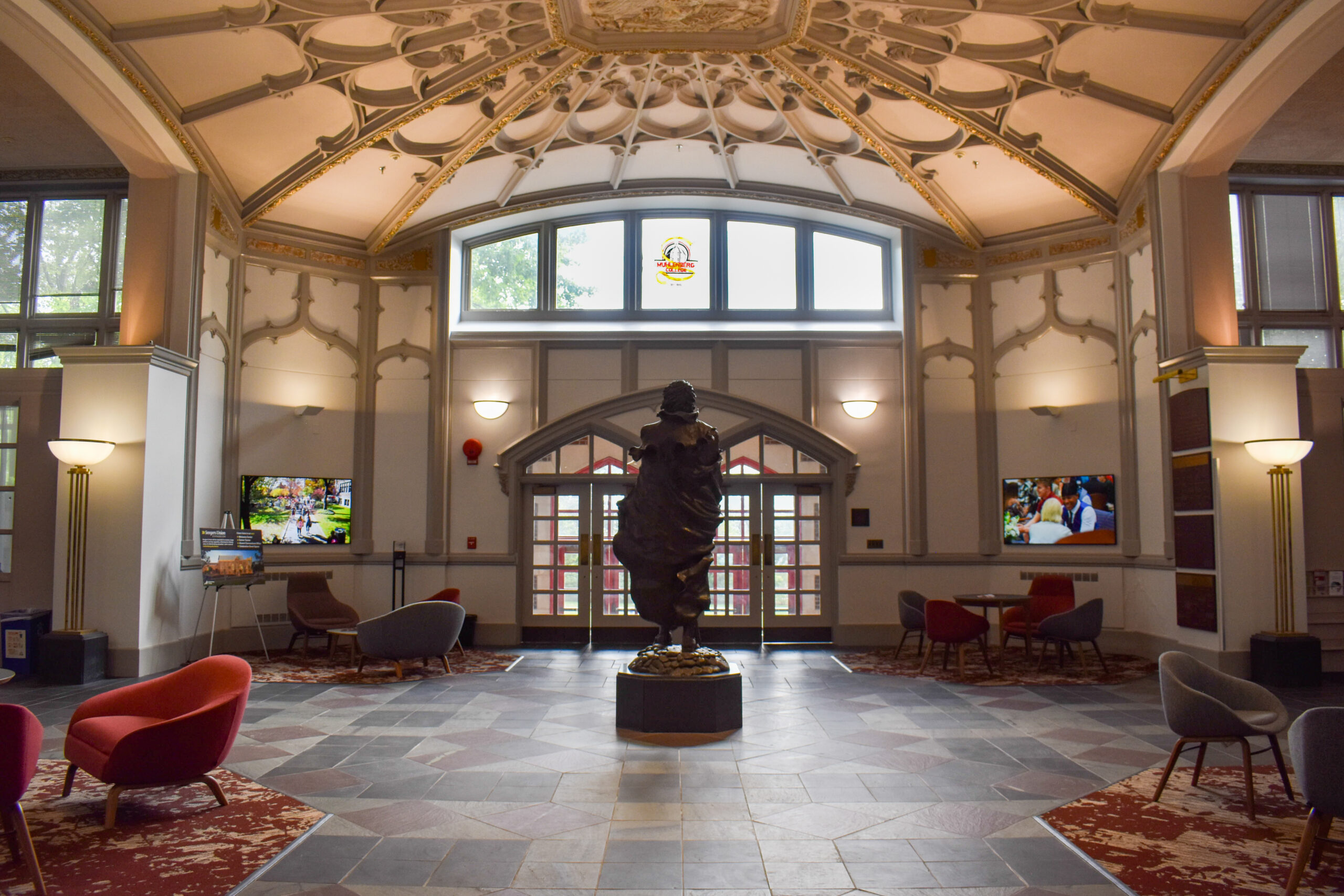
Photo by Kira Bretsky ’27.

Alexandra Downey ’27 is an English & Creative Writing and Media & Communication double major. She is incredibly excited to be Editor-in-Chief! She enjoys playing tennis, rereading everything on her bookshelf, and showing off pictures of her dogs.