


















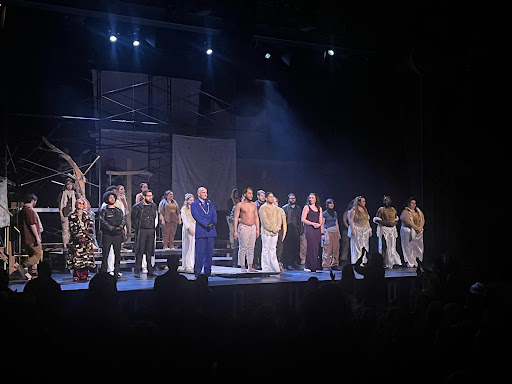
Under the haze of stage lights and the pulse of a live rock band, the Civic Theatre’s production of “Jesus Christ Superstar” didn’t just retell a biblical tale; it rebuilt it and dared the audience to look closer. Dami Shote ’28, Samantha Temkin ‘25 and Audience Services & Company Manager Maya Costanzo were in the cast, as well as powerhouse leads Diego Subero-Butler as Jesus and Alejandro Rodriguez as Judas. The show also starred the Career Center’s own Catherine Ritter as Mary. This modern retelling of Andrew Lloyd Webber and Tim Rice’s 1970s rock opera exploded with spiritual grit and emotional nuance.
I didn’t just watch this show, I lived in it for two hours, ushering audience members to their seats before being absolutely floored by the performance. I had the privilege to interview some of the actors while learning more about the roots of this theatrical phenomenon and its history.
“Jesus Christ Superstar” first took the stage in 1971, and let’s be real – it rocked a lot of boats. Written by Rice and Webber (whose prior hit, “Joseph and the Amazing Technicolor Dreamcoat” turned biblical stories into musical form) “Superstar” broke tradition by telling the story through Judas’ eyes.
This Civic Theatre production honored that legacy, and it wasn’t just another retelling. It was a challenge to conventional portrayals, an invitation to see Jesus and Judas not as statues, but as fragile and faithful humans. And it wasn’t just the story that stunned the audience. The staging was deeply immersive: Actors moved through aisles, live guitars shredded on the different levels of the stage and a massive tree loomed stage right that was part Garden of Gethsemane and part symbol of decay and rebirth.
Alejandro Rodriguez’s performance as Judas was volcanic. I sat down with him after the show to talk about what it took to bring that kind of emotional dedication to the stage. Alejandro said “as soon as I saw the announcement, I knew I had to audition”… “this story right now deserves to be heard and hopefully we helped a couple of people feel a little less alone in these scary times”
Rodriguez didn’t shy away from the discomfort baked into the role. Instead, he leaned in with heart by saying, “I came to Judas with a clear lens and a willingness to listen to what he was actually saying. Judas took no joy in the role he played. He loved Jesus, he loved his friends and he loved his people.”
The audition process, as he put it, was a gauntlet. For him it was “Terrifying. The dance call? My least favorite. And being the only one called back for both Jesus and Judas was vocally draining.” He chose Raise a Little Hell from “Bonnie and Clyde” for his audition – “a glimpse of my boy Judy before I officially had the role.”
Diego Subero-Butler brought a tenderness to Jesus that felt real in the best way.
“I’ve done the show twice before – in ensemble, and as Peter,” shared Subero-Butler. When I saw Civic was doing it, even though I live over an hour and a half away, I knew I had to go for it. When I got the callback and found out I got the role… I stopped my car on the side of the road and was literally screaming on my way to Beauty and the Beast rehearsals.” On preparing for the part, he continued, “I would’ve started vocal work earlier. I didn’t have time to prep before rehearsals. By the time I did, I had to figure out how to sing this without wrecking myself. It’s so vocally demanding.”
Subero-Butler’s Jesus wasn’t just about hitting notes. He spoke about approaching the character with a kind of radical love. “Everything in the show happens because of love. Between a leader and his people. Between two brothers. Between Mary and Jesus.”
Both Diego and Alejandro opened up about rehearsal challenges. Rodriguez wrestled with Judas’s voice and “finding a balance between doing what’s written, honoring past Judases and still making it mine.” The hardest part? “Judas’ death. The first day we staged it, I cried the whole way home.”
Subero-Butler’s biggest hurdle was vulnerability. “The crucifixion scene was tough,” he explained. Being up there, arms outstretched, shirtless, exposed. I had to not hold back, even in rehearsal.”
“Love is the thread. That’s what ties all of this together-then and now.” – Diego Subero-Butler
The connection between them was key. “We clicked from callbacks,“ Rodriguez said. “It was the thought of betraying [Subero-Butler] – as a real person – that helped me go so deep.” Subero-Butler echoed that: “By closing weekend, it felt like we really were these characters for two hours.”
Dami Shote ‘28 played an Apostle and was a part of the large ensemble. He explained this ensemble to be “very welcoming and I quickly got to know everyone in the cast, at first starting the rehearsal process from the big musical numbers to small.” When asked about difficulties that arose during rehearsal, Shote answered “the final dance sequence was a lot physically and conditioning myself to do it fully and over the top took a lot of muscle and meant being in shape for the show… it took a lot of growth and I found to be pretty challenging.”
So why does “Jesus Christ Superstar” still land in 2025? Because it’s messy. Because it’s loud. Because it’s not afraid of the gray areas. As Rodriguez said, “Our show proved that everyone is welcome in the theatre. We had openly gay Latino leads. Nonbinary cast members. People in their 40s and 50s doing this for the love of it.” Diego added: “Love is the thread. That’s what ties all of this together – then and now.”
As someone who grew up with a spiritual background, this show didn’t replace faith. It reframed it. It showed me that doubt, struggle and heartbreak are part of the story, not the end of it. “Jesus Christ Superstar” challenged me to see holy figures not as gods on pedestals, but as humans in crisis – who still chose to love. And that, frankly, makes them even more divine.

