



















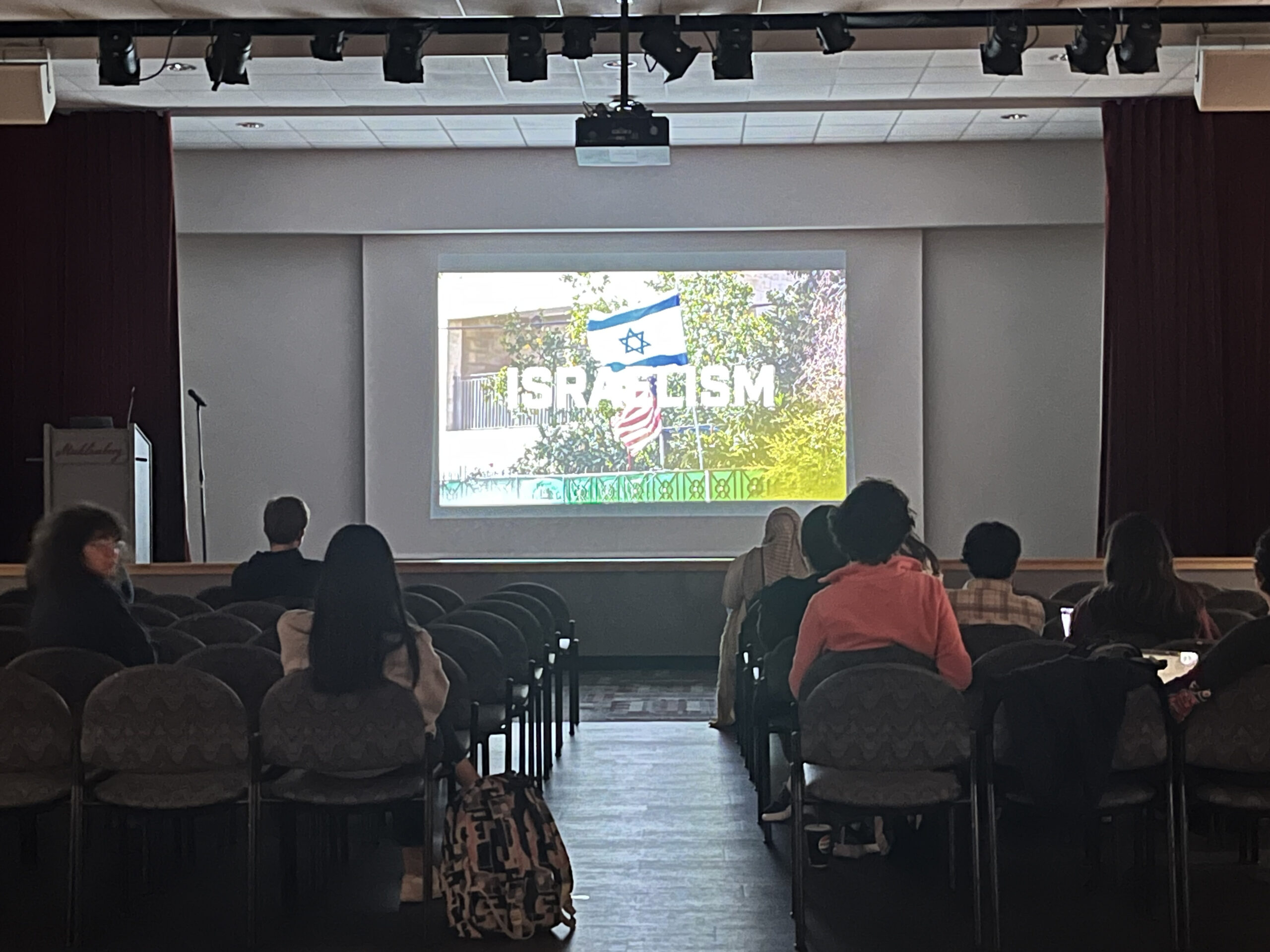
“Israelism” (2023) is a documentary that unpacks the American Jewish experience in the Zionist Jewish education system. The film follows two Jewish Americans who were raised as Zionists, yet upon going to Israel and seeing the treatment of Palestinians, they are inspired to join the Free Palestine movement.
Jewish Voices for Palestinian Liberation (JVPL) hosted a screening of the film on Nov. 19, along with a Q&A with professor of history Mark Stein, Ph.D. “What I’m hoping the Muhlenberg community can get out of this event,” said Milo Obrzut ‘25, one of the founding members of JVPL, “is a deeper understanding of why so many young Jewish Americans have become involved in the movement for a Free Palestine.”
“Ever since we formed JVPL last year, we knew that an ‘Israelism’ screening was something that we wanted to do,” said a member of JVPL who wished to remain anonymous. “The other organizers and I have seen the film and deeply resonated with it as Jews who support the movement of Palestine. I think that the film does a great job at depicting why and how Jews are mobilizing in the movement for Palestine, something that’s deeply important for people to see right now.”
“It can feel like a lot of the momentum kind of died down in intensity after last semester when there was just a lot of action that happened publicly, so we wanted to make sure people are still thinking about the conflict and about what they can do,” said Ian Graybill ‘26, one of JVPL’s four lead committee members.
“I think the film is a very well-done examination of how a pro-Israel viewpoint has become so embedded in American Jewish life, especially in day schools and afternoon Hebrew schools,” said Stein. “I think it helps people who grew up in those communities see it from another angle and begin to think about it more analytically. It is important to understand all views of the situation in Israel and Palestine and this film is a good entry point to discussing how it has been framed in American Jewish communities.”
The film primarily follows Simone Zimmerman, co-founder of the IfNotNow Movement, and Eitan, an American veteran of the Israel Defense Force (IDF). Throughout the film, they talk about their Zionist upbringing and how they began to question Zionism when they saw first-hand the treatment of Palestinians.
When Zimmerman came back to America after visiting Israel and Palestine, she began advocating for Palestinians. “Initially it was very shocking and painful for a lot of people. I had friends from high school and from college who didn’t know how to speak to me in the beginning because these conversations were forbidden to us growing up,” said Zimmerman in the film. “I’ve grown up very much as a product of this mass mobilization to ensure that young people stay engaged in pro-Israel politics. For most people I know who actually took the time to see with their own eyes what was happening, it very quickly challenges everything we’ve been taught. It’s very painful because it is so intimately bound up with the identity of the community.”
While the film has received several awards, it has received backlash and calls for cancellation of its screening on college campuses. Scheduled screenings at Yale University, Hunter College and the University of Pennsylvania were canceled due to pushback from Zionist organizations. At Muhlenberg, however, “The college has so far been supportive of our efforts to show the film,” said Obrzut. “Although it’s clear that pushback they’ve received (mostly from groups outside of the college) has led them to take certain precautions with this event they might not take for other events that are less controversial.”
The screening went on without protest. “We’ve had some issues with alumni and parent groups in the past so that’s not super surprising, but people on campus were generally pretty receptive to it, or at least didn’t publicly interfere, which I appreciated,” said Graybill.
During the Q&A portion of the event, a main point of discussion was how difficult it feels to have open conversations with those of different viewpoints regarding the conflict on campus. “I think that’s a big problem,” said Stein. “I think that it’s a big societal problem, I think that it’s a generational problem and I think in some ways it is also a Muhlenberg problem, that people don’t want to say things that are going to upset people they know, so they stay away from difficult conversations… But I think having those conversations is the only way to talk about it, and the way to do that is to make spaces where people can feel comfortable to, and that can make time. You have to work for it.”
“This was my third time watching the film,” said an anonymous student, “and this time what really stood out to me was support for Israel driving the connection between American Jewish institutions and right-wing political organizations. Especially after the election, it’s a reminder of how dangerous it can be to replace real concerns of Jewish safety with support for Israel. It definitely brought up the fears that I had for Jewish safety during [Donald] Trump’s last presidency. Watching this film again during this political climate reaffirmed the notion that we are safe through solidarity and [that] Jewish and Palestinian safety is intertwined. I’m glad we were able to bring this film to Muhlenberg and I hope that everyone in the audience learned something and was able to take something away.”
Stein stressed the need for these kinds of events on college campuses. “Many people on campus feel passionately about what happens in Israel and Palestine from many different viewpoints. I think it is important for there to be opportunities to engage with people who may not hold the same positions you do. A college education, especially a liberal arts education, should be focused on encountering a wide range of ideas, even those with which you may disagree. That can be uncomfortable, but college is a great time to embrace sometimes feeling uncomfortable in order to learn.”

Keanna Peña '25 is the Editor-in-Chief of the Muhlenberg Weekly. She is an English and Creative Writing major with a minor in Dance. She is passionate about informing the student body and sharing her creative writing.