



















Throughout athletics, and particularly at the collegiate level, there are trials and tribulations that student-athletes face on a regular basis. Sure, finding time to compete and train as a part of an athletic team, while rarely missing any of that devoted time, is the clear first answer. However, from specified class scheduling to adjusting sleep schedules to cope with early workouts or walking around campus physically battered from competition, student-athletes need to develop additional skills and relationships to conquer off-the-field tasks. Yet, one task that has risen to the forefront from an athletic perspective is taking care of one’s mental health. At Muhlenberg College, there have been initiatives started surrounding student-athlete mental health, and administration involvement has certainly changed for the better, but one particular part of the campus community has emerged and excelled as a leading caretaker.
Head in the Game is an entirely student-athlete-run mental health group within the Muhlenberg community that focuses on specific mental health topics, issues, techniques or practices that student-athletes may come across or utilize in a multitude of capacities. What makes this club unique across the whole of the National Collegiate Athletic Association (NCAA) is that there is zero faculty involvement regarding the content and operation of the club. Members and executive board staff have made presentations and met with faculty about the club, but those faculty members have never decided what the club does on a weekly basis nor the club’s mission or values. Head in the Game is designed by student-athletes, for student-athletes, in an attempt to provide a space and community that takes the weight off of the shoulders of athletes who may feel pressure to ignore or suppress mental health topics.
“I think the most important impact Head in the Game has is its emphasis on tough conversations,” said Secretary Kaya Mahy ’25. “Some topics can be heavy or personal, but they are all shared experiences we have as student-athletes, and they must be talked about. They are not necessarily conversations people want to have with coaches and teammates, and they may want an outside perspective, and Head in the Game allows the space for that. I know from these tough conversations that I am often left self-reflecting on my own experiences, which I think is another important impact the club has on members. It creates the opportunity for student-athletes to learn more about themselves and grow as student-athletes.” Ideas of improving, competing and getting the edge on the competition are common things student-athletes often hear, and Head in the Game has always emphasized that mental health is a vital part of that improvement. The organization believes that mental health should be taken as seriously as film sessions, on-field practice or whatever else student-athletes may do as part of their respective teams.
Some within the club, like Co-President Kaitlyn Buurman ’25, describe the experience as one that grounds its members, demonstrating that Muhlenberg athletic peers are not alone in the toils that they may face. “Having a community of student-athletes that share their struggles and their triumphs is something that allows for me to recognize that this experience of being a student-athlete is one that does not exist in a vacuum or within my own experiences,” said Buurman. “Other people are physically and emotionally drained from their sport, are elated with the successes from their sport and feel every emotion in between. In a community like Head in the Game, the tough topics can be related to by members, but also given insight upon from someone that is not on my team. It is because of this that the group is grounding – it is a touch point each week where my club members turned good friends and I can chat about the highs and lows of our week inside and outside of sport, all the while sharing laughs and advice to inspire us for the upcoming week.” Head in the Game seems to highlight courage as the willingness to be vulnerable, thus building trust and rapport among members who have gone through something similar. The whole of Head in the Game feels greater than the sum of its parts.
After going around the room and sharing highs and lows of the week prior, the club often has a presentation or workshop planned that addresses specific student-athlete mental health-related topics to focus on and discuss. Some of those areas include battling through injury and recovery, time management as a student-athlete, mindfulness and visualization, self-talk on and off the field, relationships between teammates and coaches and motivation.
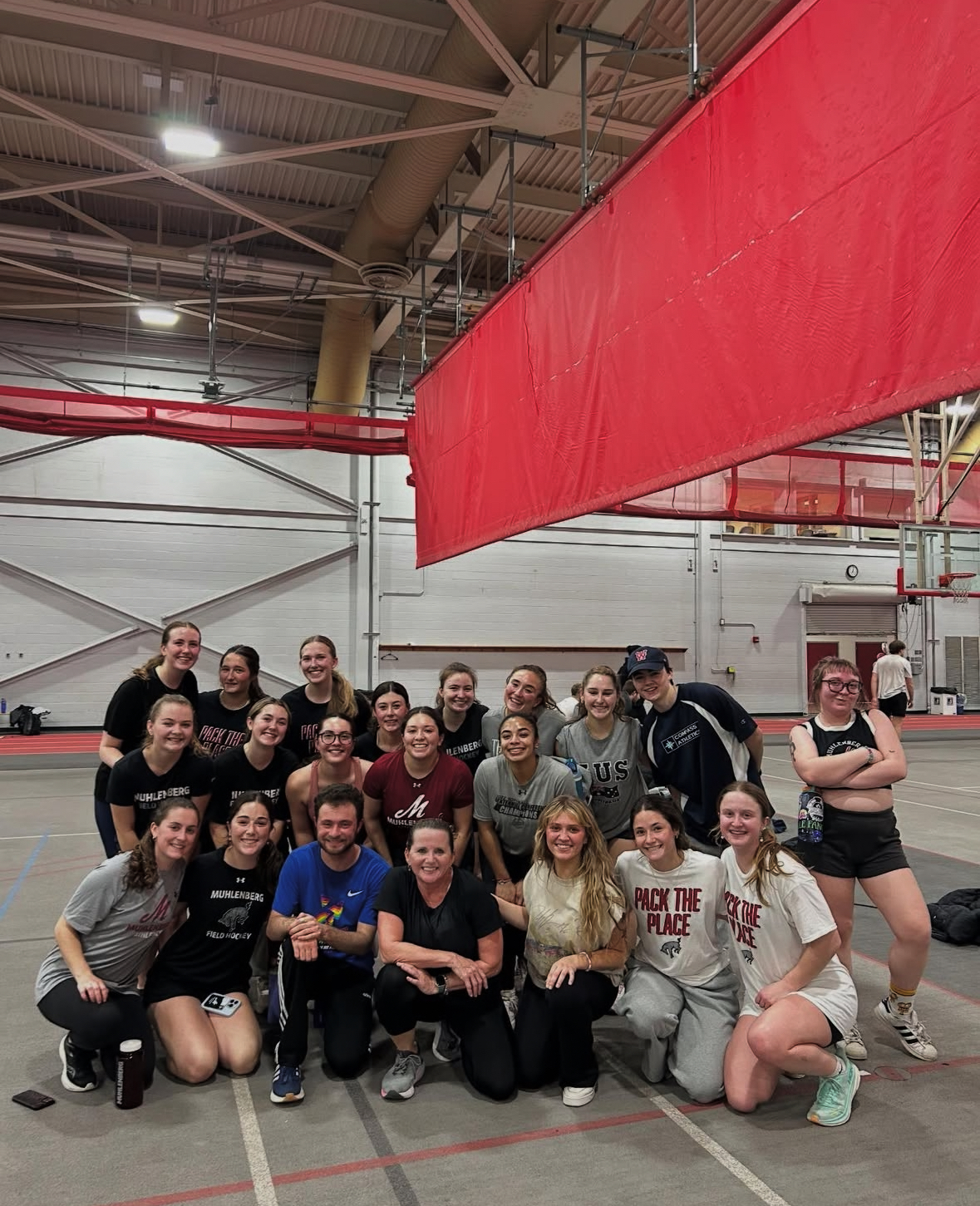
The club has also been expanding its reach and collaborating with other student groups on campus for some meetings. “We have been able to collaborate with many different clubs like Muhlenberg Peer Health Advocates, Body Positive and Voices of Strength,” said Co-President of Head in the Game Dani Roban ’25. “I hope that in the future, Head in the Game can keep expanding and reach more student-athletes on campus. Since my freshman year, Head in the Game has expanded so much in terms of members and events, and I can only hope that more clubs and people want to get involved in Head in the Game.” The club also worked with the Muhlenberg Dance Association for a Zumba class in the winter.
“I think the most important impact Head in the Game has is its emphasis on tough conversations,” – Kaya Mahy ’25
Some people are often described as thermometers – they read the environment around them and respond accordingly, changing and adapting to seamlessly integrate with the conditions presented. Some, however, are described as thermostats – those who, no matter what the previous conditions may be, stay true to themselves and alter the environment around them, not the other way around. Head in the Game appears to be a thermostat within the Muhlenberg community, an organization that sets the tone and temperature around the standards of taking care of student-athlete mental health. A beacon of possibility and growth, Head in the Game is showing no signs of slowing down, and it will be fascinating to see what pathways it continues to form as one-of-a-kind in collegiate athletic settings.
“If I were to return to Muhlenberg years down the road,” said Buurman. “I would hope to hear that Head in the Game is a club with great attendance from a variety of sports on campus, both male and female, and that community was continuing to be fostered. I would hope that standing meeting topics would be addressed like identity outside of athletics, time management and more that we student-athletes face, on top of collaborations and new meetings that the current e-board felt passionately about.”
Head in the Game meets on Sundays at 7:00 p.m. in Life Sports Center’s room 234 and can be found on Instagram @bergheadinthegame. All are welcome.

Evan is a media and communication major minoring in creative writing and journalism with a passion for sports writing as well as soccer, being outdoors and spending time with close friends and family. He is eager to continue learning about and tinkering with writing while learning from the talented Weekly staff.