



















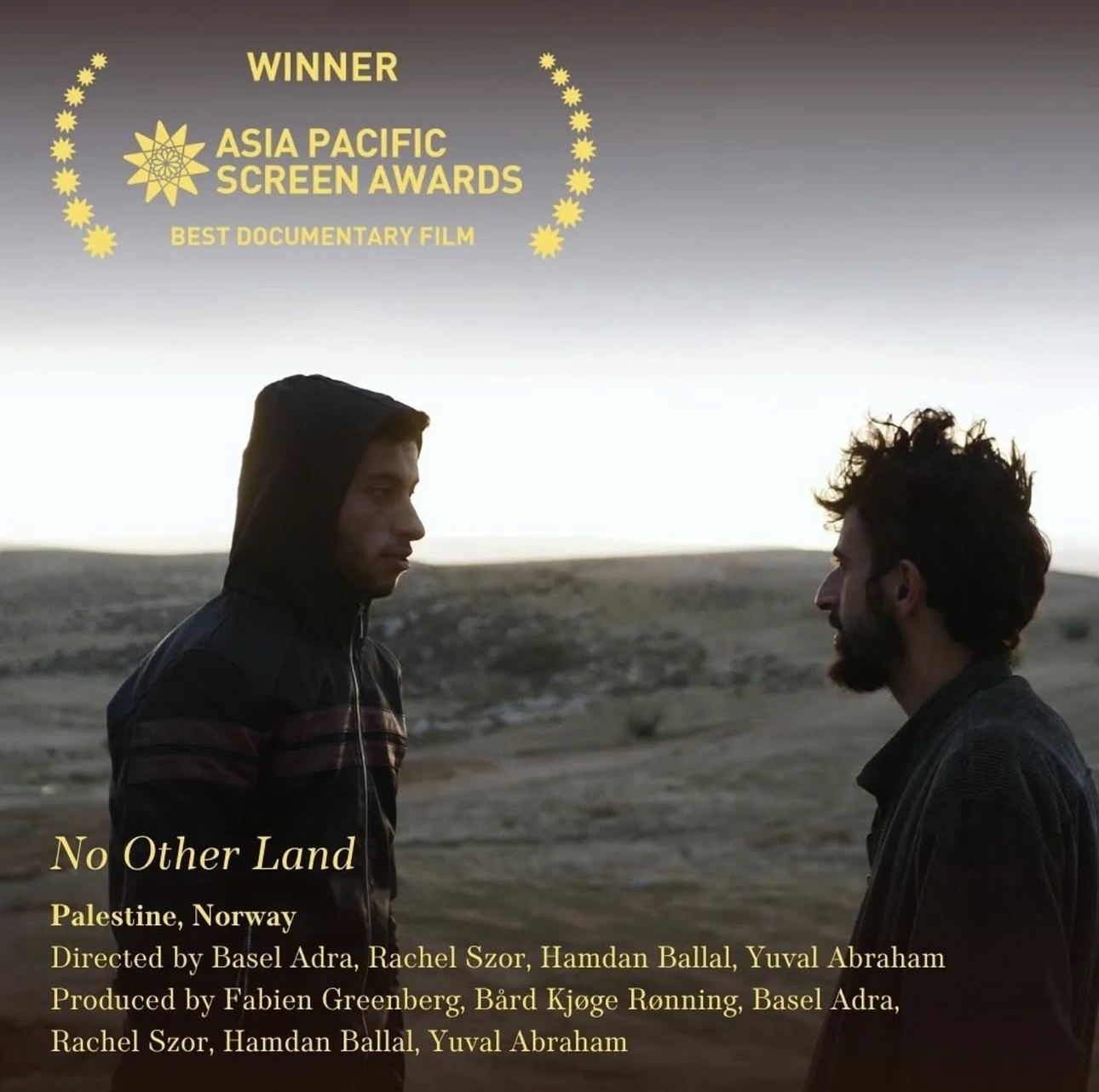
On Feb. 11, Muhlenberg’s Jewish Voice for Palestinian Liberation (JVPL) club held a screening of the documentary “No Other Land,” followed by a group discussion. The film brought together students and staff to witness a personal account of life under occupation in the West Bank’s Masafer Yatta and the consequences of resisting the occupation.
President of JVPL, Ian Graybill ‘26 said, “I think that the purpose of a liberal arts college campus is to be a space to facilitate dialogue and the open exchange of ideas, especially about politics, and especially about the political situations like this one that affect many students here so personally. The ongoing violence in Palestine, both Gaza and the West Bank, is absolutely one of those, and I felt like we’d be kind of remiss to not give space to show and discuss ‘No Other Land,’ which feels to me like the currently most critically acclaimed piece of storytelling on the topic.”
The documentary details the life of Basel Adra, a Palestinian activist and journalist from Masafer Yatta, and the experiences of Palestinians who face displacement, demolition and military control. Through Adra, the viewers are taken as far back as when Adra was a little boy, in the winter of 2023. Adra’s experiences as a young boy parallel the fractured world he currently experiences. He demonstrates this using the license plates he remembers as a kid: yellow plates for Israelis, who are allowed free movement, and green plates reserved for Palestinians, which restrict them from leaving certain areas. Adra comments, “An entire world based on division. A yellow man. A green man.”
The film illustrated how those divisions continue into the present day. Palestinians in the West Bank experience their cars being stolen by Israeli soldiers, some of whom are never returned to their owners. Movement is still restricted or delayed due to soldiers stopping Palestinians at checkpoints for hours.
Throughout the documentary, years of continuous conflict unfold. Schools are torn down, sometimes with supplies and furniture still inside. Families are denied permits to build, even a single-person home. Bulldozers level houses, displacing people into caves. Water, electricity and funerals are tightly controlled in the West Bank. The documentary recounts Adra being arrested without explanation, for being a journalist. The Israeli Army enters villages armed, shooting Palestinians, while calls go out to the police for help. However, Palestinians’ voices are rarely believed over the army’s. The film centers around the slow erosion of land, homes and autonomy.
Attendees emphasized the film’s focus on human experience, which portrays grief, exhaustion and confusion, but also resilience. One student, Isaac Backenroth ‘29, whose copy of the movie was used for the screening, stated that the most powerful tool of the movie is that “it is not political whatsoever… It is a documentation of a human experience that you can’t debunk… It’s raw human nature that gives us the power to change.”
Backenroth’s comment took place in the discussion following the conclusion of the movie, and was a sentiment that many at the discussion echoed. To start this discussion, Graybill proposed a central question: What do you do in a situation like this, and how do you tell a story like this that does something actionable?
The attendees expressed that they understand they cannot solve the political division, especially on college campuses, but they can acknowledge humanity.
Graybill added, “it’s about the consequences of decades of settler violence in the West Bank, but it’s framed through the experiences of a single town of people and their fight to save specifically their homes, and how much systems like Israel’s settlement system silences and commits active violence against not only the people resisting it, but the people documenting that resistance. There is incredible power in silence on subjects like these, and it remains an invaluable tool of colonial systems to suppress anything that might lead to their accountability.”
Hannah Winter ‘27, the treasurer of the club, said, “It’s difficult to deny the atrocities being committed when you’re being shown the day-to-day human suffering in Masafer Yatta in such an intimate way. In a war of information, first-hand accounts like ‘No Other Land’ are much more powerful than anything we’re seeing on the news.”
Graybill concluded that the discussion that took place after was important, for “these kinds of conversations only work when we’re able to break out of the same bubbles that they usually happen in… I think that even showing up to watch a film like this is meaningful, and shows that, although it certainly feels like it sometimes, Muhlenberg’s community is not an ideological monolith on this subject, and that there’s a desire for depth and complexity in these conversations.”
Amanda Growney ‘28 is a history major on the pre-law track. She is absolutely thrilled to be a copy editor for The Muhlenberg Weekly. When she's not attending classes or club meetings, you’ll find her rewatching “How I Met Your Mother,” watching a sports game, socializing with friends, or sleeping.