



















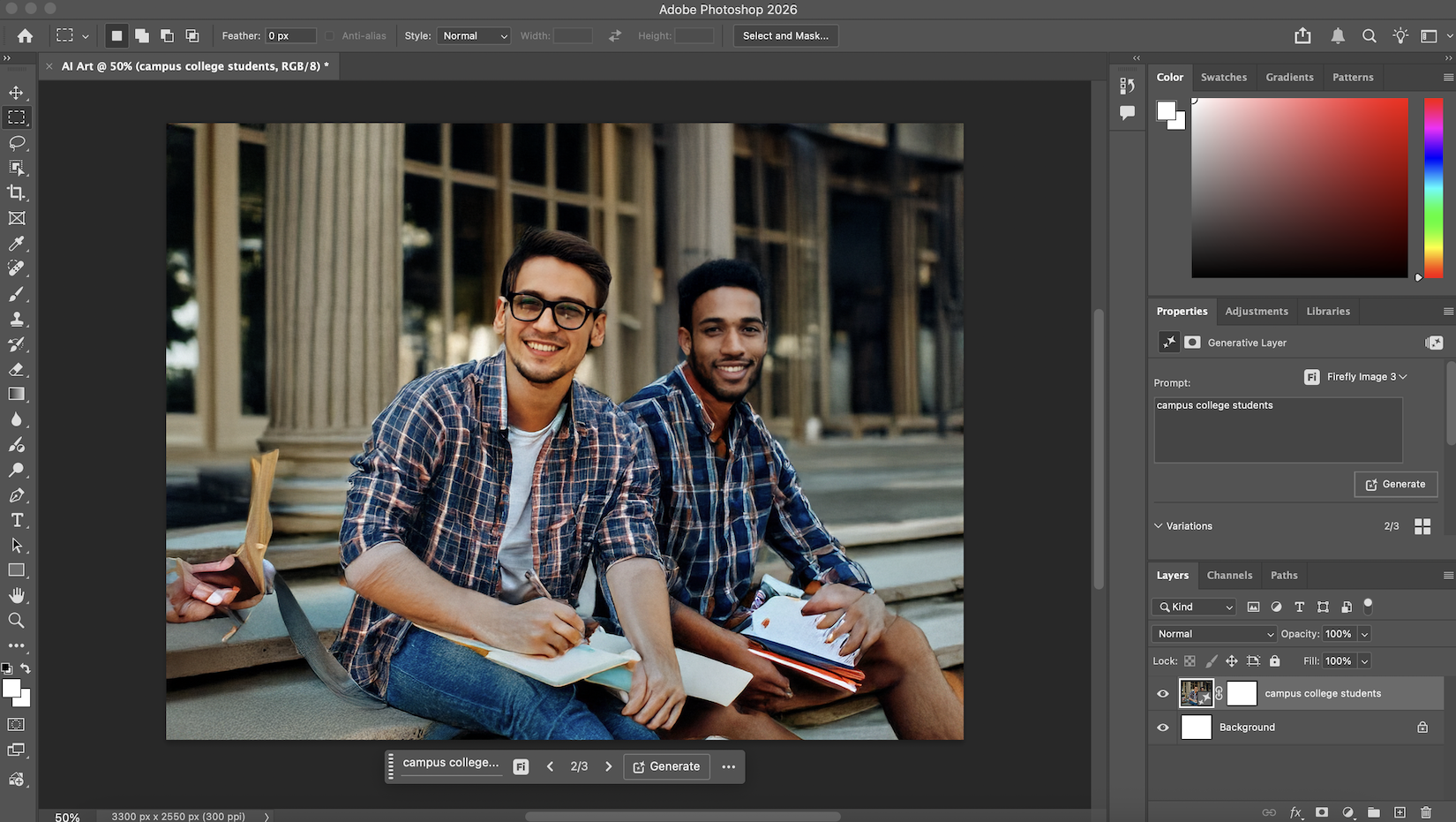
One of the most famous actresses that rose to prominence this past year is Tilly Norwood– she’s pretty, she’s British and she’s completely artificial. The character of Tilly was birthed by United Kingdom production company Particle6 and its AI talent division Xicoia. She can act, model and post on an Instagram account as if she is a real life social media influencer. Industrially speaking, Tilly seems to possess the skills of any real life performer– and for cheaper hire. In fact, Tilly began causing controversy when it was revealed that several talent agencies were looking to sign her.
The conversation around not only the existence of the character, but the success she seems to be obtaining, has called into question the relationship between generative AI (Gen AI) and art. It is often a debate between creativity and convenience: Will AI generated art push against and eventually replace the work of humans and diminish artistic integrity as we know it? Or, will the advancement of technology work harmoniously with innovation across various artistic disciplines, as new developments often enhance modern visual arts? As Gen AI continues to grow, creatives across mediums are left to wonder if the presence of AI is a threat to creativity or a tool that will help artists achieve something new and interesting.
Professor Dawn Lonsinger, director of creative writing and journalism and active writer herself, says, “I think AI and art are antithetical. What makes art meaningful is that it is a deeply human form of connection and communication. I don’t want to view or read or watch ‘art’ made by AI.”
Studio art and art history student Sarah Homer ‘26 agrees. “AI puts artistic authenticity at risk. AI takes away personal and human connection. There is a sense of personal and human connection that art gives to the audience. Physical art births connection and provokes awe within human existence. Even within the name, ‘artificial intelligence,’ it inherently contradicts the values of what makes art so valuable to human existence.”
Generative AI has the ability to rapidly produce audio, image based, textual and video content when given a prompt and criteria. The more it is used by humans, the more the program is able to pick up on language, jargon and even sense emotional tone, as it learns habitually and repeats behavior.
Chair of the College Committee on Technology and Digital Learning David Tafler retains the notion that regardless of the progress made in the development of Gen AI, it will never be able to fully replicate the humanity that is the draw of art. “In the modern era, art has become a discipline of discovery, a means for processing human engagement within a radically evolving sphere of experience. Many of those discoveries come about through a playful process of trial and error, where the ‘errors’ have the capacity to prove more meaningful and enlightening than any pre-calculated, scripted or planned itinerary. A sophisticated mirror/calculating machine may not have the capacity to operate illogically, emotionally, intellectually courageous in the same manner as a more limited but visionary human agent.”
On how Gen AI encroaches itself on human artists, student theatre Director Lacey Cataleta ‘26 says, “I am not really sure if it is [that] the arts [can improve] its relationship with AI, more like AI [needs to be] ‘respecting’ individual artists and not spitting out copy pasted products without proper credit. AI could be good, if it is used in the proper way.”
In Lonsinger’s eyes, what was perhaps created to advance the artistic experience does end up plagiarizing these very artists. “It’s another way for the elites to make money off of stealing others’ ideas,” she says. “There are, of course, multiple class action suits against AI companies for the unauthorized use of copyrighted material underway. And what will it mean to live in a world where machines are creating art that dishonest people then put out as their own creation? Perhaps an emptier and emptier (soul-wise) world of grifters vs. artists. With creative writing, in particular, I worry about how AI use over time will flatline language, make it more utilitarian, predictable and tactical, and less beautiful, communal and alive.”
Lonsinger also points out some of the other detriments the use of AI has on the world as a whole rather than just on artists: it furthers climate crises, eliminates entry level jobs, enhances economic and social inequity, furthers ultra-privitization and atomization of our lives degrading community and more. Many researchers have echoed her concerns. Environmentally speaking, the demand of energy required to use AI on large scales and the use of water as a cooling agent for hardware have raised some eyebrows. Other technologically advanced machinery and hardwares, including AI, have been known to replace humans in many jobs causing greater divisions in the wealth gap and ultimately affecting not only equal opportunity, but the presence of opportunity at all.
Lonsinger encourages her students to resist AI, “[Mary] Shelley’s ‘Frankenstein’ is elucidating here, which is to say it asks us to think about human hubris in creating things for the sake of it, for a feeling of godliness, for supposed ‘progress’ without ethical considerations or a way of navigating any fallout. If nothing else, adaptation should be slowed down to consider and mitigate ethical concerns about its ramifications in our lives and on the planet. As the corporate world perpetually wants to encourage us to feed and expand our technological selves– in large part because it’s easiest to extract from, sell to, manipulate and surveil those who are constantly online/in front of a screen– I’d like to hold some space for the parts of our students (as they search for meaning and form and reform their opinions about the world, themselves, etc.) that are otherwise.”
Sonny Berenson ‘26 is a music student conducting research on how to weigh the industry benefits of using Gen AI as it rises in prominence, while navigating its ethics and issues. “My move towards this subject actually came from my own discomfort with AI. As a musician and a writer, I have always been resistant to using AI, let alone talking about it in my research. In the arts, the thought of AI possessing the power to replace human thought and writing is terrifying– I mean, that’s kind of our entire thing, coming up with creative, original ideas. However, as fearful as I may be of using AI in my own academic and artistic practices, I understand that pretending that it does not exist will not make it go away. I think the only way to get ahead of something is to truly understand it, which is why I wanted to focus so deeply on AI and music.”
“Like it or not, AI has become part of our technosphere. One cannot ignore AI. AI poses challenges, environmentally, economically, on the general cognitive well-being of individuals in our society, particularly students. Nevertheless, as a tool it holds great promise in many fields…” David Tafler, Chair of the College Committee on Technology and Digital Learning
Meanwhile, Tafler says that the College Committee on Technology and Digital Learning have been working towards developing AI guidelines for the campus community, as its existence is inevitable. “Like it or not, AI has become part of our technosphere. One cannot ignore AI. AI poses challenges, environmentally, economically, on the general cognitive well-being of individuals in our society, particularly students. Nevertheless, as a tool it holds great promise in many fields, particularly as an instrument of research, programming, medical diagnosis… The challenges must be overcome. In that manner, every advance in technology poses a counter platform of problems– industrialization and inhumane factories, pollution, runaway consumption, devastation of the environment (mining, industrial waste). The automobile has proven an environmental disaster and an inefficient mode of transportation. Nuclear power threatens the existence of all life on this planet.”
Berenson continues, “I think that AI provides unique potentials for the future of music. Although the examples I analyze are ethically muddy, there is something to be said about how revolutionary these works are. It’s fascinating and futuristic to think that recorded music is not fixed or finite. Outside of the recording studio, I think that generative AI music platforms, such as Suno or SOUNDRAW, allow music-making to be accessible. Those who may not possess the means to create music without such technology now have an outlet to experiment. What makes me nervous, though, is the thought of generative platforms fully replacing live musicians. All music made for passive listening (elevator music, music for TV commercials, etc.) have always been composed by real musicians who make a living off of their work. With generative AI, it takes a fraction of the time and money to create these pieces. That’s what’s troubling to me, caring more about cutting costs and labor over the livelihood of musicians.”
Despite taking a generally negative position on AI, Homer points out the different ways studio artists can play with and utilize it. “Spending endless hours on a piece of art, and wanting to take a risk could turn out horribly. By using AI, the artist is allowed to digitally work with their canvas without running the risk of ‘destroying’ the work.”
Ultimately, differing opinions on Gen AI and its impact on art tell a story that all artists have to learn in the ever-changing industries they belong to: adapting as they climb.
Ultimately, differing opinions on Gen AI and its impact on art tell a story that all artists have to learn in the everchanging industries they belong to: adapting as they climb. With ethical quandaries at stake, though, something as simple as experimenting with new technologies becomes more difficult to contend with. Berenson says, “Honestly, I would encourage artists to play around with different AI tools and see for themselves what it’s all about. That’s why I’ve enjoyed falling down the rabbit hole I have in my research: It’s frightening and fascinating to look at what technology can do. I really think that fear is based in the unknown. You have to understand the work of the machine to see what it can and cannot replace.” But to take language from Lonsinger’s class syllabi, “We are not interested in the ghost of AI-generated text past or future. So, please invest in your own eccentricities and attention. Believe in your own creative chaos and authentic weirdness. Using AI-generated content is like throwing store-bought cake mix into the oven and calling it ‘culinary genius.’”
As the future of this new technology progresses, and actresses like Tilly Norwood spawn in chemistry reads and screen tests, it is up to individual artists to contend with and decide the extent to which generative AI with all of its detriments and enhancements impacts the world of creation.

Megan ‘26 is a Theater Studies and English Literature double major with a minor in Film Studies. She is extremely grateful to have worked with the talented and passionate students on the Weekly staff since her first year. When she isn’t working in the production room, you can find her directing shows on campus, writing sketch comedy, leading the Muhlenberg Film Association, or enjoying a night with her friends.