



















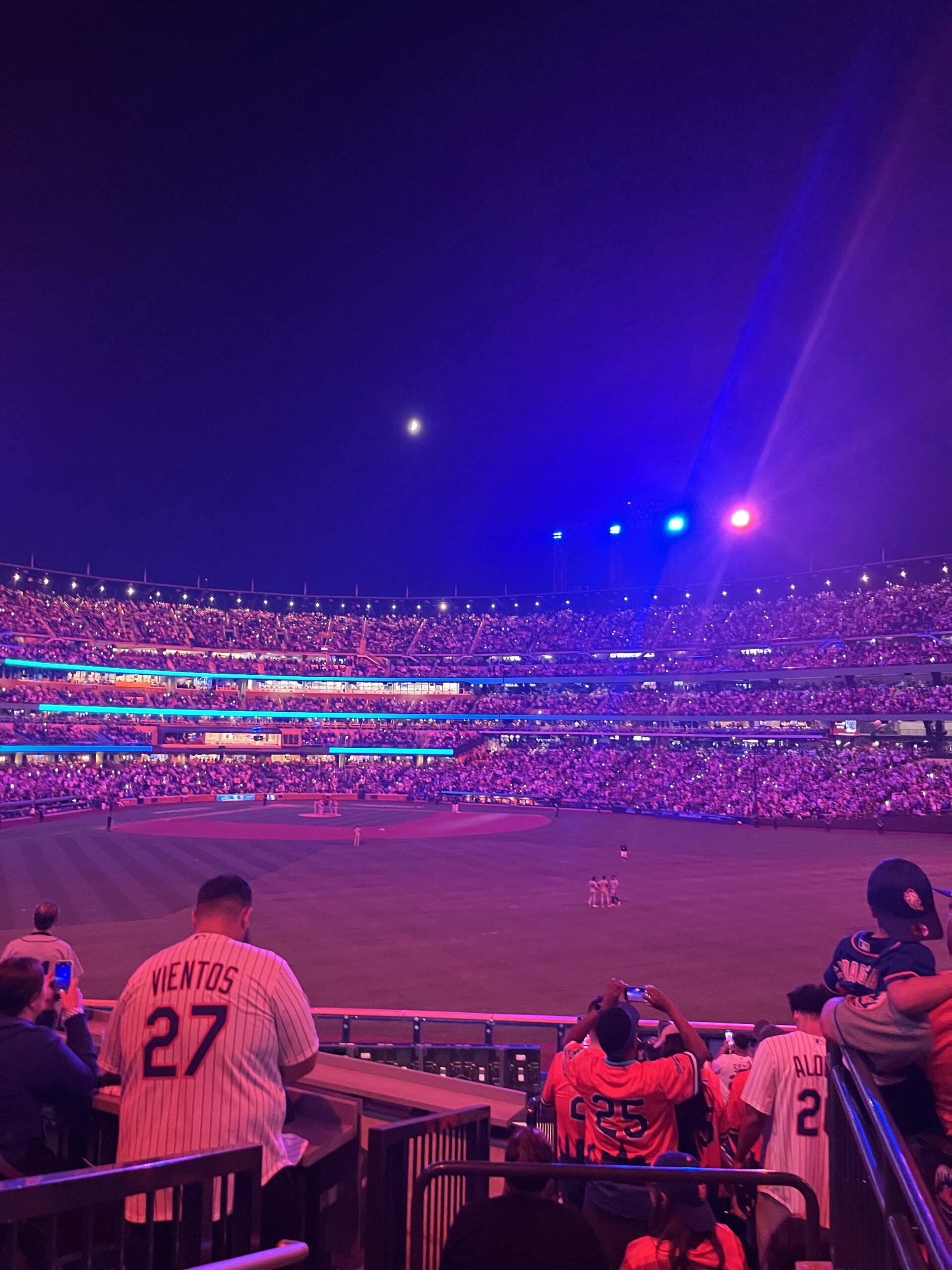
I was basically born with the spirit of New York baseball coursing through my veins. If my family had a crest, it would be blue and orange and have Daryl Strawberry’s number eighteen looming at the top, or perhaps ‘86, the year to be alive in Queens. Before I even knew the meaning of the word “democracy,” my cousin was born and given the middle name “Shea” after our beloved retired stadium. My Papa was pitching underhand to me in the yard at four, and I rode the seven train more than any of the razor scooters rusting in my Long Island shed.
I have been a Mets fan for twenty one years and 324 days: my entire life. And even though my traditional opening day jersey is worn to threads, this season I am putting it on with new meaning. This season, being the underdog of the five boroughs represents a sentiment held by many New Yorkers, baseball fans and defeated Americans across the nation.
Baseball being deemed “The Great American Pastime” has always been more political than I think many of its fans wish to acknowledge. While varying versions of bat and ball games existed in years proceeding, it wasn’t until around 1855 that “baseball” clubs started popping up around New York City. These organizations began developing and refining the rules to be uniquely American for the first time– breaking away from cricket influences and British games. The spread of the sport and its new rules across states created an ironic sense of unity by becoming some sort of “American standard” while not really knowing what it meant to be American. The country was divided, the north fighting for “union” and the south calling into question the physical boundaries of what we consider to be our nation by seceding– the terms “unity” and “nation” were wildly undefined.
Thereafter, baseball rose to higher prominence in more politically charged times. Just a few years after the Civil War in 1866, newspapers recorded the formation of 2,000 baseball clubs, and referred to the 1860’s as “the age of baseball”– marking the sport as an agent of reunification after the Civil War. When the league continued functioning during the Great Depression, its reputation of being the “American Pastime” strengthened. The sport played a huge role in honing patriotism during World War II– giving women the opportunity to contribute to the war effort by keeping spirits high and playing while men were drafted. When American morale is low, there will always be baseball.
With our current administration threatening other nations with American “greatness” and strength, it is hard to be a fanatic of a sport that has become so deeply entrenched in patriotism and conservative nostalgia. Yet there is something that feels deeply democratic about being a New York Mets fan that I think many other franchises in the MLB (Major League Baseball) lack.
The Mets in their entirety are obsessed with gimmicks. We have expanded the scope of our blatant corniness from a slogan like “Amazin’!” to adopting the meme-famous Grimace as our unofficial mascot. In 2024, player Jose Iglesias brought us our very own theme song “OMG!” This is what makes the team attractive in terms of who to root for: the Mets are a damn good time. Love it or hate it, it reminds me a lot of Kamala Harris’ presidential campaign’s obsession with social media trends, and turning Charli XCX’s “Brat” into a series of theme songs. There’s always something fun to attach yourself to, something to sing or to laugh about with others who support the cause. It’s recognizable, and it gives people something to enjoy in the face of a six day losing streak, or fluctuating election polls.
Meanwhile, the other New York team, the Yankees, are known for their clean cut pinstripes, marketable logo seen on every tourist, and of course, their all American name. They don’t even have a mascot. Cranking out win after win, season after season, their entire “gimmick” is being the figurehead of American success.
The Mets are consistently inconsistent. Every game is a rollercoaster. On opening day of the season, we went from watching pitcher Freddy Peralta give up a two run homerun on the second batter of the game to seeing Brett Baty drive in three runs for the Mets the very next inning. I do think, in a way, that unpredictability is reflective of Trump’s– we never know what he will do next, or how much worse it’s going to get. The difference is that because of the excitement generated in the stadium, the Mets still manage to provide a sense of hope that many people are missing when it comes to politics.
When I wear a Mets hat, suddenly I am the queen of Queens. Strangers shout “Let’s go Mets!” or “Good game last night!” as I walk by them because we are all so prideful of our shared love. In those stands, we sing “Take Me Out to the Ball Game” in unison and make conversation on the gyro line. The Mets make an effort to make their games communal, with nights celebrating different heritages and identities, family nights, “Bark at the Park” where everyone brings their dogs– a whole schedule dedicated to making the games less about what’s happening on the field and whether we are winning or losing, and more about who is in the seats. We struggle through losses and celebrate wins together, and we have a good time doing it. There is unity in hoping for something, or fighting for something we know the odds are stacked against– for Mets fans it’s a spot in the playoffs, for many folks living during the Trump administration, it’s legislation that protects their right to exist safely.
To an extent, the sense of unity in the stands may be false: we may all be rooting for the same team, but outside the walls of Citi Field, we’re fighting about what the country needs right now and posing threats to each other’s safety. But a spot in the playoffs is proof that what seems impossible can be achieved if you fight for it. Typing it out now, that seems naive to me when it comes to national politics, but to many fans, our ability to unify in the name of the Mets is proof that there is hope for our polarized nation.
I’d be remiss if I didn’t acknowledge that the Mets are not the only underdog coming up from Queens this year. Newly elected New York City Mayor Zohran Mamdani hails from Astoria, and although most polling data had him as the favorite to win for most of the race, his staunch progressivism feels out of place on a national scale, especially as the first Muslim person and first democratic socialist to covet the New York mayoral role. When Mamdani won, I was washed with the same sense of New York pride I feel when attending a Mets game. At least my city is fighting for what I believe in and succeeding when it feels like very few people in power are right now.
For better or for worse, the American way has always been that in the face of national upset, there will always be baseball. I am grateful to root for a team that echoes New York City’s need to celebrate collaboration, progression and diversity, the heart and soul of the city. Wearing my gear has always been, will always be, and especially is now, as much of a symbol for my pride as a New Yorker as it is for my love of the team. Even though they can’t win a game to save their lives right now, and 1988 player Howard Johnson hit a fly ball that nailed my mom in the stands and sent her to the hospital, for me, there will always be The New York Mets.

Megan ‘26 is a Theater Studies and English Literature double major with a minor in Film Studies. She is extremely grateful to have worked with the talented and passionate students on the Weekly staff since her first year. When she isn’t working in the production room, you can find her directing shows on campus, writing sketch comedy, leading the Muhlenberg Film Association, or enjoying a night with her friends.