



















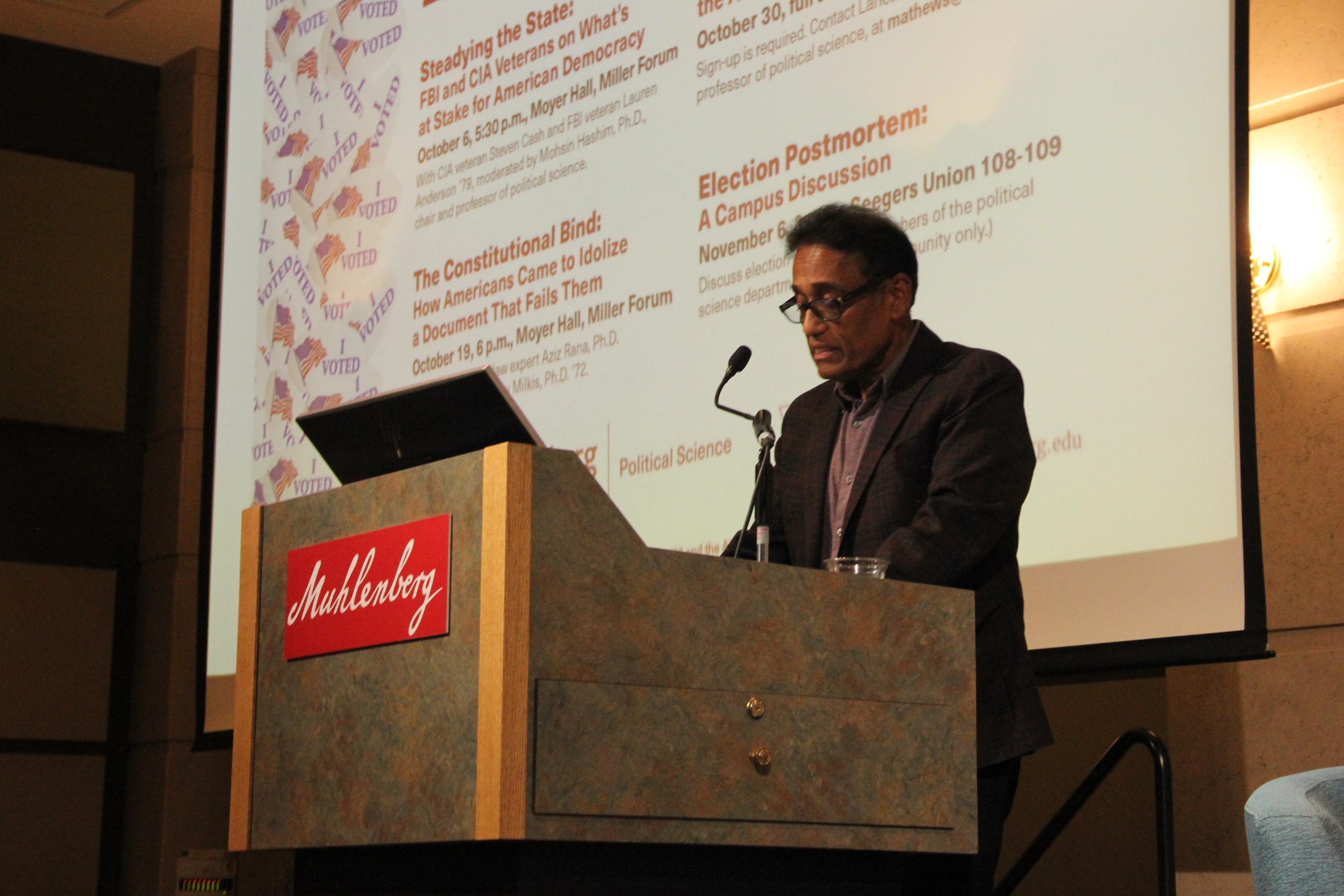
On Monday Oct. 19, the Muhlenberg political science department continued with its midterm election series, following its first event which included a discussion with FBI and CIA veterans, Steven Cash and Lauren Anderson ’79, on the state of American democracy. Monday’s event featured a discourse by Boston College J. Donald Monan, S.J., University Professor of Law and Government Aziz Rana. The title of Rana’s event was “The Constitutional Bind: How Americans Came to Idolize a Document That Fails Them,” which shares the name of Rana’s 2024 publication discussing similar topics.
The session opened with a few remarks by chair of political science, Mohsin Hashim and associate professor of political science, Ross Dardani. During Dardani’s dialogue, he emphasized the lack of political literacy held by many adults in the United States. Citing the Annenberg Constitution Day Civics Survey, he shared, “Over one-third of U.S. adults cannot name the three branches of government.” Additionally, within the same study he shared that respondents are likely to only name freedom of speech when asked to name rights given to U.S. citizens. Kathleen Hall Jamieson, a professor at University of Pennsylvania and the director of the survey shared, “It is worrisome that one in six U.S. adults cannot name any of the branches of government and that only 1 in 20 can name all five freedoms protected by the First Amendment. One is unlikely to cherish or work to protect freedoms one does not know one has and will have trouble holding elected and unelected leaders accountable.” The opening statements regarding the lack of political literacy among U.S. adults set the stage for the topics to be covered through Rana’s discourse, highlighting how a lack of knowledge can contribute to misunderstandings regarding how the constitution governs the American political system.
Rana began by discussing the current state of the U.S. political environment, citing what many fear, that America is currently experiencing a “constitutional crisis.” One of the things he shared was how the idea of the “constitutional compact” has shifted in its meaning and use throughout the years, as the constitution was originally viewed as a compromise between northern and southern states. Specifically, he highlighted how recently it has shifted from the contingents established in the period of the 1930s to the 1960s, where New Deal and civil rights reform established federal authority and federal courts as protectors of individual freedoms. As of late, deep bipartisan polarization and several key rollbacks conducted by the Supreme Court has weakened the federal power established during the 1930s-1960s, leading to greater power at the state and executive level, and the erosion of countless political norms. Rana emphasized how provisions within the constitution led to this current state, specifically the role of the Supreme Court in its failure to limit this divide, or in some cases facilitate it. He specifically noted how elements of the court system outlined in the U.S.’s constitution, such as nine justices and lifetime terms, are unique to the U.S., as other countries like Germany or India have a larger number of justices or do not have lifetime terms for their supreme courts. It is these unique aspects of the court, as well as the complicated amendment process, that Rana warned may limit the democratic rights of U.S. citizens, leading to worrying signs that the current state of the U.S. government could feature fewer freedoms, which Rana referred to as “Electoral Authoritarianism.” The term comes from political scientists Steven Levitsky and Daniel Ziblatt, who in their publications, “How Democracies Die” and “Tyranny of the Minority,” focus on how modern authoritarian regimes work through elections, where strong executive power is supported by the limitation of removing those in power through elections and the country’s courts.
Many students attended the session, with the discussion part of the Q&A section seeing large participation from students. Kendra Brosious ’27 shared, “For me, one of the most interesting reflections made in the talk was made during the questioning section, where Dr. Rana pointed out that countries who have redone their constitutions in recent years no longer follow the U.S. model. As an International Studies major, I find this interesting in that there is a clear shift away from the idea of the U.S. as the ‘bastion of democracy’ that was held by the world for so long, and is still held by some Americans. By not rewriting our Constitution, the U.S. has missed an opportunity to revive that title and once again become a true harborer of modern democracy.”
In his closing remarks, Rana re-emphasized the importance of the upcoming election to the future of the United States, sharing, “A set of landmark statues could materially improve the functioning of the American system… with improvements to voting rights, congressional responses to gerrymandering and significant court reform.”

Braeden Skibicki '28 is a finance and accounting double major. When not writing for the weekly, he enjoys reading, playing guitar, and watching soccer.