



















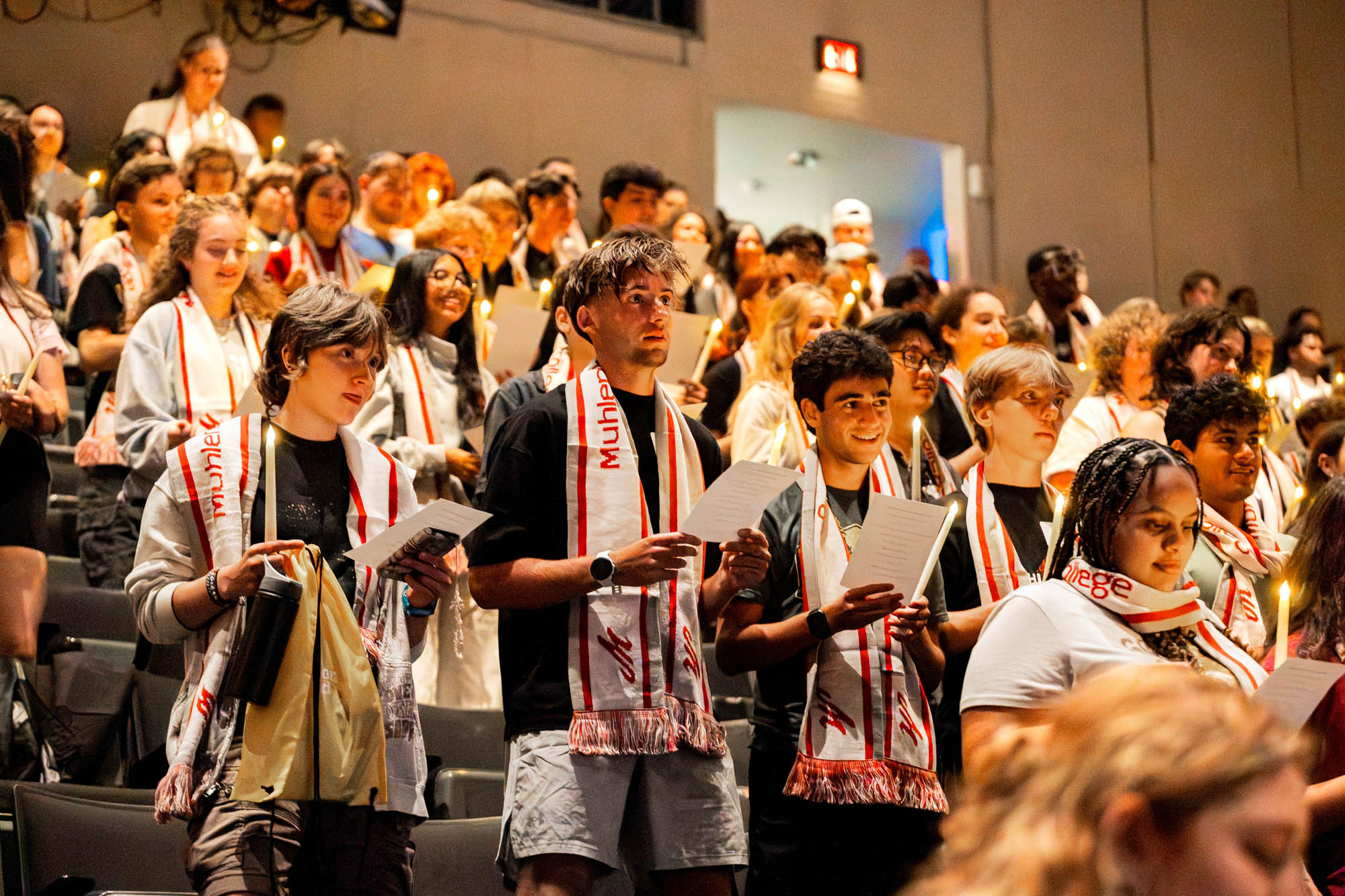
In late August, Muhlenberg campus sprang back to life with the buzz of move-in week, as packed cars, red-clad student volunteers and excited families and students alike convened on Chew Street. As the class of 2030 walked through the red doors and experienced the annual candle-lighting and scarving ceremony, they officially began their four-year journey on campus. The 415 new incoming Mules bring a mix of academic promise, personal background and adaptability to Muhlenberg College.
The class of 2030 stands out both for its academic strength and its geographical breadth. Vice President of Enrollment Management Amy Becher reports that the incoming class represents students from 24 states and six countries. With an average GPA of 3.73, they arrive with a strong academic foundation. Furthermore, Becher shares, “Our growing Lehigh Valley enrollment also strengthens Muhlenberg’s connection to the region, as we continue to develop talented graduates who will contribute to its future.”
In terms of academics, the incoming class reflects the intellectual breadth championed by a liberal arts institution. Initial pre-advising data demonstrates strong intended major enrollment in the natural sciences, social sciences, accounting, business, economics, finance and the arts. Additionally, nearly 30% of the incoming class represents first-generation college students.
Many incoming classes face unique sets of institutional and historical circumstances, but the class of 2030 enters college at a particularly notable period in academia. This class arrives not only at a pivotal moment for Muhlenberg, but for higher education as a whole. In the midst of the 2025-2026 demographic cliff, low birth rates following the 2008 financial crisis are now causing a decline in the traditional 18-year-old college going population. For private liberal arts colleges throughout the Northeast, this changing environment has intensified competition for prospective applicants as well as amplified institutional financial constraints.
“For me and most of my teammates, we had all of our students show up. The incoming [first-years] this year seem to be a very diverse population, and everyone was willing to intermingle and talk to people outside of their groups.” – Orientation Leader Charlotte Cama ‘28
The pressures of this demographic shift are reflected in the long-term data. Over the past decade, Muhlenberg’s total enrollment has gradually decreased from 2,408 students in 2016 to 1,788 in 2025. Rather than solely signaling a decline in reach, this change demonstrates how colleges across the region are nearly all adapting to the smaller cohorts.
Despite broader national trends, student leaders on campus report a noticeably positive shift in energy and engagement among the incoming first-year students during Orientation Weekend. “I did see a change in this year’s cohort of students,” said Orientation Leader Charlotte Cama ‘28. “Numbers-wise, there were only a handful of students that didn’t come to their activities [this year], whereas last year, Student Life had to go knock on doors. For me and most of my teammates, we had all of our students show up. The incoming [first-years] this year seem to be a very diverse population, and everyone was willing to intermingle and talk to people outside of their groups.”
Theo Yang ‘30 corroborated, “Orientation was a pleasant experience. I got to meet a lot of new friends and upperclassmen who helped me adjust to the school better.” He further explained, “I think our class as a whole is very eager to meet new friends and connect. We were blessed with such a good group of individuals and it has been a pleasure going to school with them.”
Orientation Team Leader Griffin Blackburn ‘28 shared that the class of 2030 is “very active and already getting involved across campus in many ways which is always great to see. That sets such a great tone for future incoming classes to see people who were in their shoes recently and it really makes a positive difference across campus when there are new people, voices and perspectives.”

Tony '28 is a biology major. When he's not in class or writing for the Weekly, he's usually doing some research, reading a book, or lowballing on Grailed.