



















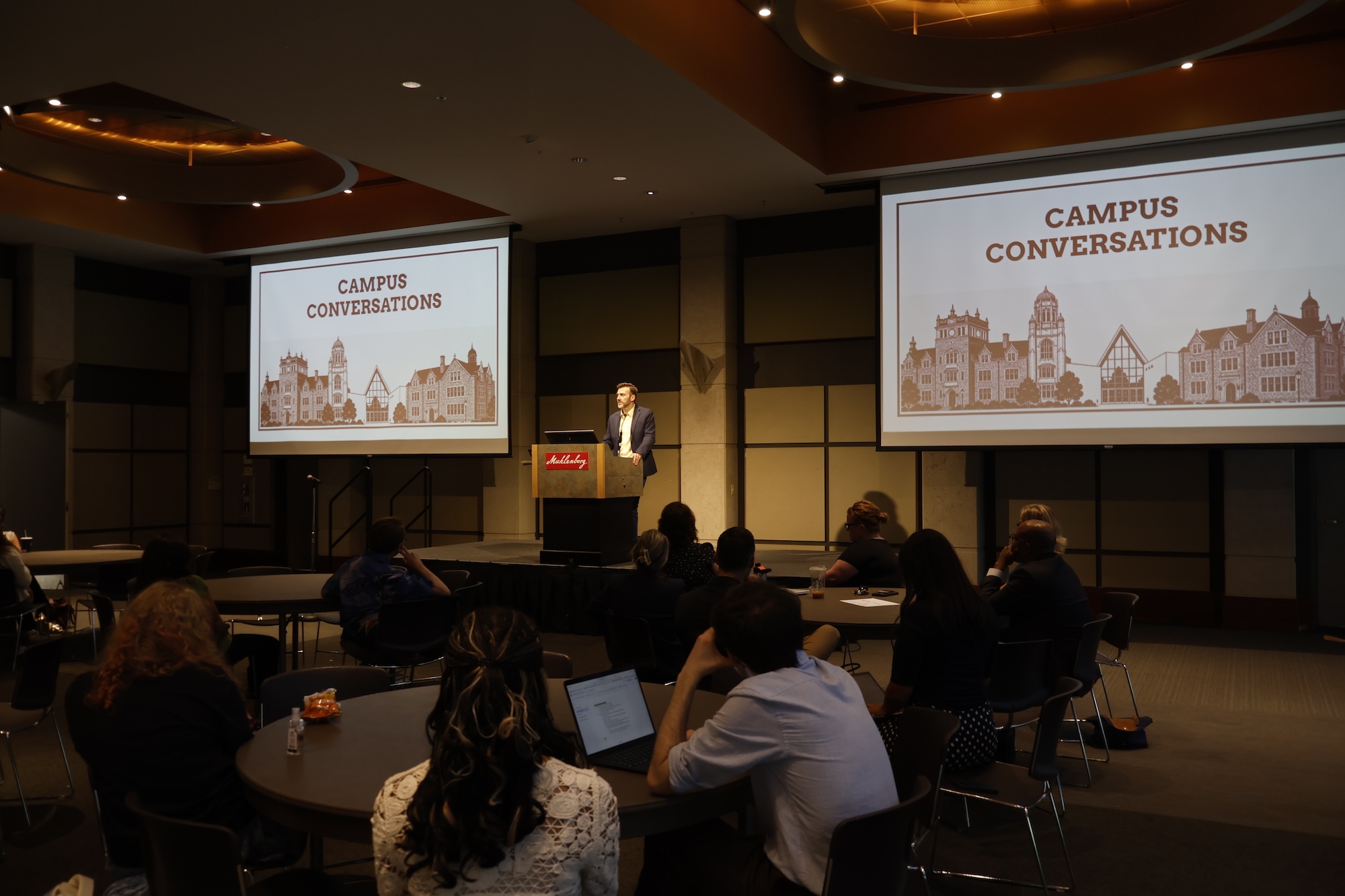
Throughout Campus Conversations on Sept. 9, there seemed to be two words that persisted amidst the cavalcade of reassurances and promises: transparency and sustainability. In a combined effort between the Student Government Association (SGA) and senior leadership, students held direct conversations with faculty regarding three key issues: the Seegers Union Expansion, changes to meal plans and faculty and staff departures. The format consisted of a speaker panel of President Kathleen Harring, interim Chief Financial Officer (CFO) Larry Bomback and Vice President for Operations and Chief Information Officer José Dieudonné, followed by student questions, before the session was divided into two breakout rooms with one covering faculty and staff departures and the other covering the Seegers Expansion and meal plan changes.
Speaking with members of SGA before the event, many had hoped that the night’s conversation would demystify certain actions recently taken by leadership, specifically highlighting decisions related to faculty and staff departures. There was a similar sentiment shared by members of administration, who wished to hear from students and provide clarity for the issues affecting them. Assistant Vice President of College Life and Dean of Students Courtney Stephens explained that she enjoys events such as these as, “I can hear directly from students to understand the issues that are most important to them.”
Muhlenberg must “realign” its staff size to reflect the student population.
The panel opened with President Kathleen Harring discussing the changes to faculty, where she stated that 25 faculty and staff positions were “eliminated,” with 16 of those positions being vacant. Additionally, 13 faculty members were given one-year contracts expiring at the end of the current school year. Harring further reassured that, despite these cuts, no programs were being removed; rather, programs were being added. The main reason behind the cuts, the declining student body numbers, was a common theme throughout the night. As admin adjusts to smaller incoming class sizes, Muhlenberg must “realign” its staff size to reflect the student population.
The panel continued with Bomback taking the stage, discussing the changes related to dining. Bomback explained how the decision to make meal plans mandatory for every student was a measure to combat rising costs. Additionally, he shared that Muhlenberg is currently exploring other dining providers beside the College’s current, Sodexo. Bomback explained the three elements of costs of dining are food quality, food variety and labor, sharing that the recently unionized labor force has increased the labor costs. In searching for other providers, they wish to keep food quality and variety the same while cutting down on labor. The panel concluded with Dieudonné, who shared updates on the Seegers Union Expansion, emphasizing the Expansion is still projected to be open by spring 2027.
Following the panel, the session was divided into two breakout rooms, allowing the students to ask questions directly to senior leadership. In the Seegers Expansion and meal plan breakout room, students raised questions about coming changes to the dining system, such as changes in hours. Leadership responded by stating dining hall hours would be reduced during “off-hours,” or hours where there are fewer students using the dining commons, further rehashing that other options such as General Quarters (GQ) and the Mule Kick Cafe would still be available at these hours. Leadership also shared future plans of offering meal swipe exchanges at these other locations, where students could purchase a set amount of items with a meal swipe rather than dining dollars, but these swipes would be limited to two or three a week.
In the faculty departure breakout room, students raised concerns over the future of several departments given recent faculty outgoings, specifically highlighting the uncertain future of the public health department. Senior leadership reassured that despite certain cuts to these departments, every student will still graduate on time. Additionally, when asked about staff retention, Provost Laura Furge stated, “Muhlenberg has been around for 175 years… we want to make sure it’s around for another 175… We have to make the hard decisions now.” Furthermore, when questioned about how professors should manage burnout related to increased course load from larger class size, Furge suggested professors concerned about this should reduce the amount of work assigned to students.
While the event brought students and college leaders together, some felt it left more to be desired. Owen Shaffer, president of Mules for Transparency, who attended the session Wednesday shared: “This event really was a letdown for me. I expected to get more answers out of such an important event…it feels like they’re more interested in appearing transparent than actually being transparent.”
Conversely, Stephens stated, “It was helpful to hear directly from students about the more specific questions and issues they had related to the Seegers Expansion and dining.” Although much information was shared Wednesday night, many students shared they question the pertinence of such information in the larger scheme of Muhlenberg’s financial and communal struggles.
A previous version of this article mis-credited a quote from Provost Laura Furge to President Kathleen Harring. The article has been updated. The correction has been printed on page 2 of the Sep. 22 issue.
Braeden Skibicki '28 is a finance and accounting double major. When not writing for the weekly, he enjoys reading, playing guitar, and watching soccer.