



















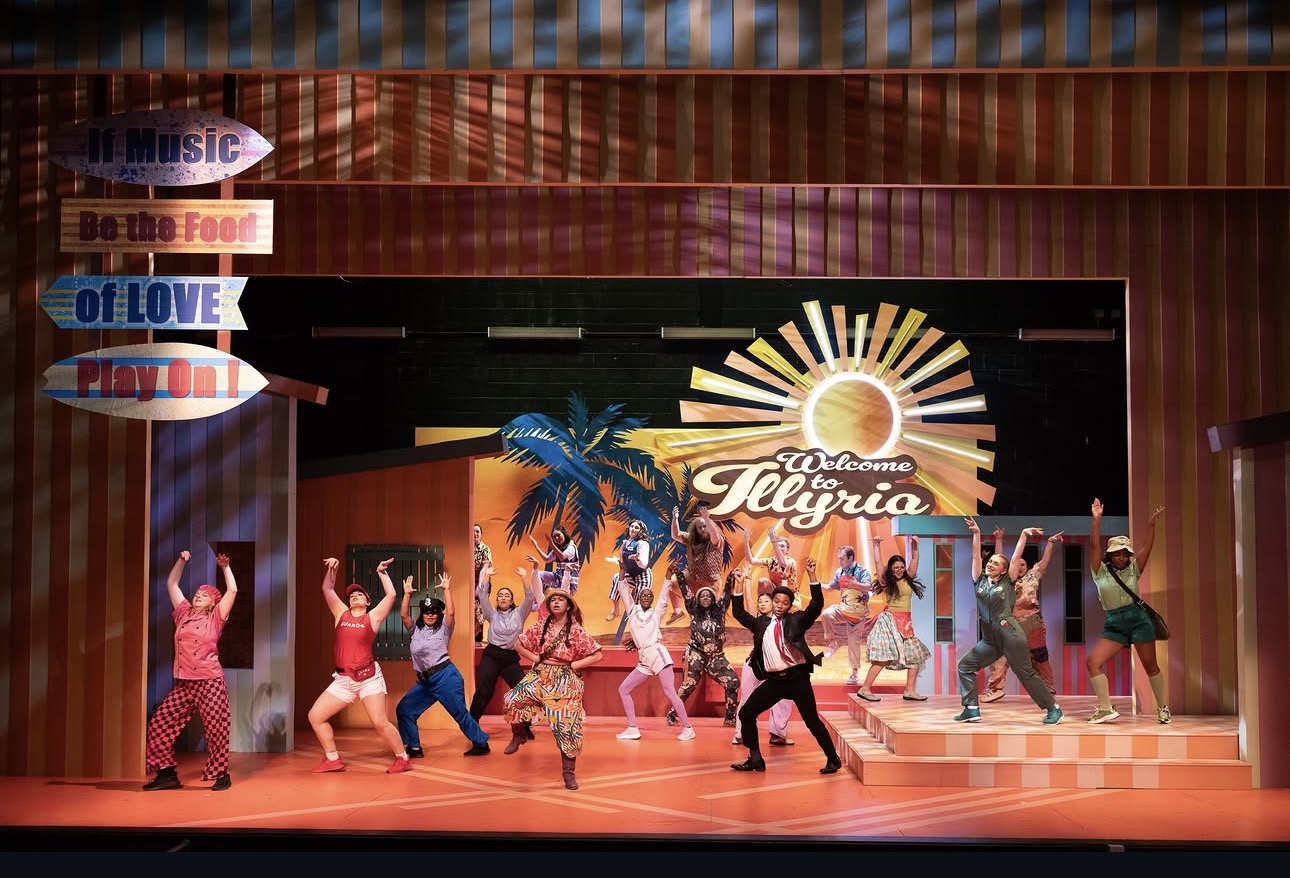
With a radiant set, punchy music and a cast dressed like they were on vacation, people may have been surprised to know that a Shakespeare play could look as refreshing and modern as Muhlenberg’s. This past weekend, from April 23 to 26, the Muhlenberg Theatre and Dance department presented their mainstage performance of “Twelfth Night,” a musical filled with classic Shakespearean spoken word combined with a pop of musical theatre songs.
Conceived by Kwame Kwei-Armah and Shaina Taub, with music and lyrics written by Shaina Taub, “Twelfth Night” was first performed in 2016 at the Delacorte Theater for the Public Works initiative. The musical follows the similar plot and spoken word as the written play by Shakespeare, with characters Olivia, Viola and Orsino caught in a love triangle of misdirection and confusion, and their counterpart characters who find themselves in their own separate mess of schemes and trickery. The only difference in the version placed on the Muhlenberg stage to the “Twelfth Night” play was its inclusion of songs which contribute to the plot of the original play.
Running for 90 minutes, “Twelfth Night” had no intermission, keeping the audience engaged with its fast-paced movement and ever-evolving plot. “I love the fact that it was only an hour and a half with no intermission. I think it makes it so accessible for audiences to want to sit through a Shakespeare play. It was so quick and it was so awesome,” Faith Miller ‘26 expressed. Miller played Maria in “Twelfth Night,” Olivia’s personal assistant but also, as Miller put it, “the head of the household.” Miller continued, “She’s so clever and smart, and funny too, in an understated way. I get to be tricky and scheme, but also be so girl boss, which I really enjoyed getting to play.”
Rehearsals for “Twelfth Night” started in late January and carried all the way to late April, with cast members rehearsing five days a week, four hours each rehearsal. “The rehearsal process was a long one,” commented Abby Bera ‘27, one of “Twelfth Night’s” assistant directors, “but when it was time for the show, it was truly a fun and joyous experience. Looking from the outside, every rehearsal, the cast members had huge smiles on their faces. I could tell that they were having a good time and that they were building a community within the cast.”
Bera worked with Jim Peck, director of “Twelfth Night,” and noted how her experience as assistant director was “truly invaluable.” “As someone who is used to being onstage,” Bera adds, “it was very exciting to be able to work on a departmental production from the other side. I learned a lot about the management side of directing; things like collaborating with other creatives, making difficult decisions and creating a shared vision for a whole production.”
“It was really surprising how close we got as a cast since there were 34 of us,” Caden Dowgin ‘27, who played Sir Toby, expressed. “It’s the largest cast I’ve ever been a part of but also one of the most close-knit. It was my first ever Shakespeare performance so it was fun to dive into this language, especially for a character that creates so many schemes. I learned so much about this kind of language and how to work with such a large cast. It’s one of my favorite theatre experiences I’ve had on this campus.”
Johnny Galletti ‘27, who played the character Malvolio, notes that working on a show that is both a musical and Shakespeare is “so interesting, as stories written so long ago by William Shakespeare are still impacting people to this day, people also being me.”
Galletti spoke of part of the process that included building his character, who he explains is the closest thing the show gets to a “villian.” Malvolio spends most of the show wanting to enforce what he believes to be his own rules, despite not being taken seriously by any other character in the musical, which leads to a comedic crux of the show when both Miller and Dowgin characters’ trap Malvolio in a porta-potty, who’s also dressed in ridiculous yellow garb. “A note that [Peck] gave me that really helped the character develop was that you can’t judge the character that you’re playing. You need to believe in what he’s fighting for, on his morals, even if you don’t agree with them as yourself. And I’ve had so much fun being able to play this role. Truly, I feel like it has made me a more confident person.”
Reflecting on the performances, Miller mentioned both the difficulty and rewarding factor of having to focus on the Shakespearean speech in the musical, noting how she spent time “really getting into the grammar and the sentence structure of the Shakespearean language.” She added that when an audience member is not familiar with Shakespeare, it’s important as an actor to “really understand what you’re saying and get the emotions across well.” Miller further expresses how it felt getting to perform the show with the “high energy audiences,” saying, “I honestly found it very gratifying. Because it was my first department show, making my departmental debut as a senior, even when I was tired, I found myself very grateful to even be in rehearsals because, you know, it’s like it’s an experience that I hadn’t had before.”
Bera added that, “the actual performances went great. The show was truly a fun and joyous experience. Looking from the outside the cast members had huge smiles on their faces.” Galletti contributed a similar experience, explaining the support he felt from all of the cast, especially some of the other principal roles, and how that impacted the actual success of performing the show. He further added that even things like the energy from the audience were “so important for this show. Friday was our highest energy day, and all of us felt fantastic during the entire show because of it, and that was really, really special for a lot of the cast. It was what we talked about mostly backstage.”
With the combination of lively music, to the exuberant set and bright costumes, the cast and crew of “Twelfth Night” was able to put on a show combining the classics of Shakespeare while allowing for the modernization of the musical aspect to shine through, letting the audiences feel and fuel the continuing energy as each performance progressed. “Every night it just kept getting better and better,” Miller finished off, “so for me personally, I didn’t feel like there were any bad shows. That’s all you could ask for, really.”

Emily Nally ‘27 is an English and Creative Writing major with a Women and Gender Studies minor. She is editor of the Campus Voices section and is so excited to be a part of such an immersive organization on campus. Outside of the Weekly, you can find Emily rereading “Little Women,” binge watching “Gilmore Girls,” or being really cool practicing her flute and guitar.