


















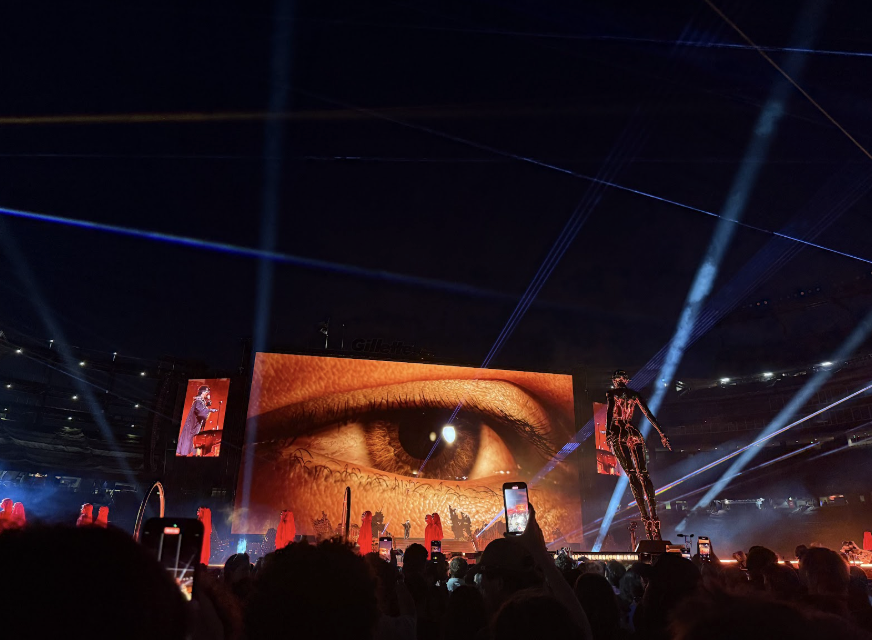
There’s a certain kind of night that college students chase. Not to add to their résumé or for a grade in a class, but for the unmistakable feeling of being fully alive. It begins with a question and ticket link sent in a group chat or a song played too loud in a dorm room. These nights stretch to a parking lot, where someone slams a car door and shouts that they’ll “Venmo for gas later,” to the highway into Philadelphia or New York City, where the skyline glows like an invitation you can’t turn down. By the time anyone actually steps into the line outside a concert venue, the night has already written half of its story.
The Fillmore in Philly is one of these venues. It always looks like it’s lit from the inside, with an industrial layout that is a sanctuary for soon to be adults who want to feel something bigger than their own dorm room ceiling. The crowd outside these shows hum with a single shared pulse. Strangers lean into one another. Conversations spark then fade, and everyone is waiting for the same moment. Everyone believes, in some small way, that what happens inside might change the way tomorrow feels.
For many college students, this pursuit of the live-music high has become almost ritualistic.
I felt that same pull last year, right after my freshman spring semester ended. My friends Daniel and Anto sent a link in our group chat: The Weeknd with Playboi Carti performing live at Gillette Stadium. At first, I hesitated. The prices looked brutal, hovering around $300 for seats that weren’t even close. But every night that week, the three of us sat on our phones like we were monitoring the stock market, refreshing SeatGeek and StubHub and comparing fees.
A night or two before the show, a pair of seats popped up for $115 each, still expensive, but nowhere near the gut-punch prices we’d seen before. We bought them immediately. The plan was set.
Parking at Gillette was pricey, but the moment we got our tickets scanned, we were caught in the tide of excited fans flowing toward the entrance.
And that’s when I saw him, a kid my age sprinting full-speed toward the metal detectors. He launched over the barrier, hit the ground running, and disappeared into the crowd before security could react. Maybe he didn’t have a ticket. Maybe he just didn’t care. Watching him, it hit me how much these nights mean to people, how someone would literally risk getting arrested or banned, just to be inside the same room where the music happens.
A close friend of mine, Ella, doesn’t talk about concerts the way most people do. She talks about them like operations that require strategy, multiple email addresses and at least a mild disregard for the rules of Ticketmaster. Her battle to see Harry Styles live unfolded like a war story told with soft edges.
She had multiple Ticketmaster accounts, each with a different email and a different backup number, a different little lie. Her laptop ran two browsers with four tabs each. Her phone ran three more. Her hometown best friend sat across her, refreshing a separate queue like she was manning a second lookout tower.
Ella waited forty-six minutes. She lost her tickets. Got kicked out of the system once. Logged back in. Watched the spinning blue circle like it held her future inside it. She kept refreshing long past the point where she believed anything would change.
And then, suddenly, it did.
“When the confirmation email hit, I screamed so loud my mom thought I fell off my bed,” she said. For Ella, it was never just about Harry. It was about proving she could get herself into the room, into the moment where thousands of people inhale at the same time and the lights hit your face and everything feels earned, even if the price borders on unreasonable.
This is the invisible truth behind the rising cost of concerts. Prices have risen nearly 30% since 2022, even for ten-plus-year touring artists. Ticketmaster, SeatGeek and StubHub have become their own ecosystems: part marketplace, part battleground. Students know a night can easily pass $200 with gas, parking, food and fees. But they also know that the value of the nights when music rearranges the shape of your memories, doesn’t have a price.
While the money spent on a ticket to a concert has gone up, and the ticket platforms used by Gen Z have grown more chaotic, students are still pouring time, money and energy into live music because the crowds themselves have become a kind of sanctuary. What keeps them returning isn’t just the artist onstage, but the collective pulse of strangers singing the same lyric all at once, the spontaneous friendships formed in lines to get in and the sense of unity that doesn’t exist in lecture halls or dorm hallways. In an era of rising stress, isolation and financial strain, concerts offer a rare communal space where students feel connected to something larger than themselves, proving that for many, the power of belonging outweighs the cost of admission.
Earlier last month, I also met with my friends Gabbi and Izzy. Both girls leaned into their concert stories.
Gabbi’s been to more than thirty shows, from small indie sets to massive hip-hop concerts. “Above a hundred dollars, I have to really love them,” she added, “but being in a crowd? That’s the part you can’t get through headphones.”
Speaking about Broadway, “If it’s someone like Jeremy Jordan, I’d do anything,” Izzy said. The cost becomes background noise when the artist has shaped a part of who you are.
Dorone, one of my fraternity brothers, understands this pull too. For him, it’s mostly about the artist, the energy they bring and the atmosphere that changes depending on who’s onstage. He’s been to six concerts, most of them planned weeks in advance.
Dorone reflected on what students face cost-wise. He says, artists could make concerts cheaper, or venues could offer student deals. But most of the time, the choice comes down to the same simple calculation students everywhere face:
Is this night worth it?
All of the people I talked to said different versions of the same thing, which is that once the lights dim, the crowd surges and the bass climbs up through the floor, money stops mattering.
Gabbi told me about the time she stood at the barricade at Childish Gambino after selling her original ticket because of orientation here at Muhlenberg, then buying another one last minute. She touched his hand. She met her best friend in that same crowd. “Worth every dollar,” she said.
Maybe that’s why, even as prices swell and waitlists grow and Ticketmaster becomes the villain of every group chat, students still go. They save, they scheme, they build multiple accounts, they refresh pages until the spinning blue circle becomes a second sun.
Because inside the venue, when the artist walks out and the crowd erupts and the lights scatter across the air, something settles. Something opens. You remember the version of yourself who still believes in moments. Or maybe you meet that version for the first time. “It’s the only place where everyone is rooting for the same moment,” said Addi, a friend of Ella’s. Just bodies packed together, waiting for the exact same chord to drop or the first lyric of a favorite song. “We’re broke, busy and impulsive,” she added. “Maybe that’s why concerts hit harder now.”
In that crowd, pressed shoulder to shoulder with strangers who somehow feel familiar, life becomes bigger, louder and more electric. For a few hours, you become the person you hope you’re growing into.
Sometimes, that’s worth the cost.

