


















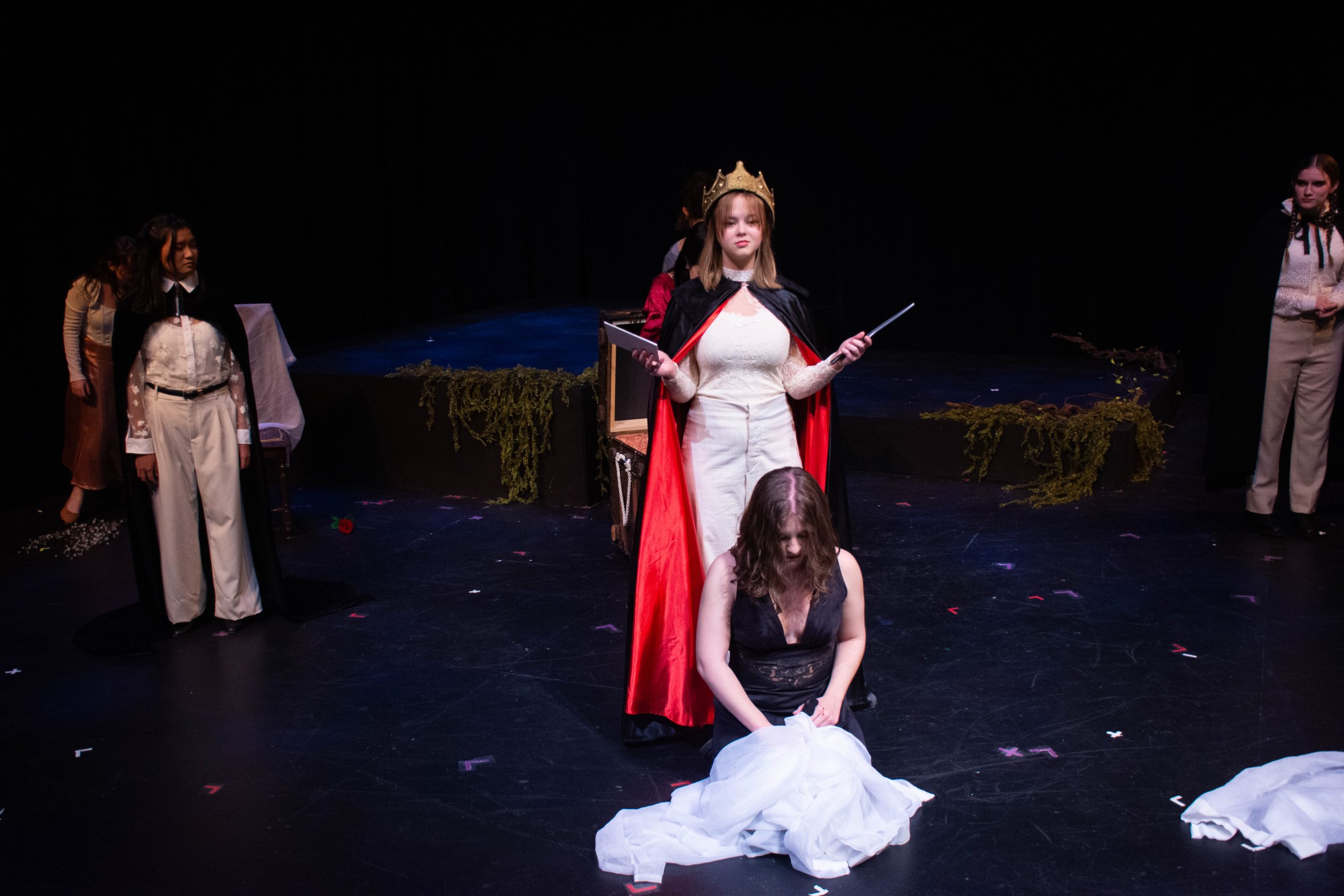
Between Nov. 13 and Nov. 15, the Muhlenberg Theatre Association (MTA) presented their Fall 2025 studio shows with a bonus performance to wrap it all up. These shows included “These Shining Lives,” “Shakespeare Hates Women”. The company celebrated their close with a following performance of “God I Didn’t Get it… A Miscast Cabaret.” Each show was student run and organized, allowing ample opportunity for involvement and creativity.
“These Shining Lives” was written by Melanie Marnich and directed by Lacey Cataleta ‘26. Based on a true story, the play begins in the 1920’s and follows through to the 1930’s following Catherine Wolfe Donohue, Charlotte Purcell and Pearl Payne, who were known as “The Radium Girls.” These young women were lured by competitive wages and a seemingly glamorous factory job painting watch faces, only to find themselves poisoned by their radium-dipped brushes years later. The story follows ordinary women who stood up against systemic neglect and fought for bodily autonomy, forever making an impact on worker’s rights.
This is not a sensationalized story, but one of complicated and brave women. Summer Neiditz ‘27 expressed that connecting with her role as Pearl was difficult at first, so she had to ask herself, “Why does [Pearl] still hang out in this group? Why wasn’t she as involved in the trial? What is her home life after work? Why did she stay at this job?” By putting herself in Pearl’s shoes, Neiditz reflected, “At a certain point it didn’t even feel like playing a character, but rather remembering a family member who had passed on. I’m always going to keep her with me.”
This was Adam Browning’s ‘28, who portrayed the company doctor and Judge 2, first play at Muhlenberg. He found that “playing multiple characters is always fun, even when they’re small parts, because you get to play around with different kinds of expressions, mannerisms and voices.” Browning had done theater all throughout high school with an outside director for all his shows, so he found Muhlenberg’s Studio Productions being student-produced to be very impressive, ultimately compelling him to audition and reconnect with theater.
Cataleta enjoyed leading new faces through this process, “including first-years who impressed me with their dedication, attention to detail and ability to balance the demands of transitioning into college while contributing so much to the show. It was a joy to mentor my stage management team Lucy [Corkery ‘29] and Lilly [Fleischer ‘29], both first-years, through their first experience as production stage manager and deck stage manager!”
Cataleta credited Sam Freed ‘26, the production’s dramaturg, as being essential to “effectively communicating the play’s message. She adeptly guided the cast and creative team through the rehearsal process by providing crucial education on the societal norms prevalent in the 1920s.” Freed was “the bridge that connected the divide between the world we live in and the world we must portray.”
Like Neiditz, Browning highlighted how “All of the characters are so well developed– they’re the heart of it. And the script touches on so many different themes, from gender roles to social class to the existential fear of death. I really loved the more abstract aspects of the script, and I think our director, Lacey, really leaned into those elements.”
This performance was not only emotional for the audience, but for the cast and crew as well. Cataleta said, “It was most important to me that each designer, actor and stage manager felt safe and had room to feel through their emotions. This production reminded me that time is precious, and it moves too fast. Often, we do not take a moment to really let that soak in, and we were doing that throughout the entire production process.”
Neiditz connected to “These Shining Lives” personally. “As a disabled woman, I know what it’s like to not have your pain be believed by others, so being part of a story that shows women standing up for themselves was so empowering for me. It also taught me the importance of living in the moment and cherishing the time we have together. I spend so much time worrying about the future, but this play showed me how to slow down a bit and just cherish the moments I have with the people I love.”
Neiditz explained, “The play ends with us reflecting on all of the beautiful women who have come before us and will come after us.” Ultimately, “These Shining Lives” is an inspiring, poignant and powerful story that highlights the value of life and the importance of using this time to fight for justice.
The second studio play,“Shakespeare Hates Women,” written and directed by Nerissa Deschambeau ‘28, was performed on Nov. 13 through 15 in the Studio Theatre. The play featured five prominent female leads from Shakespeare’s works, Ophelia, Juliet, Lady Macbeth, Cordelia and Tamora. The five women shared one thing in common: harrowing, gruesome fates, which they mourned in the production.
The scene began with Ophelia, played by Lucy Baron ‘26, and Juliet, played by Maren Robins ‘29, innocently playing together, with Ophelia breaking into a sorrowful ballad, setting the tone for the performance. One by one, the five women took center stage to speak their tales of woe. Hamlet, played by Corey Childress ‘29, and Romeo, played by Avery Peters ‘26, debuted on stage throughout the play, taunting their female counterparts.
The three witches, played by Sof Oberg ‘26, AJ Devine ‘29 and Katelen Estrada ‘29, appeared to offer the five women salvation, bearing a collection of items to represent their downfall. These items included a noose for Cordelia, a dagger for Juliet, a letter for Ophelia, a crown for Tamora and a bloody cloth for Lady Macbeth played by Faith Miller ‘26. One by one, they give their items back to the lead witch, and in doing so, seem to regain their sense of hope and liveliness. They break into laughter which turns into screaming, as the play concludes.
Baron says, “I thought ‘Shakespeare Hates Women’ was a different experience, bringing a student’s original written work to life on stage. Having not worked on a lot of Shakespeare material, I loved getting the opportunity to bring Ophelia to life. I am thankful to have gotten closer to the cast through the process.”
Another one of the actors in the piece, who wanted to stay anonymous, weighed in on their experience and areas for improvement. They commented, “I think our cast bonded a lot throughout the rehearsal process which was great! We had a lot of time to play around and get to know each other so we also managed to develop inside jokes as we developed our characters. It was really fun getting to explore a new work and a new interpretation of Shakespeare, although I would have loved a bit more insight from the playwright as to why these characters were chosen and what is significant about the interaction between them. Some of the choices within the script felt like they deeply misunderstood the characters’ motivations in their original stories, and I think the piece would benefit from more workshopping, although I think the idea is solid.”
Summarizing their experience with the process, Deschambeau adds, “Working on a Studios [Productions] has given me a chance to broaden my horizons in the theater making world. It has allowed me to view things from brand new angles and work with other people passionate about student led creative projects.”
Also in the Studio Theatre, “God I Didn’t Get it… A Miscast Cabaret” took place on Sunday, Nov. 16. The show ran twice, first at 2 p.m. and at 7 p.m. Directed by Dominick Borges ‘27, the show combined songs from some of theatre’s greatest hits. Amusingly self-referential, the plot followed a series of students auditioning for a play.
The cabaret began with two ensemble numbers, “In” from “Carrie” and “God I Hope I Get It” from “A Chorus Line.” When the cast list came out, the students began singing “Pure Imagination” from “Charlie and the Chocolate Factory,” electing to rewrite the narrative and perform their dream roles for each other.
This led to some antics, such as Dan Harel ‘26 singing “So Much Better” from “Legally Blonde,” Harel, Joaquin Arce ‘29 and Bobby Becht ‘27 taking on “The Schuyler Sisters” from “Hamilton,” Avery Frank ‘28, Sam Loeser ‘28, Sophia Wentz ‘27 and Sam Hoffman ‘27 performing “Gee, Officer Krupkee” from “West Side Story” and Becht tackling “For The Gaze” from “Death Becomes Her.”
That being said, it also led to deeply emotional and moving performances, such as Hoffman’s “Maria” from “West Side Story,” Amaya Romero’s ‘29 “ I Don’t Care Much” from “Cabaret,” Noelle Simone’s ‘26 “Santa Fe” from “Newsies,” and Natalie Ottaviano ‘26 and Romero’s “If It’s True” from “Hadestown.”
Commenting on these performances, Hoffman added, “Being a part of the cabaret was such a wonderful experience! I loved working with everyone and the cabaret format let us have fun working on songs that we typically wouldn’t be able to perform.”
The play ended with a final performance from all of the students: a choreographed rendition of “We’re All in this Together” from “High School Musical.”
Reflecting on the creation of the show, Borges shared, “Creating a show from the ground up was definitely a unique challenge, especially in a cabaret setting. You have to figure out what songs you want, how it can fit into a relative plot and how it all can come together while still preserving the original stories being told in the songs you’ve chosen, and I’d be lying if I said it didn’t take a lot of trial and error. In the end I knew that I wanted a show that was just a fun time, for actors and audiences alike, and in being able to work with such an amazing team and cast I think we were able to achieve just that. Crafting something new and fun with such great people was such a gift and I’m beyond grateful for the experience.”

Emma Northrop '27 is a History, English Literature and International Studies major at Muhlenberg. She loves writing for the Weekly, and is immensely excited to be a managing editor. When not at the Weekly, she loves reading her favorite fantasy novels, drinking lavender vanilla iced lattes, and scrapbooking.

Gabriela Mendez ‘28 plans to major in English with a minor in Spanish. She is very excited and honored to be joining the Weekly staff! Outside of writing, she loves to read, be one with nature, and watch new movies.

