


















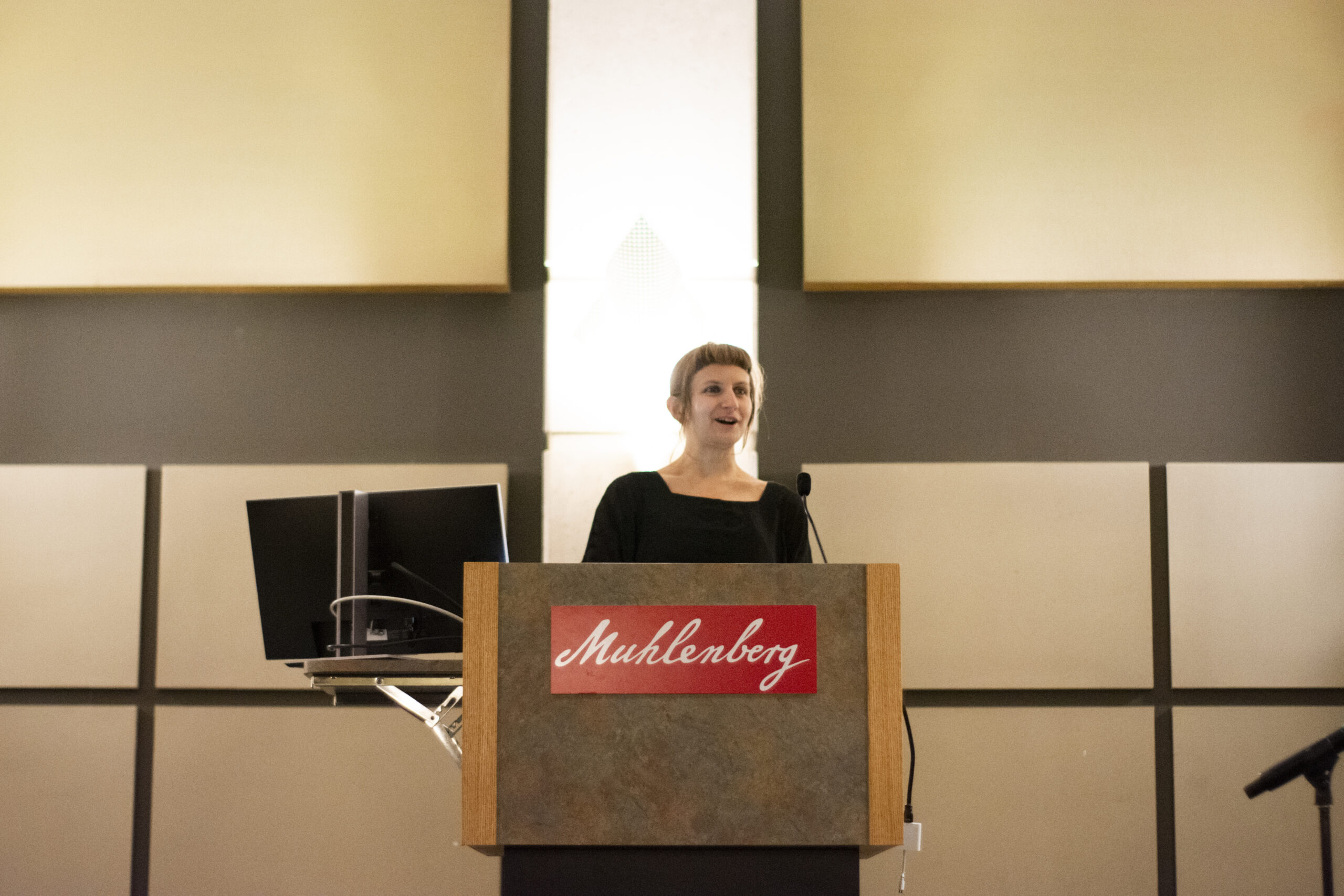

On Wednesday, Oct. 1, Muhlenberg College’s Radio Station WMUH, welcomed Liz Pelly to discuss her book “Mood Machine: The Rise of Spotify and the Costs of the Perfect Playlist.” With a turn out of almost 60 attendants, the lecture was shown to be an intriguing topic for many.
Paul Krempasky, the general manager of WMUH, began by thanking the department of media and communication, the department of accounting, business, economics and finance, the Lectures and Forum Committee and The Martin Guitar Charitable Foundation for making this event possible.
Pelly made the audience laugh by introducing herself as an author and music journalist, “but to Spotify I am also some other things.” She wrote her first official article, published by CASH Music’s Watt, about Spotify in June 2017 regarding her concerns over artists on Spotify not getting paid directly. Instead of direct payment, a big portion of their earnings first go to rights holders, record labels and distributors. Krempaky highlighted that “While streaming allows for easy access to the consumer, the process seems to undervalue the art and the artist.”
Pelly continued to dive deeper into Spotify’s power dynamic with artists. At first Spotify wanted to be a platform for all music, however, in 2012 they performed studies, changing their priority into using their interface for advertisement to grow their outreach. The studies revealed that more people listen to music based on moods and movements. According to Pelly, Spotify realized “active listening was a smaller part of the experience. There were way more listening hours using music as a background.” Spotify began promoting their platform as having “music for every moment.”
“Pelly tries to ‘push back on the idea that replay value dictates music’s worth’ because artists should be encouraged to prioritize artistry over trying to make a song commercially successful.” – author and music journalist, Liz Pelly
Music being homogenized makes it hard for local artists to gain enough traction to transition out of the “Early Bets” regional playlists. Pelly tried to “push back on the idea that replay value dictates music’s worth” because artists should be encouraged to prioritize artistry over trying to make a song commercially successful.
While Kendra Brosious ‘27 enjoys the mood playlists Spotify promotes, they compared Spotify’s tactics to America’s trickle down economics “where the big artists have gotten bigger and the small artists have little traction to ever hope of getting to that size.” Due to smaller artists getting significantly less recognition on Spotify, some artists have sacrificed 30% less pay in exchange for Spotify’s discovery mode to increase their chances of having their chosen songs recommended on Spotify’s interface. After this lecture, Sadaat Umankulova ‘29 was left wondering, “how such [a] big streaming platform for music is not paying enough for artists.”
Brosious has noticed this disproportionate push of well known artists as Spotify continuing to “promote Taylor Swift’s new album when I don’t listen to any of her new stuff, but at the same time not getting more than one notification for a small artist named ‘brooke’ who also released something today, and whose music I listen to way more frequently. [It is] not a healthy way to sustain the industry.” Umankulova comments, “there are artists who put hard work into music we listen [to] as a background but they do not get enough recognition.”
According to Pelly, Spotify wants people to mindlessly accept it as a place where a click of a button will result in the perfect recommendation at the perfect time. Reduced cognitive work is further promoted by Spotify’s use of Artificial Intelligence (AI). Pelly explains that AI DJ makes personalized playlists using radio metaphors to resonate with older generations while Generative AI targets the younger demographic by having playlists like “pilates princess” and having “titles with all lower cases.” Different demographics may be targeted differently, but Krempasky notes that “the issues of access to art, artist compensation and exploitation of data should concern us all.”
“WMUH hopes to continue hosting similar events because ‘they offer the campus and community an opportunity to listen to and learn from experts on topics that may not be discussed at length in the traditional classroom.” – Paul Krempasky, the general manager of WMUH
Pelly concluded by emphasizing the importance of collective power. During the pandemic, musician solidarity organizations came together to talk about their struggles, resulting in a piece of legislation being introduced last year. In September the United Musicians and Allied Workers (UMAW) bill was reintroduced advocating for artists to be paid directly and fairly. Dylan Rodas Estada ‘29 appreciated how Pelly focused “not only on regular day to day people, but she is also involving musicians themselves which you don’t see happen very often.” All artists, regardless of popularity, deserve a community that supports them and a payment model that serves them.
Krempasky noted that WMUH hopes to continue hosting similar events because “they offer the campus and community an opportunity to listen to and learn from experts on topics that may not be discussed at length in the traditional classroom.”
Photo by Sierra Addy ‘27

Gabriela Mendez ‘28 plans to major in English with a minor in Spanish. She is very excited and honored to be joining the Weekly staff! Outside of writing, she loves to read, be one with nature, and watch new movies.