



















On Sept. 1, The Academic Program Prioritization Advisory Task Force delivered its 87-page report to President Kathleen Harring and College faculty members. The Weekly obtained a copy soon thereafter. The task force consisted of 10 faculty members and members of the Provost’s staff, who were authorized to spend the summer creating recommendations for changes to different academic programs. According to the report, the goal of this task force and their recommendations is “to ensure the College’s academic offerings are aligned with its mission, are responsive to student interest and societal need, are financially sustainable and positioned to enhance the institution’s distinctiveness and value proposition in a time when the value of higher education is challenged.” While the task force’s report makes recommendations for changes, it is not responsible for making any final decisions.
These recommendations for change come at a time where “the number of students and overall net tuition revenue have declined steeply in the past few years, the cost of instruction at Muhlenberg has remained relatively flat, leading to a deficit.” The cost of instruction at Muhlenberg is already higher than that of our peer institutions. In the 2023 fiscal year, Muhlenberg spent 54% of its core expenses on instruction. In comparison, the average instructional costs of non-profit, private, 4-year colleges is 40% of its core expenses.
The impetus for forming the Task Force was economic realities that result from the significant change in the number of students (2200 to 1600) and the College’s continued generous financial aid assistance to students and their families.
Along with the cost of instruction remaining “relatively flat,” net tuition revenue (NTR) has declined. The report defines net tuition revenue as “[representing] the earnings the College receives from tuition and fees after all discounts, scholarships and other aid are subtracted.” In the 2023 fiscal year, the College gained 48% of its revenue from net tuition revenue. With enrollment declining, tuition revenue has declined. This has led the College to enter deficit spending.
Changes have been recommended across all departments and programs, and the report also offers suggestions for investing in new programs. The report states, “As a faculty task force, we urge all programs to make changes that both respond to declining tuition revenue and ensure our curriculum evolves in ways that attract and inspire future students.”
The report continues onwards to state, “These recommendations will not be comfortable or easy. They will challenge deeply held assumptions about what is possible in the classroom, laboratory or studio. The task force continues to underscore the need to think innovatively, and to make choices we may not like in the short term in order to accomplish long-term financial sustainability. Please do not read these recommendations and assume that it is possible to continue teaching the way you always have. For this to work, we must change together. For us to make space for new and innovative collaborations and programs, we will all need to think critically about how our programs can offer fewer classes than they traditionally have.”
The report detailed seven categories of recommendations, including increasing average class size, offering fewer courses across the College, reducing/sharing departmental administrative costs and rebranding programs to increase enrollment. In addition, suggestions were made for changes to sustain losses to faculty and instructional staff. The goal is to get to 120 faculty.
Each department was then given program-specific recommendations within these broader categories. Not every department was given recommendations in every category. For example, the dance department was given recommendations in the following categories: “teach fewer classes,” “reorganize administrative structures,” “restructure to sustain reductions, future reinvestment not likely” and “rebranding/repositioning,” while the international studies program was only given a recommendation in “increase average class size to closer to 20:1.”
When looking at program specific recommendations, there are continuities across different departments. Stacking courses, meaning that multiple different sections of a course run at the same time to decrease the faculty workload and its equivalent costs, are recommended in departments including biology, chemistry/biochemistry, environmental science, history, physics/physical science and studio art.
Many departments were advised to move multiple introductory courses into one larger section to decrease faculty workload. Such departments include biology, mathematics and psychology.
The task force even recommended eliminating certain major programs and shrinking them to a minor, including French & Francophone studies, American studies and film studies, or shrinking programs to a micro, like Asian studies.
Following the program specific recommendations, there’s a section titled, “Why our cost savings plan will work,” which explains how the excess instructional costs will help in recovering the 2024 fiscal year deficit of $9,440,455, but there must also be additional changes.
These changes are found under a section titled, “Recommendations for new programs.” Recommended new undergraduate programs are a minor/major in Artificial Intelligence (AI) and cybersecurity, a business concentration in sustainable logistics and supply chain management and musical theatre. Some of the new undergraduate programs that utilize the College’s existing resources are medical humanities, food science, sustainable business and bioethics.
There are numerous “College-Wide Cross-Program Recommendations” that “[capture] recommendations that apply College-wide, or across all academic programs that emerged from our analysis and deliberations.” These recommendations include staffing reductions, curriculum changes, changes in administrative organization, changes to the course unit system and changes to how the College uses recitations. Specifically, the recommendation for recitations urges recitations to only be offered when there are more than 40 students enrolled in one course.
The final section in the college-wide recommendations is titled “Other” and specifically mentions that it “is a more eclectic list of ideas that the task force has not extensively vetted, but came up in our conversations and survey of the faculty.” Some of these ideas include setting expense caps to faculty travel, cutting back on the hiring of professional musicians when necessary for ensembles, limiting students to going abroad for one semester and charging students if their program is more than what they pay in tuition, limiting the number of courses “first-year, first-time degree-seeking students” can bring to Muhlenberg and changing the nature of teaching evaluations.
All changes in the report are simply recommendations. It is not yet clear what recommendations will be implemented.
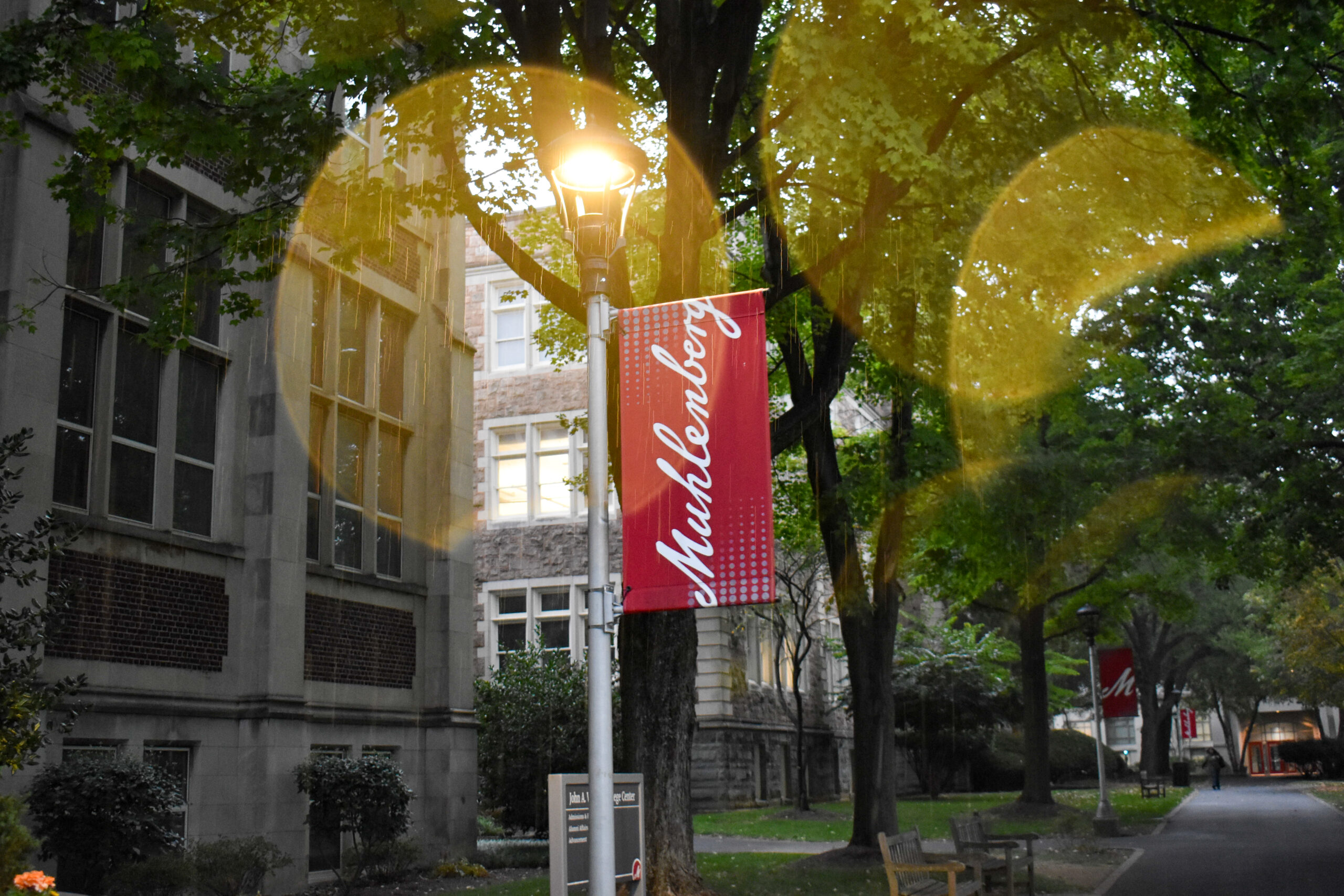
Photo by Kira Bretsky ’27.

Amy Swartz ‘26 is an English & Creative Writing and Political Science double major. She has been part of The Weekly since her freshman year, and is thrilled to be Editor in Chief! Outside of the Weekly, you can always find her reading a new book, crafting, or rewatching an episode of her favorite sitcoms!