



















It’s easy to look at collegiate football players as entertainers and competitive athletes. However, behind the helmets and dirty jerseys are students dealing with the growing pains of physical and mental challenges as they navigate the pressure of school while trying to balance their sports commitments. Stress, anxiety, depression and burnout don’t discriminate, no matter how talented one’s athletic ability may be. Interviews with football players competing at different levels of collegiate football, Division I (D1) versus Division III (D3), indicates a distinct difference in the stressors these athletes face indirectly and directly, as demonstrated through their struggles to manage their priorities between athletics and academics.
Exploring Division I and Division III football provides insights into what it means to be a student-athlete while highlighting the demands that accompany the sport. In contrast to D1, D3 football schools tend to host a more balanced collegiate experience where academic performance and personal growth are equally prioritized. Alternatively, D1 football schools often focus more on the athletic performance of their players than their academic successes.
D1 football is the highest level of college gameplay, and with that comes several challenges and experiences that D3 athletes do not face. A majority of D1 players go to college on athletic scholarships, which can provide significant relief from financial burden. However, the added pressure to be successful on the field as well as in the classroom can lead to intense stress for the athlete. D1 football players generally dedicate more time to training and conditioning compared to D3 players, leaving them with less time to study or become involved in clubs or extracurriculars. This can ultimately create an unbalanced college experience for the D1 athlete.
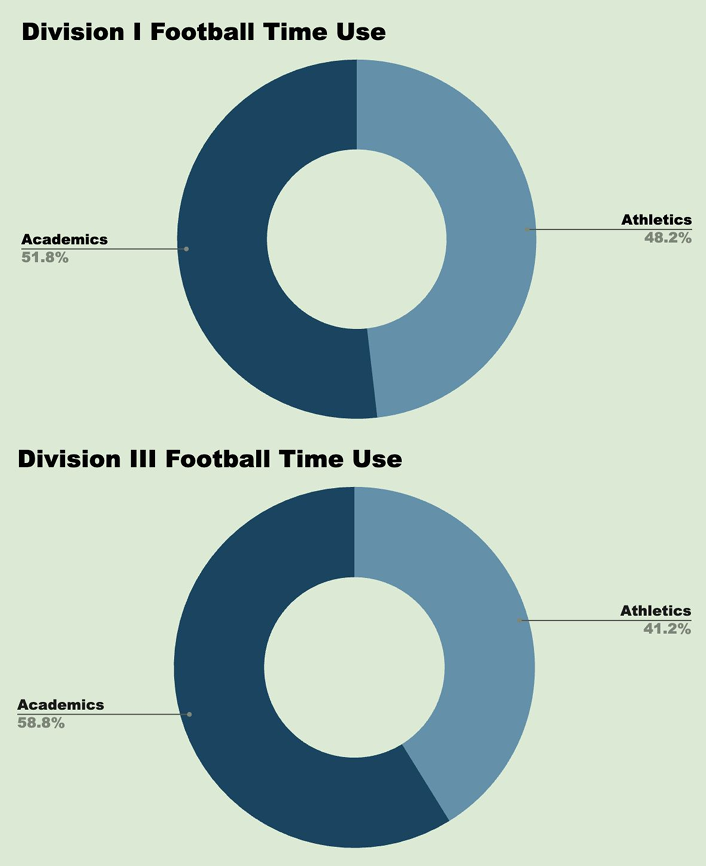
A study conducted by the National Collegiate Athletic Association (NCAA) found that D1 football players invest an average of 33 hours on athletics and 35.5 hours on academics per week. Conversely, D3 football players were found to spend 28 hours on athletics and 40 hours on academics per week. While this weekly difference may seem minor, it adds up to 18 hours more a month that D3 athletes are able to dedicate to their school work.
Arguably, the commitments of D1 football players and other high-level collegiate athletes allow for very limited time on their academics, which can lead to lower grades and the risk of their scholarships being rescinded. “I do sometimes struggle with balancing schoolwork, football and my everyday life,” exclaims Trace Scott ‘28, a defensive lineman at the University of Delaware. “I find myself getting too focused on one specific part and ignoring the rest.” Scott is “one of many on the team” who struggle with the demands of being a D1 student-athlete. Scott also feels that some of the major reasons for D1 football consuming so much time and stress is because off the field and outside of game days. Scott says he participates in “extensive strength training, hours of film study, high stakes and pressures to win from the amount of people in the stands.” Along with that, “With so much on the line, it’s easy for academics to slip from your mind and priority.”
The imbalance between being an athlete and a student has been a concern for years now. A study conducted back in 2009 reported that “70 percent of respondents in Division I said they considered themselves more an athlete than a student,” based on the time they spend training compared to all other activities. On the contrary, “D3 schools often foster close-knit communities where student-athletes receive academic support from professors and athletic staff. This type of support allows for stronger mentorships, networking, and a balanced college experience.”
“I do sometimes struggle with balancing schoolwork, football and my everyday life,” exclaims Trace Scott ‘28, a defensive lineman at the University of Delaware.
“At times, it feels overwhelming with lifts, practices, meetings and schoolwork. I would say at the D1 level it’s probably more overwhelming as they are kept on an even stricter schedule,” states Shane Corkill ‘28, a football receiver at Muhlenberg College. When asked about how the balance of academics and athletics play into his mental health, Corkill answers, “Mental health and balance with school and academics is the most important part of my experience and performance as a student-athlete. […] Keeping things in perspective and never getting too high or too low is necessary for your quality of life.” When asked the same question, Scott responds, “School, sports and mental health play a huge role in how you play [on the field]. You need to be in the correct state of mind to perform at your best at all times. Off the field, having good mental health allows you to focus on what needs to be done in order to be eligible to play.” As seen, the D1 athlete is conditioned to focus more on maintaining strong mental health in order to play well, however, the D3 athlete understands that maintaining good mental health contributes to a better balance in life and a more fulfilling collegiate experience.
Mental health concerns, injuries and burnout exist at both the D1 and D3 college levels, however, the resources available to address these stressors can differ dramatically within the divisions. D1 programs often have access to top-tier athletic facilities, nutritionists, trainers, sports psychologists and medical staff. On the contrary, D3 schools often are unable to take advantage of those same luxuries, relying more on personal support networks and their own resources to manage their health and well-being.
Based on the noted studies above and athlete interviews, D1 athletes seem to battle higher athletic expectations and intense national exposure, with less emphasis on academics. Meanwhile, D3 athletes have more support to balance their academic and athletic responsibilities, all while being able to play the sport they love. In closing, D3 football schools host a more balanced collegiate experience where academics and personal growth are equally prioritized. D1 schools tend to place much more rigor on athletics, where academics can often take a back seat, making it that much more challenging for a student-athlete to find balance. D1 programs should look for more ways to provide equal athletic and academic support for their athletes so that they can maintain more of a balance while playing and succeeding in college. This, in turn, can lead to less burnout and greater mental and physical health among the athletes.
