



















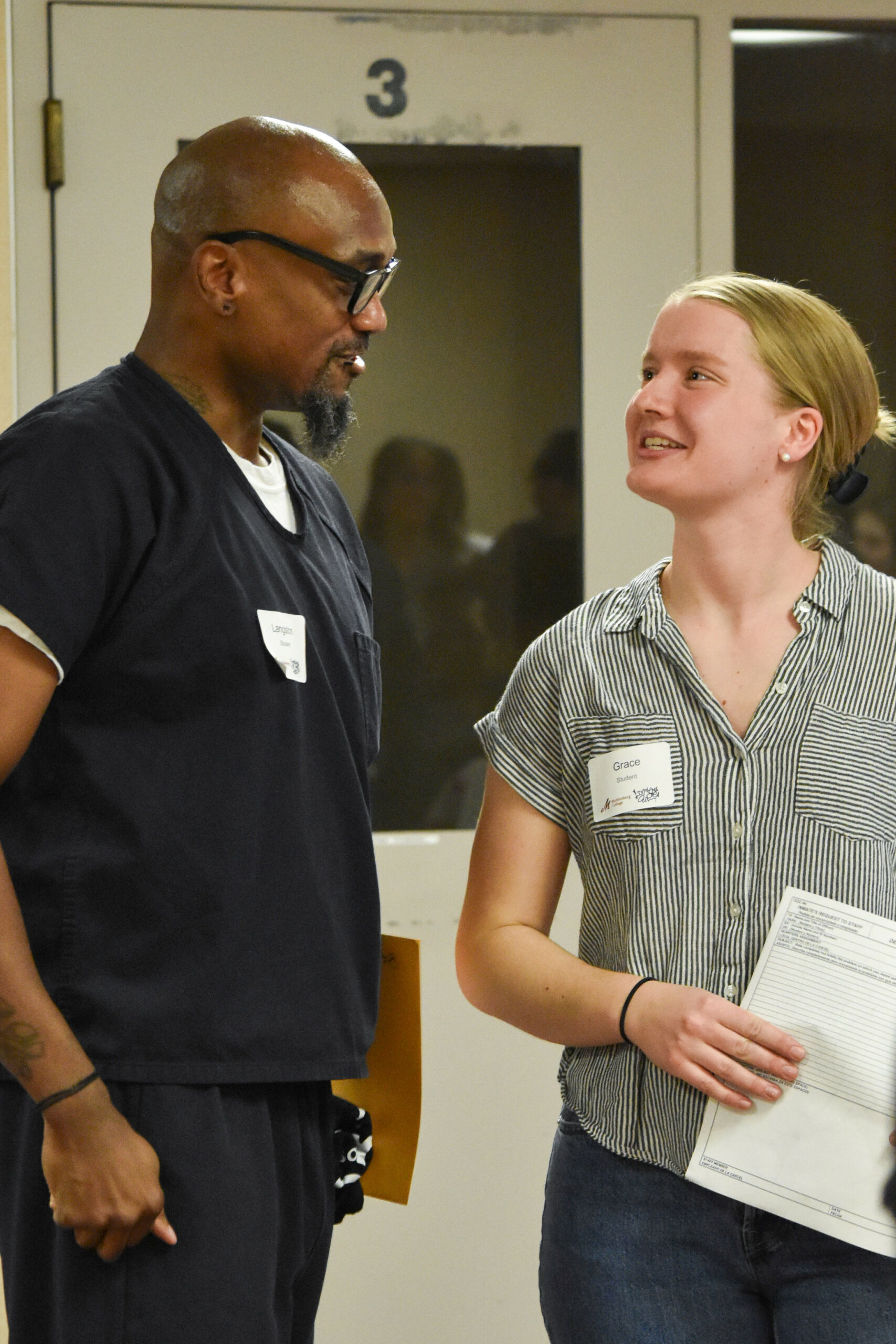
Grace Leard ‘25 is a research assistant for Muhlenberg College’s Inside-Out Prison Exchange Program, which works with the Lehigh County Jail to conduct classes with both Muhlenberg students and currently incarcerated students. The program is co-run by Psychology Professor Kate Richmond and Community Engagement Librarian Jess Denke. The program consists of a think-tank, where “inside” (Muhlenberg) alumni and “outside” (formerly incarcerated) alumni collaborate on prison reform efforts.
Leard’s work with Inside-Out began in fall 2023, where she joined the program’s research team, which consisted of half Muhlenberg students and half formerly incarcerated program alumni. Starting last year, currently incarcerated students were able to earn college credit through the program. She noted, “The goals and projects of this team really shift with time and are informed by what Inside-Out is engaging with in the community.” During this time, the research team was invited to present at the Inside-Out Prison Exchange Program’s Twenty-Fifth+ Anniversary Conference at Temple University, where the first Inside-Out course was taught. “I had the opportunity to be a part of the team’s panel entitled, ‘Valuing Community: Relational Development to Support the Formation of a Credit-Bearing Inside-Out Program,’ exploring how relationships built with community members, organizations and policymakers allowed Muhlenberg’s program to receive it’s first grant funding in order to continue to operate and expand. Very quickly I learned that not only was I deeply passionate about these relationships, but that this relational development is critical to the sustainment and success of the work we do.”
Her work continued that following spring semester, participating in a research project that sought to evaluate the program’s effectiveness at meeting its learning goals, as well as taking the Inside-Out course. Leard noted her excitement at “getting the chance to be a part of the transformative community I had only been a witness to up until that point. Unlike a traditional class focused solely on knowledge attainment, Inside-Out is deeply rooted in fostering community, building hope and increasing critical consciousness, encouraging students to go forward and engage in broader prison reform work. It is intentionally intergenerational and relationally-driven, helping actively dismantle the assumptions and biases both ‘inside’ and ‘outside’ students may bring into the classroom space. The course’s learning goals were identified through participatory action research design, asking students what they believed the biggest take-aways from the class are and that spring we collected our first data set, measuring both ‘inside’ and ‘outside’ students’ attainment of the learning goals.”
“I continue to be excited by the asset-framed, actionable and social-justice focused framework radical hope provides.”
Stemming from a childhood interest, Leard’s motivation for engaging in this work was bolstered by her time at Muhlenberg, especially with the psychology and sociology departments. Leard shared, “Growing up, I always knew carceral-system reform was something I was really passionate about but had never had the chance to truly engage in the work. Coming to Muhlenberg, my psychology and sociology majors allowed me to explore this passion in an academic sense, contributing to my growing drive to get involved further.” Her passion was further developed by an internship with SELF! Lehigh Valley Women’s Reentry (SELF!) the summer after her sophomore year. She continues, “As a transitional housing program for women reentering society after incarceration, SELF! allowed me to get involved in all levels of community reentry work, attending community meetings about incarceration policy in the Lehigh Valley, grant writing, tabling at community events and communicating with potential new residents or their families. However, very quickly I realized the relational part of the work was what I was most passionate about. I came to cherish days spent in the office chatting with the women who lived in the house or helping people learn how to tell their stories in order to apply for a pardon from the state of Pennsylvania. At this point, I knew that whatever direction I headed next, it had to be driven and informed by the voices of justice-impacted individuals whose knowledge and lived experience is all-too-often silenced.”
At the core of Leard’s research is the concept of radical hope, introduced to her by Richmond. As she wrote her senior honors thesis for both psychology and sociology, she found herself reflecting on her involvement with Inside-Out’s research team, particularly the obstacles faced by those reentering society after being incarcerated. She particularly grappled with the lack of hope most reentrants have, especially when struggling to obtain steady employment, housing and resources. Radical hope, for her, poses a unique resolution to this issue. “Radical hope proposes a unique pathway to developing ‘true’ hope: One that does not place false hope in far-off or impossible things but instead, holistically examines the realities and complexities of individual and collective experiences, trauma and avenues for change through not only individual action but also collaboration with the larger community. I continue to be excited by the asset-framed, actionable and social-justice focused framework radical hope provides.”
Leard’s senior thesis aims to explore this concept of radical hope: “For this project, I am utilizing a mixed-methods design, collecting new survey data from formerly-incarcerated alumni across various years of the program’s existence as well as conducting interviews to focus more specifically on hope, exploring how an individual’s personal conceptualization of hope may be correlated with increased or decreased reentry success. I am incredibly grateful for the opportunity to explore my specific interests more deeply, receive mentorship throughout the research process and be able to hopefully contribute to the continued growth and success of a program that means so much to me.”

Alexandra Downey ’27 is an English & Creative Writing and Media & Communication double major. She is incredibly excited to be Editor-in-Chief! She enjoys playing tennis, rereading everything on her bookshelf, and showing off pictures of her dogs.