



















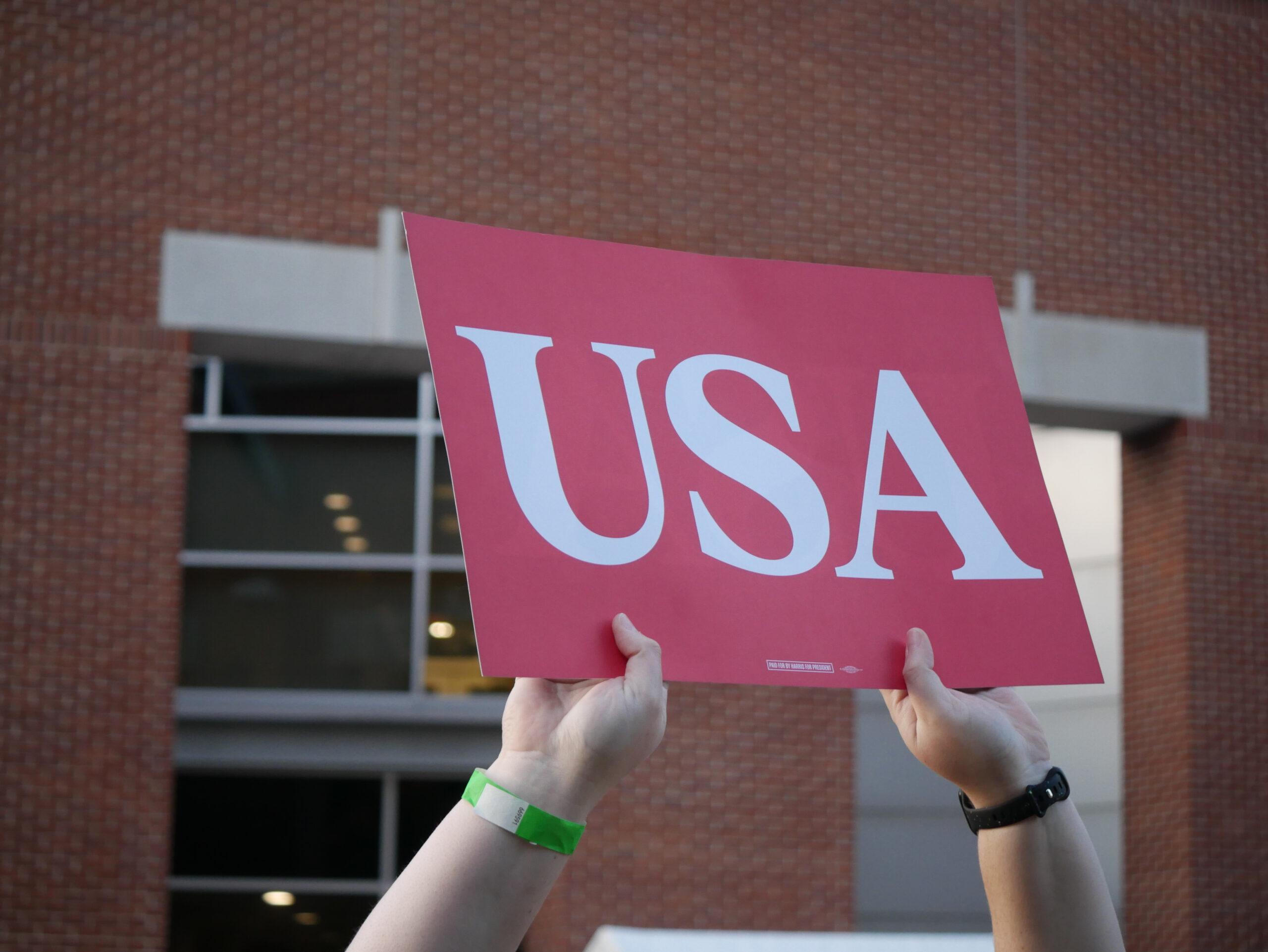
Muhlenberg students are tired. With Vice President Harris holding a rally in the Life Sports Center on the final day of her presidential campaign, to a highly polarized election day where Muhlenberg students flooded the polls and Donald Trump being elected the 47th president of the United States– it’s been a tumultuous election season.
The election post-mortem, the concluding event of the 2024 election series, acted as a space for students and faculty to reflect on the election and discuss potential impacts. Mohsin Hashim, Ph.D. and Lindsay Burt, Ph.D. were the moderators for the event. Hashim discussed the goals of holding a post-mortem. “The goal of this event was to help our campus community make meaning of the election results. My colleagues in the department used their expertise to explain the election outcome from a variety of analytical perspectives. The presentations and the robust discussion that followed considered the impact of Trump and the Republican party’s victory on a variety of policy fronts that will affect our lives.”
Burt and Hashim opened the event by giving a priming speech, explaining what the post-mortem is meant to be, how American politics got to where they are now and how important the election was.
The panelists for the event were members of the political science faculty, as well as students who went exit polling on election day. Panelists were Lanethea Mathews-Schultz, Ph.D., Ross Dardani, Ph.D., Jack Gambino, Ph.D., Emelia Delong ‘27, Marissa Cohen ‘25 and Chris Borick, Ph.D.
A significant portion of the post-mortem was dedicated to students being able to ask questions to panelists. Students were eager to have their questions answered, with over fifteen students participating during the Q&A portion. Topics of students’ questions included the relatability of Harris, possibilities if Harris weren’t the incumbent, climate change, current political polarization in the US, populism, the divide between college-educated and non-college-educated voters, if the pendulum of Republican and Democrat being voted into office will continue, Trump’s tax policies and why Pennsylvania– as a pivotal swing state– turned red.
“The election post-mortem, the concluding event of the 2024 election series, acted as a space for students and faculty to reflect on the election and discuss potential impacts.”
Panelists used student questions to frame their responses, oftentimes opting to cover broader topics spanning multiple student inquiries.
Gambino gave his perspective on climate change, its impact on the election and what policy could look like moving forward under the Trump administration. “I wish I had something positive to say about this, but I don’t think there is. You’ll recall that in the first administration, Trump pulled out of the Paris Agreement. He’s promised to ‘drill, baby, drill’… even though the United States is drilling more than it ever has.” He continued with a reflection on the issue at large. “I think the issue of climate change is on hold despite what we’ve seen in Florida in the last couple of months. I’m afraid that the American public has taken that off the agenda to a large extent. I think there’s an underlying feeling, a mood, that climate change really is real, but it’s too big of a problem for me to worry about, so I’m not going to worry about it.”
Borick discussed the tax policies that could impact Americans moving forward under the Trump Administration. “Trump is promising tariffs. What will happen with tariffs? It raises costs of goods. At the same time, he’s promising tax cuts on lots of things that might be pretty good, and valuable over time, tips, all those things. The reality is, and I’m not an economist, but that money, for folks with moderate incomes, goes right back into spending. That’s not saved, that’s put back into the economy. What do those two things do? That’s inflation.”
Borick asks, “what can we take away from this election?” He claims “That educational divide that is present now in the electorate is bigger now more than ever. People in the electorate with college degrees versus those without college degrees diverge more than ever in this election cycle.” He then relates it back to students attending the post-mortem, claiming that if this event happened a few decades ago years ago, the views at Muhlenberg would be a “more mixed crowd.”
Students and staff alike reflected on the post-mortem. Kendra Brosious ‘27 said, “I feel as though the post-mortem gave the campus community a place to discuss the elections that wasn’t a heated online debate. For me, every time I’ve gone on social media this past week, there has been argument after argument, and it has become suffocating.”
Kirsten Ward ‘27 found the post-mortem as an opportunity to learn. “I believe the election post-mortem provided an important space for dialogue surrounding the recent results. It was interesting to hear the perspectives of each department member in relation to their concentration and was an opportunity to think about the election through multiple lenses. There was focus on both the positives and the negatives, but it mostly provided information. People, especially students, have lots of questions right now. Even if not all of them have answers, this event was a starting point for collaborative problem-solving.”
Lanethea Mathews-Schultz, Ph.D., discussed the importance of moving forward. “Friday’s event was a shining example of the best kind of inquiry and analysis that guides the liberal arts and civic education. These events are important spaces where we can all think more critically and deeply about what we think, and what we feel, about our political world—this is so important for meaningful participation in the public realm. I don’t know what the long-term consequences of the 2024 election will be, but I do know that one of the most important ways we can protect our democracy is by building and engaging in community–on campus but importantly also beyond campus– and connecting with other people.”

Amy Swartz ‘26 is an English & Creative Writing and Political Science double major. She has been part of The Weekly since her freshman year, and is thrilled to be Editor in Chief! Outside of the Weekly, you can always find her reading a new book, crafting, or rewatching an episode of her favorite sitcoms!