



















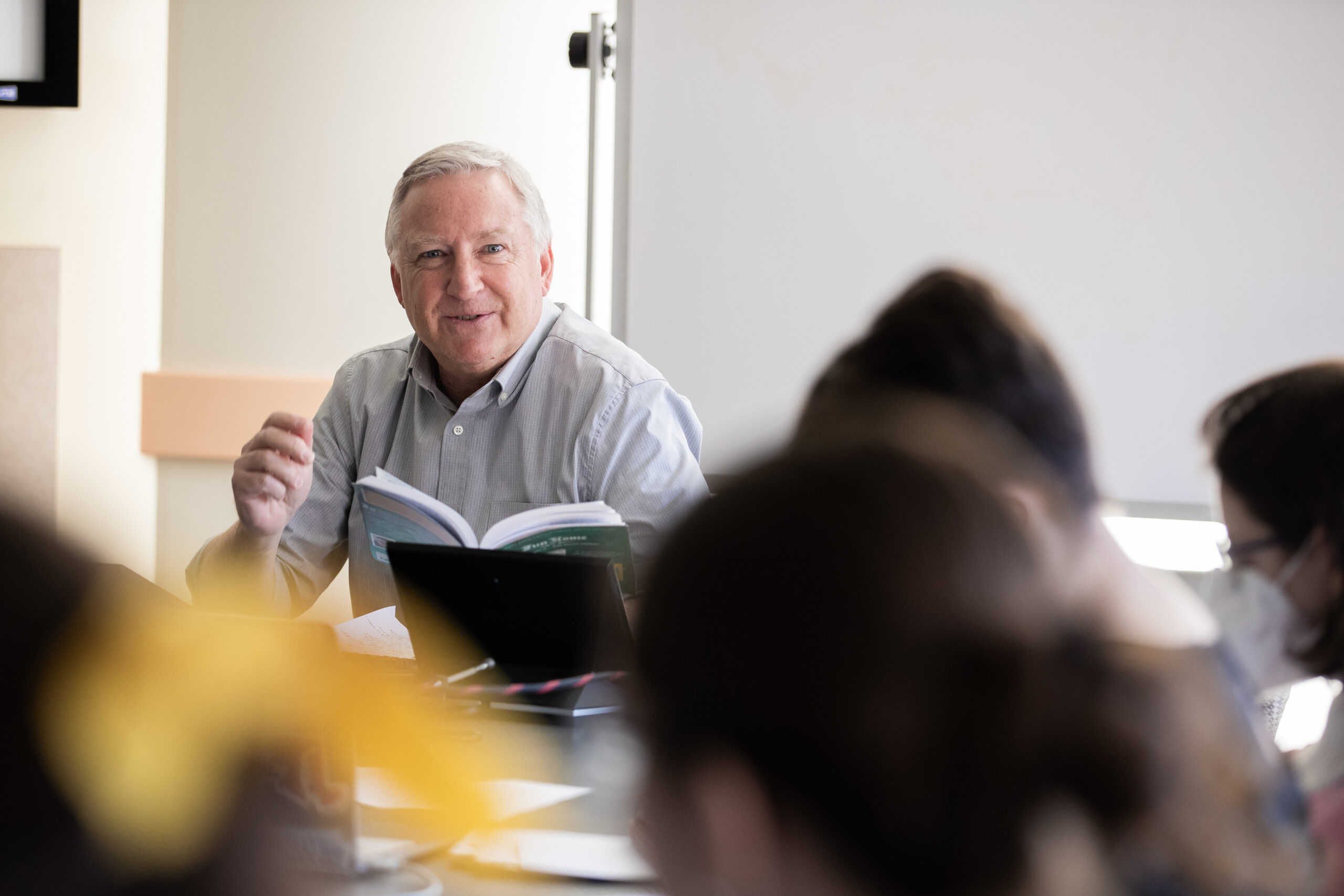
As a professor of English and acting chair of the English department, Grant Scott, Ph.D. understands the ruthless pursuit for interpretation just as much as any of his students. Having grown up in California, Scott received his bachelor’s in English and American literature from University of California San Diego and received his Ph.D. in English literature from the University of California, Los Angeles (UCLA). Scott’s journey at Muhlenberg began in 1989. His cross-country journey began after graduating from UCLA: “When I applied for jobs in my field, which is romanticism, there were thirteen jobs in the entire country. So I applied for all of them.”
At the core of his literary passion is John Keats, an English poet renowned for his work during the romantic era and also famous for his brief lifespan. “In graduate school, I was very interested in Keats,” Scott added with a laugh, “partially because he only lived [for] twenty-five years, and so I figured I wouldn’t have as much to read.” Writing his dissertation on the romantic poet, Scott’s interest ventured beyond the poems and into Keats’ life. After reading a nineteenth-century biography of Joseph Severn, the artist who accompanied Keats to Rome, he began to suspect the accuracy of the transcripts and so began doing his own research. “Not only were there mistakes, but there were also embellishments. [The author] started rewriting Severn’s actual language. So he omitted lots of things, he added lots of things, and this became really, really interesting to me. I started getting skeptical of the authenticity of those manuscripts.”
Scott’s quest to read the original manuscripts started with an attic. “I did a lot of asking around—people thought they were lost. So I thought the best thing to do was see if I could find a Severn relative.” By reaching out to distant relatives of Severn, he got in contact with Severn’s great-great-granddaughter who lived near Oxford, England and served as lady-in-waiting to Queen Elizabeth. In her attic were 700 unknown letters written by Severn, all untouched since they were first read by his wife, Elizabeth. “That was the attic that just kept on giving,” Scott shared enthusiastically. Letters written by Mary Shelley, author of “Frankenstein” and mother of the science-fiction genre, and John Ruskin, an English writer from the Victorian era, were also in this archive discovered by Scott. In 2005, Scott compiled his discoveries into the scholarly edition, “Joseph Severn: Letters and Memoirs.” Five years later, Scott digitally published “New Letters from Charles Brown to Joseph Severn,” which included letters between Severn and a close friend who was also in Keats’ inner circle.
“That was the attic that just kept on giving,” Scott shared enthusiastically.
Last semester, Scott went on leave, continuing his work with Keats and Severn’s legacy. He traveled to New Zealand to view two original Severn paintings, as well as to gather references for a physical edition of “New Letters from Charles Brown.” When the online edition became unavailable last spring, Scott decided to publish the collection as a book, adding a number of new letters he had discovered over the summer. During his leave, Scott also began putting together a second edition of “Joseph Severn: Letters and Memoirs,” drawing on the many letter and email responses he had received during the twenty years since its publication.
Now back in the classroom this semester, Scott reflected on his time teaching literature to students. “That’s the challenge—to try to pick books that you think will speak to this generation. There’s a lot of books that speak to me but won’t necessarily speak to [students].” He finds that student discussions are the cornerstone of any successful English course, particularly when students themselves usher in that conversation. “I think that is the true measure of something going right.” He wants students to develop a true passion for reading and thinking through his courses. “If I’ve generated some sort of passion in you to keep reading, and maybe even to read different kinds of books, then I’ve done my job.”

Alexandra Downey ’27 is an English & Creative Writing and Media & Communication double major. She is incredibly excited to be Editor-in-Chief! She enjoys playing tennis, rereading everything on her bookshelf, and showing off pictures of her dogs.