


















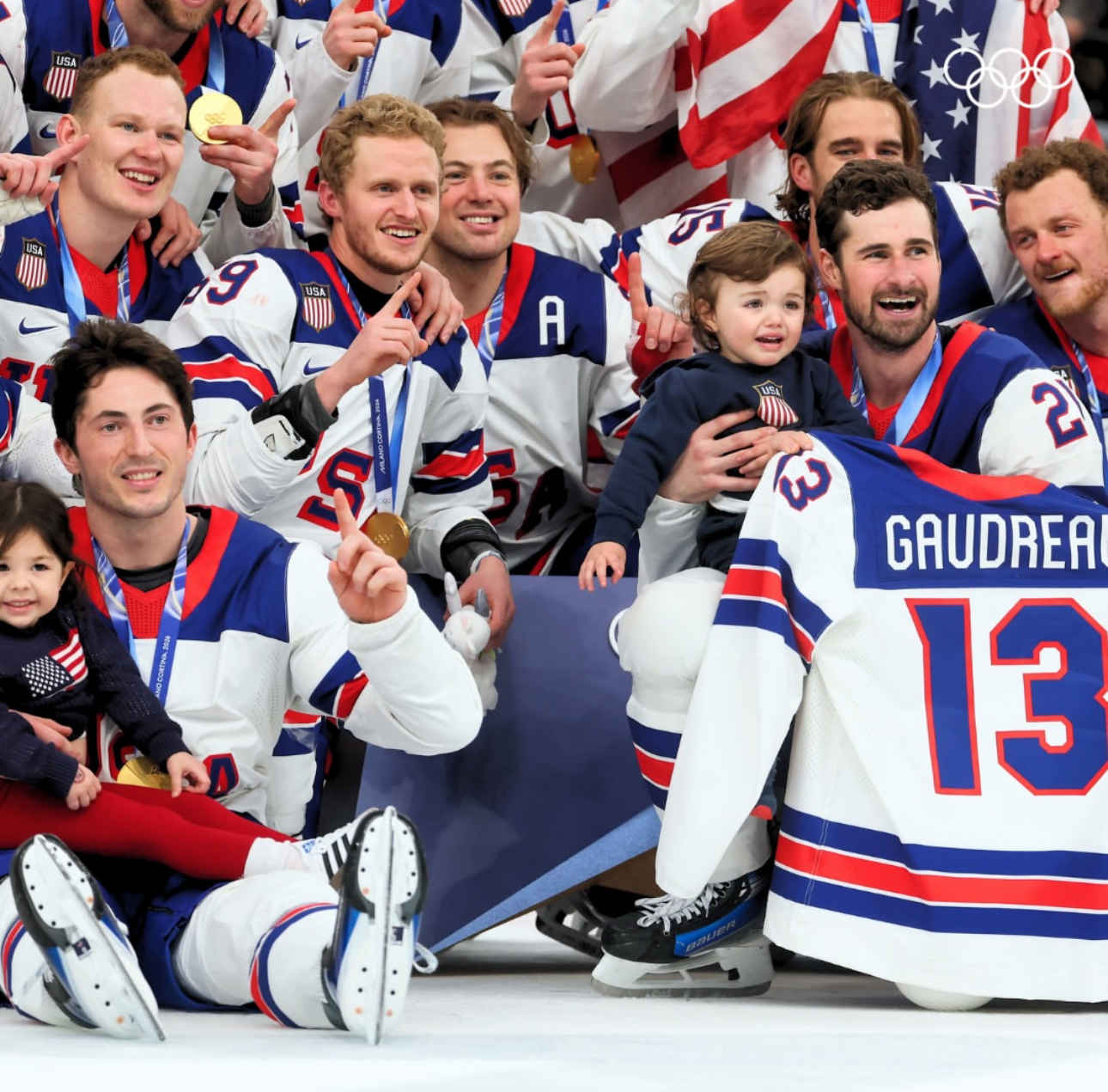
In men’s and women’s hockey, the U.S. beat Canada by identical 2-1 scores, with both games ending in overtime. Although each gold medal game felt very different, in the women’s game, the U.S. needed a late goal to tie, whereas the men’s team made a tough defensive stand to keep the game tied at one a piece before each game went to overtime. For each game winner, the American goalie played a critical role, with Connor Hellebuyck recording an assist in the men’s game. Hellebuyck sent an outlet pass to defenseman Zach Werenski, who poked the puck into the American offensive zone. Werenski then made a great forechecking play to pry the puck away from Canadian forward Nathan MacKinnon. Werenski passed to Jack Hughes, who beat Jordan Binnington through the five hole to win the game and the gold.
In the women’s game, Goalie Aerin Frankel made some saves on high-danger chances before Taylor Heise made a stretch pass to Megan Keller during a Canadian line change, which opened the ice for that pass. Keller then used an outside-in move to beat Claire Thompson, before beating Ann-Renee Desbiens through the five-hole to win the game and secure the first of two gold medals for U.S. hockey. The men and women’s teams have each won three gold medals in hockey, with the men winning gold in 1960, 1980 and 2026 while the women have won in 1998, 2018 and 2026.
The two regulation goals scored for the U.S. across the games were very different. In the men’s game, Canada took the first four shots of the game before Quinn Hughes passed it out of the defensive zone to Austin Matthews, who connected with Matt Boldy as he crossed into the offensive zone. Boldy then chipped the puck into the air and split Defensemen Cale Maker and Devon Toews before finishing the play with a backhand shot sliding through Jordan Binnington’s five-hole to take an early lead just six minutes into the game on the team’s first shot of the game. In stark contrast, the women’s team didn’t score until there were two minutes left in the game. Hilary Knight tipped a shot from Laila Edwards with 2:04 left in the third period to tie the game. After pulling their goalie to get a six-on-five advantage with an extra skater, the U.S. team had possession. Edwards slid the puck left toward Megan Keller, who skated a bit to her left, just above the circle. Keller then reversed it back up top to Edwards, who skated up and took a wrist shot, which got deflected in by Knight to tie the game. Though these two goals were at opposite ends of their respective games, each goal was vital.
Following the women’s loss, the Canadian team’s X account posted a picture with the caption “Silver shines just as bright,” which might be true to a country that hasn’t won the Stanley Cup since 1993, but not to the U.S., though a tweet is much more civil than some of the men’s responses. Nathan MacKinnon– the same guy who got the puck poked away from him leading the overtime goal– absolutely whiffed on an open net shot with 10:50 remaining in the third period. After the game, MacKinnon told us to “be the judge of who was the better team today.” Yes, Canada outshot the U.S. in the men’s gold medal game 42 to 28, and Canada didn’t have Sydney Crosby, but you can’t play the game on paper; you have to play for real and sometimes you don’t get lucky or you have a bad night. Canada had a five-on-three advantage for a minute and thirty-three seconds, but couldn’t capitalize despite having one of, if not the greatest, power play units ever assembled. The U.S. penalty kill was a major reason why they took home gold, as the unit went 18 for 18 throughout the entire Olympic run. Following the win, Head Coach Mike Sullivan talked about his roster construction and had an interesting quote, “the team was built with personality in mind… There are whiskey drinkers and milk drinkers, and we got a lot of whiskey drinkers.” Prioritizing what Sullivan considers a whiskey drinker certainly had a major impact on that penalty kill and the overall team.

