


















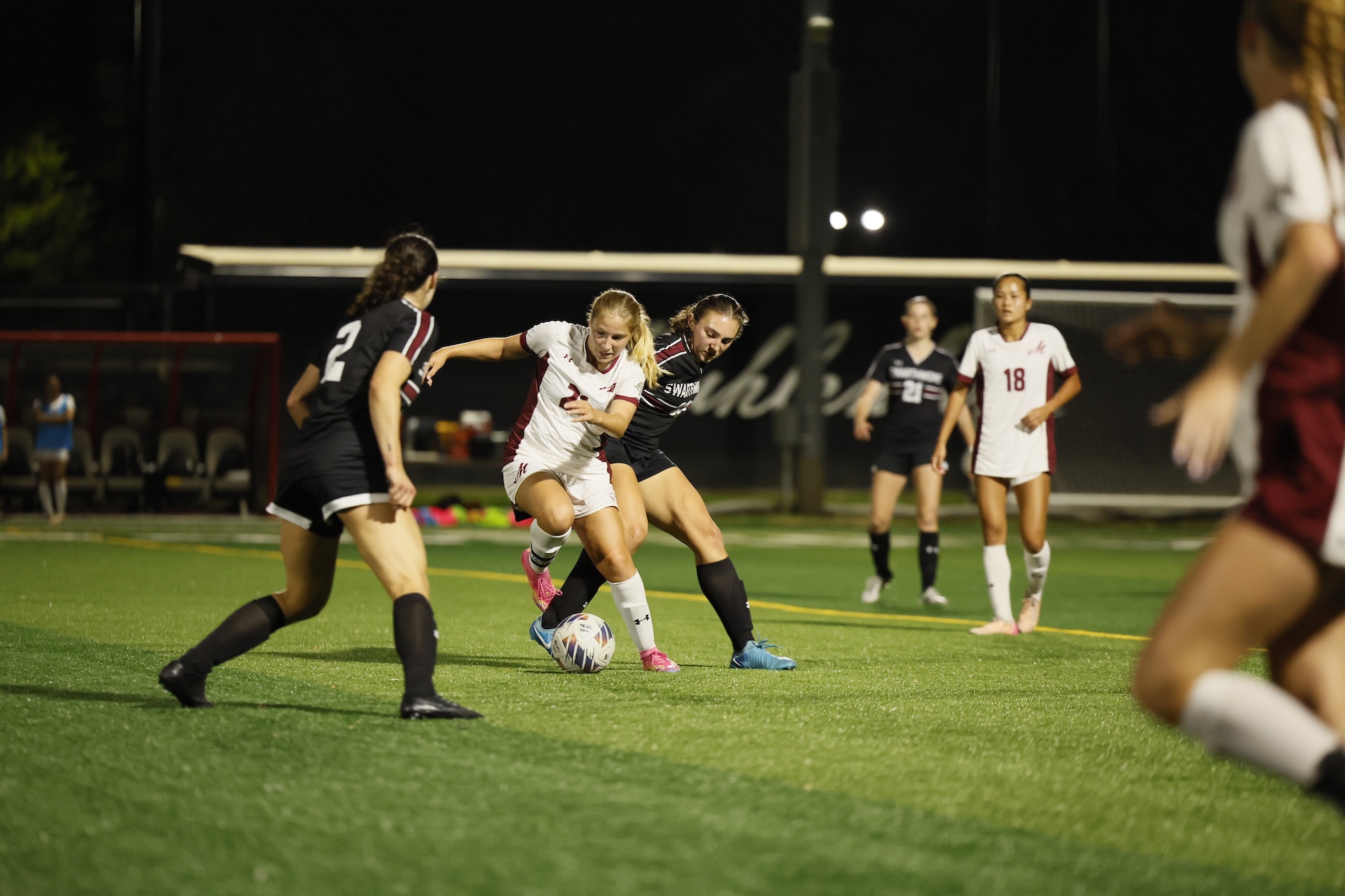
Across college campuses, athletes tend to choose certain majors such as business, finance, media & communication, and economics. The reasons tend to vary, but most of the time, it’s because of the time demands, pressure, and social influence; the pattern is clear and consistent. Most fields, like STEM and other time-intensive majors, are harder to balance with the high demands of college athletics. After graduation, former student-athletes have skills they built during their playing careers that give them an upper hand going into corporate America and beyond.
A survey of Muhlenberg field hockey and women’s lacrosse players found that more than half, 55% of students, were pursuing business degrees. 5% are in media & communication, which is a related business field. Making up a little over half the population, business-related degrees reinforce the idea that athletes gravitate towards the business world.
“I don’t really know what I want to do,” said Mackenzie Durkin ‘28, a defender on the women’s lacrosse team. “It felt like the safest option was going the business route, and the more I learn about it, the more I like it. It worked out!” Durkin later goes on to state how athletics shaped her experience at Muhlenberg. “I cater my schedule to other teammates, but it depends. Usually, one of my teammates is in each of my classes.”
Gabi Damens ‘27 is a political science major and is involved in a lot of activities at Muhlenberg, like the Phi Sigma Sigma sorority. Initially, she was an environmental science major, but with the help of her teachers, she changed majors to political science. “As I took more political science classes, I found that I was a lot more drawn toward those topics and methods of research than lab-based work. I was encouraged by one professor to learn more about what political science is and to pursue what I was interested in, which was the big push toward switching my major.” Damen continued, “I see a mix in my classes… There are more non-athletes than athletes, but not a ton more; it feels fairly reflective of Muhlenberg as a whole.” This response shows that most athletes here on campus lean towards the business side, but there are some crossovers.
Anna May ‘26, a soon-to-be graduate, stated she chose her major because it aligned with her personality as well as her family influence. “I felt it aligned well with my personality, and I was also influenced by my older sister. She is four years older than I am and was an accounting major as well, and since we have very similar personalities, I believed it would be a good fit for me. Additionally, I took a financial accounting class in high school that I really enjoyed, which sparked my interest in pursuing the field further.”
May’s classes were often athletics heavy. “In most of my classes, they were made up of about 65% student-athletes, except for a few courses like financial accounting. My class sizes were relatively small, usually between 15 and 20 students, and up until my final semester, I knew everyone in my classes.” As graduation approaches, May makes the connection that athletics will help her go into the job market. “When interviewers learn that you were a student-athlete, they often ask follow-up questions about time management, leadership, and the ability to work with people from diverse backgrounds. These are qualities that are highly valued in the workplace.” May also stated, “I have never been directly asked if I was a student-athlete, but it has come up during interviews either because I mentioned it myself or because interviewers noticed it on my resume.”
Those experiences from May and Durkin are similar to what the Muhlenberg Career Center states: “Being a student athlete is a huge asset that students should speak to throughout the interview process. You are not just skilled in your sport– you are skilled in time management, prioritizing, communicating, and collaborating with others. These are valuable transferable skills that employers value the most, and being a student gives you an excellent way to develop those skills and speak to them with employers.” The article “Why Employers Love College Athletes” talks about why employers enjoy hiring athletes. “Sports and good business practice involve a lot of similar qualities. There’s the competitive nature, ability to multitask, the team mentality, and comfort with taking orders. And really, which employer isn’t looking for those assets? A magic word that sums up the college athlete’s attractiveness to employers (and which was independently mentioned twice by both interviewees for this story): ‘coachability.’” The article goes on to connect athletics and academics in the workforce.
Being an athlete doesn’t disappear after graduation; that advantage carries over to the job market. Devon Eastlack ‘25, a former field hockey student athlete, started off as a psychology and business double major who decided to switch to a business and finance double major. “I had always been interested in business because my dad is a business owner, and my initial interest in psychology came from taking [Advanced Placement (AP)] Psychology in high school. Attending a liberal arts school allowed me to explore different subjects, and some of my business courses incorporated finance topics, which really sparked my interest,” she said. “I realized I’m naturally drawn to working with numbers.” Within her classes, she had many athletes, “especially in my finance courses. Those classes tended to be more male-dominated, and many of the students were athletes.” In the job market, she sees the connection athletics has that can help her. “Employers in corporate America value the traits that student-athletes bring, such as discipline, time management, teamwork and leadership.” While Eastlack has never been asked about being an athlete, she makes sure to highlight it in an interview. “I make sure to include it in my elevator pitch,” as athletics is a big part of her identity.
“Why Employers Like Hiring College Athletes” states that the real world and athletics work together. Based on Jeff Selingo’s article, he states that student athletes know how to develop skills and learn in different environments. It’s through their experiences that help athletes succeed in life. “We see a lot of transferable skills in athletes,” said Marie Artim in Selingo’s article, and “Enterprise– which hires more college graduates annually for entry-level management positions than any other company in the United States– likes to recruit college athletes as employees because they believe athletes know how to commit to a task.”
There is an overlap of athletics and the job market today. While there is no “secret club” for athletes after graduation, there are sets of skills that help athletes gain an upper hand over others. From practices every day to late nights studying, student-athletes at Muhlenberg are balancing all sorts of demands. This helps shape our athletes when going into the world after graduation and prepares them for all the obstacles that come.

