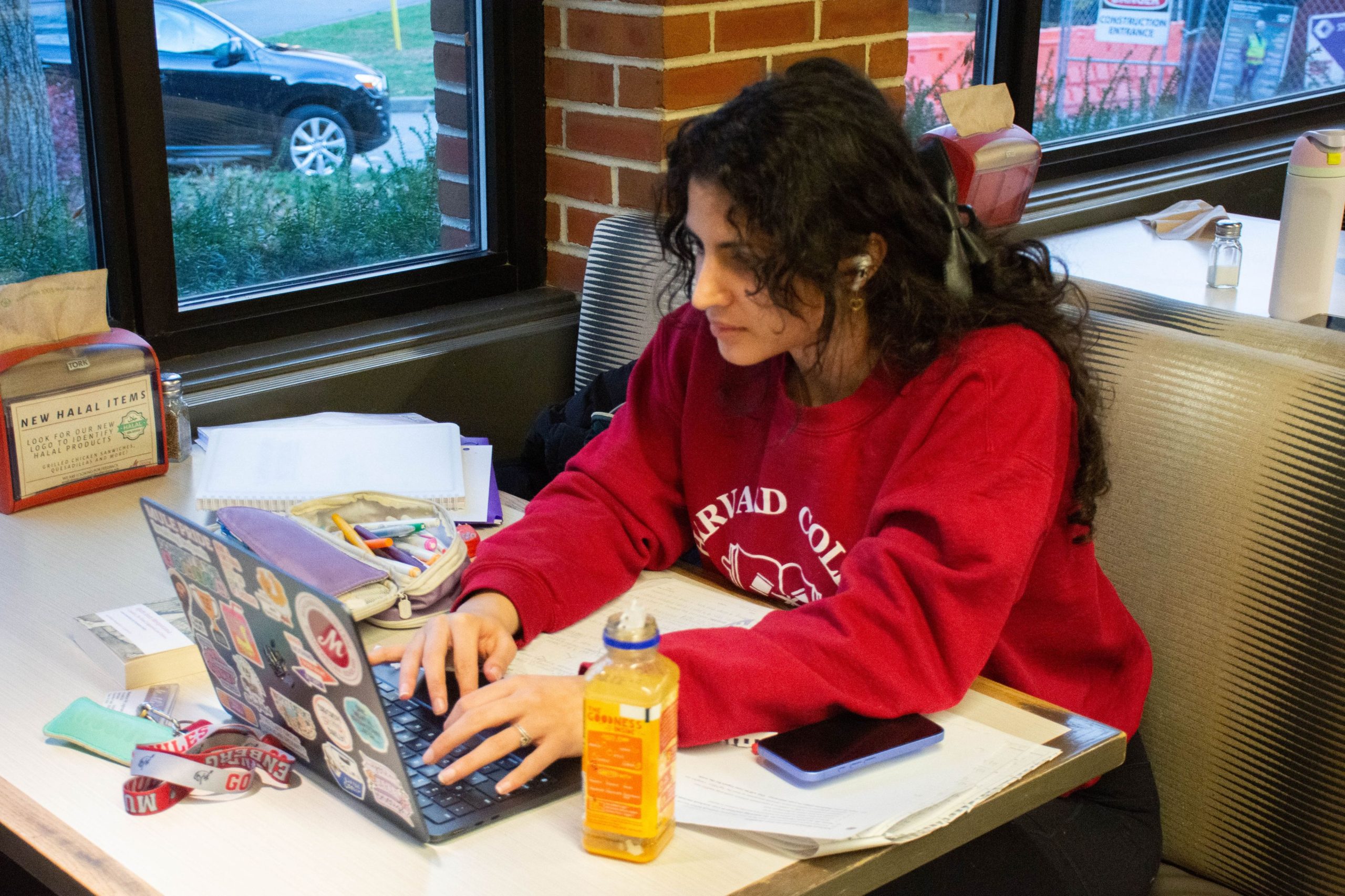
“Spotty, unreliable and finicky.”
That’s how students like Cassidy Chason ‘28 describe Muhlenberg’s campus Wi-Fi, and she’s not alone.
To address longstanding frustrations, the College’s Office of Information Technology (OIT) rolled out a new network this year, promising faster speeds, fewer dead zones and an easier connection process. But beyond the announcement, what does that upgrade look like in practice?
To find out, The Weekly conducted tests across campus, logging download speeds from Parents Plaza to Seegers Union and Scotty Wood Stadium. The results reveal where connectivity has improved and where it still lags.
Zoom in, hover and move around the map to explore the data we collected.
The Weekly’s on-foot testing covered roughly 150 points across the main campus, running several tests at each location to capture an average speed and avoid one-off glitches or temporary drops in performance. We tested both “Muhlenberg” and “MuhlenbergWifi” networks to see if there were any significant differences between the two.
Robert Charles Mahar, director of networks and infrastructure, clarified that both the “Muhlenberg” and “MuhlenbergWiFi” networks likely ran on the same upgraded hardware at the time we conducted our tests across campus.
“Assuming both sets of data were collected this semester, both the ‘before’ and ‘after’ measurements happened after Wi-Fi equipment had already been replaced,” Mahar explained. “If so, both sets of data measured the new system. The differences you observed are likely due to measurement methodology or statistical variations.”
Nevertheless, he remarked that the data remains “very useful in terms of two snapshots of the current system’s performance. It seems to show fairly high performance in places where students, staff and faculty would be.” Herein, he noted that most of the campus appears to provide sufficient bandwidth for video streaming, conferencing and registration-day tasks, even in areas that performed below average.
Speaking to recent changes, Chief Information Officer José Dieudonné said the upgrade aimed to modernize a system that was reaching its limits.
“Like any technology, our wireless infrastructure required an update to meet current demand and security standards,” Dieudonné said. “It was time to upgrade to support the increasing number of devices students and faculty use daily, as well as newer applications and learning technologies that require strong connectivity.”
Planning began in winter 2024, with implementation rolling out through summer and finishing by spring 2025. In total, the College replaced 970 wireless access points and migrated to a cloud-based platform for stronger performance, better security and easier oversight. According to Dieudonné, the new network should offer more reliable connectivity, a smoother device registration process and improved performance in both residence halls and outdoor spaces.
Still, students have reported uneven Wi-Fi performance, particularly in residential and outdoor areas. And even with the new network, some frustrations persist. In a recent poll on our Instagram account, a majority of respondents reported that their network performance generally slowed.
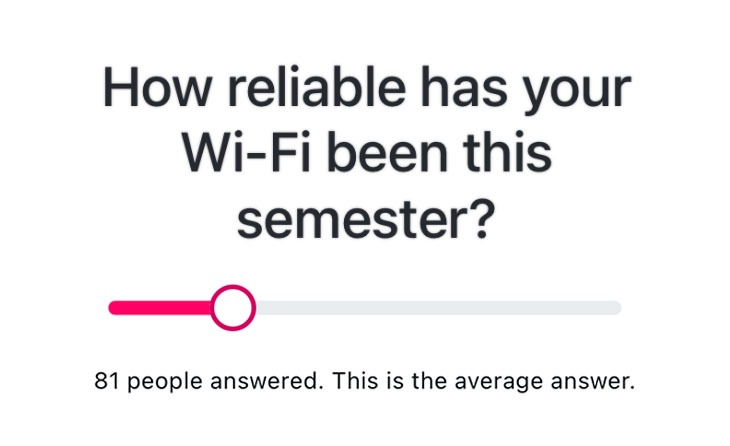
Participate in future polls by following us @bergweekly
“I would definitely say that the new network is slower and gives out a lot more,” said Chason. “I rarely do work in my apartment because the Wi-Fi can be so spotty. I also kind of think the whole individual passwords thing is silly. When we all got our own passwords at the beginning of the semester, I was expecting some high-tech upgrade– but in reality, all we got was virtually the same Wi-Fi.”
Other students highlighted a sense of unpredictability. “The new Wi-Fi does not seem to have a pattern for when it works well,” said Katherine Nguyen ‘28. “It varies by day, time and location. Phones always seem to struggle– whether it’s searching something up, calling someone, or sending a photo, it has never worked quickly.” Nguyen said that slow speeds make even small online tasks– like checking an event date– frustrating.
Ahead of registration, she worried whether the connection would hold.
“My roommate and I went to the dining hall to register,” Nguyen later reflected. “We both had issues reloading the page when it was time to register, although that may be due to the amount of people reloading at once.” Nevertheless, she highlighted that compared to when she “registered last semester, it definitely took longer to load and to complete the registration.”
These apprehensions have led to real costs for students like Emma Shaffer ’27, who lamented an increase in her phone bill as she found herself using more data to access the internet.
The network overhaul marks a major step toward modernizing Muhlenberg’s digital backbone. But as the data shows, even with nearly a thousand new access points, Wi-Fi connectivity remains uneven– and the College’s next challenge may be ensuring that fast, stable internet reaches every corner of campus.
Graphic by Kabir Burman ’27 and photo by Sierra Addy ’27.

Kabir Burman '27 is an international student from India double majoring in media & communication and political science. He is constantly looking for new ways to bring you the stories that matter and feature different perspectives. If you can't find him in the newsroom, you'll find him playing the piano, taking a nap, or planning his next trip to NYC!