


















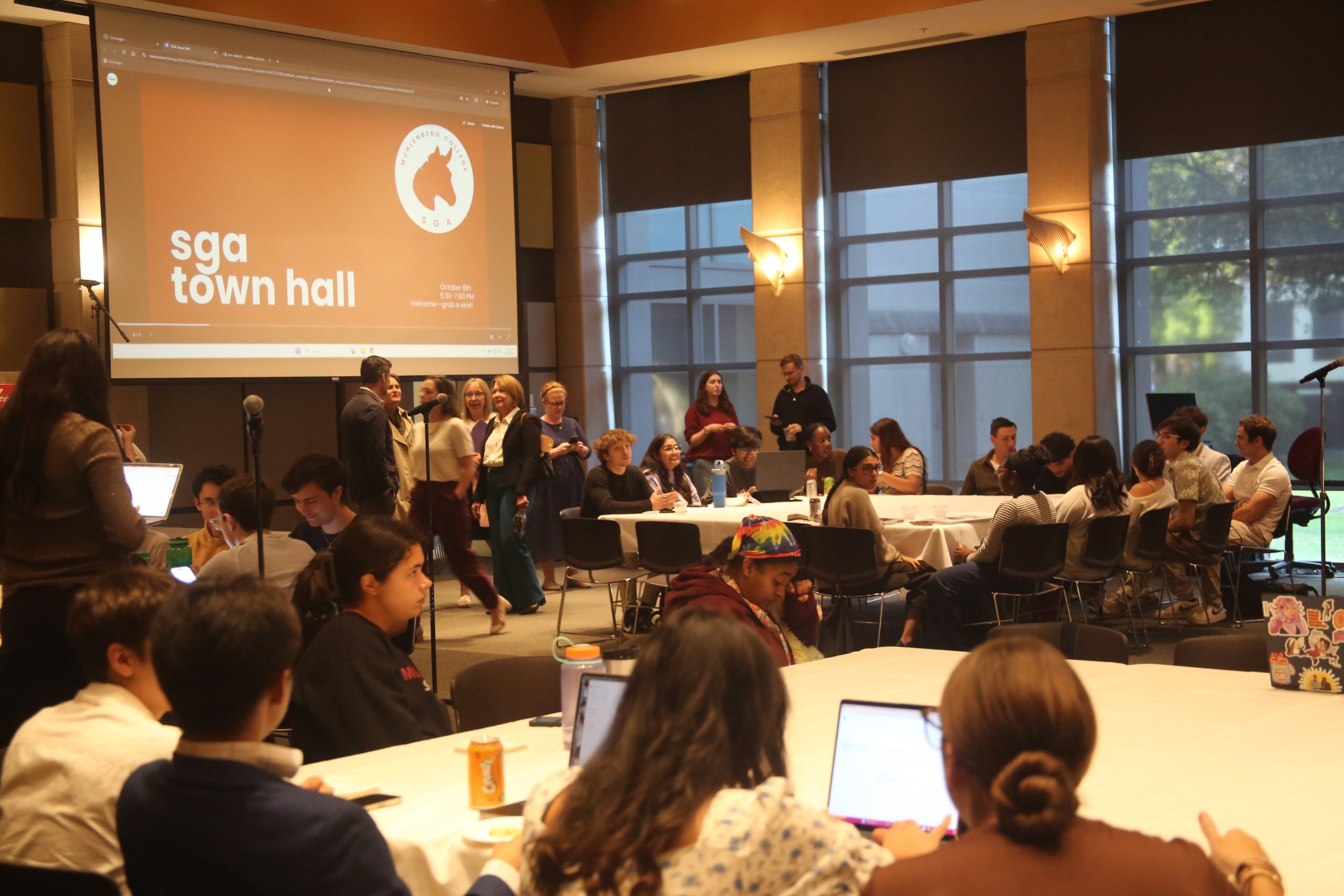
On the evening of Wednesday, Oct. 8, Muhlenberg’s Student Government Association (SGA) hosted a Town Hall in Moyer Miller Forum. Open to all students, it served as an opportunity for them to gain insight to the workings of their student government and to ask questions of the administration in a dynamic environment. Well-attended, the meeting began with SGA updates before proceeding into a series of roundtable discussions.
Sabeen Safi ‘26, SGA president, shared the organization’s work towards a number of current and upcoming changes in dining, including the earlier General’s Quarters’ (GQ) hours and the announcement of a new vendor coming to the Life Sports Center in January. Other members such as treasurer Sinhayana Srinivasan ‘26 had similar optimistic news, supporting multiple student initiatives like Rock Climbing Club and the cheerleading team, as well as funding Muhlapalooza, an on-campus music festival in the spring semester.
Students were then encouraged to voice their concerns at any one of four roundtable discussions surrounding different subjects: President Kathleen Harring represented the table for state of the College, and Vice President of Communications & Marketing Todd Lineburger represented the table for marketing. Kimberly Guyer, vice president of student life, represented the table for student life, and Provost Laura Furge represented academics. The direction of these conversations was decided mainly by students, with all questions welcomed. SGA ensured that students were given enough time to ask questions at every table.
At President Harring’s table, a discussion ensued regarding Muhlenberg College’s current placement on the American Association of University Professors (AAUP) list of censured administrations. Students were worried that the institution had not taken enough action to try and get off of this list, and Harring’s response to these inquiries emphasized that Muhlenberg is more focused on contesting the fact that the College was put on the list in the first place. Harring assured the table that several members of the administration have met with the AAUP and are in communication with them, saying that these kinds of conversations take time. She also encourages students to look into the response to the investigation.
Both Harring and Lineburger answered questions about enrollment and class sizes. With class sizes increasing and faculty rates being reduced, many students found themselves worrying. Harring shared that the College has already received a great number of applications for new professors, and that they’re trying to meet the current size of the student body as well as student interest. As she and Lineburger told their tables, there are simply fewer and fewer college-aged students in the current demographic, so before making these changes there were a number of classes that only had three or four students. President Harring informed the table that she’d heard from faculty and students alike that this presented difficulties, especially in regards to figuring out what projects are possible to work on in such a small group.
Provost Laura Furge started her discussion by telling the table that Integrative and Experiential Learning (IEL) requirements will be finalized in approximately another month.
Guyer addressed concerns about accessibility on campus. Guyer and SGA Campus Engagement Chair Amanda Growney ‘28 confirmed that the flattening of the Red Door Cafe in its remodel was for accessibility purposes, as any space the College renovates needs to be Americans with Disabilities Act (ADA) compliant. Students were also worried about how many accessibility buttons around campus haven’t been functioning, and how difficult it can be to work with the Office of Disability Services (ODS) for certain accommodations. Guyer responded that she would look into these issues further.
Provost Laura Furge started her discussion by telling the table that Integrative and Experiential Learning (IEL) requirements will be finalized in approximately another month. One student asked if more Muhlenberg Integrative Learning Abroad (MILA) courses will be offered in the future, and she answered that the College will continue to offer three to four a year. If that number were to increase, she says, the College would not be able to provide as much financial help to students hoping to attend; keeping the number of MILAs low means they remain accessible.
One student inquired as to if the Donald Trump Administration cuts will change how the College operates, and she answered that the changes have made a small impact on Muhlenberg specifically thus far, and that the institution will continue to uphold its standards.
When asked how faculty was responding to funding changes, Provost Furge responded, “Muhlenberg is still offering an incredibly robust academic experience; we’re not going anywhere.” She assured students that though things are changing, Muhlenberg will come out on the other side, and she encouraged everyone to focus on the good things that are happening and what’s improving. One student inquired as to if the Donald Trump administration cuts will change how Muhlenberg operates, and she answered that the changes have made a small impact on Muhlenberg specifically thus far, and that the institution will continue to uphold its standards. “I hope and believe,” Provost Furge said, “education is a solution… Knowledge is power and we demand access.”

