



















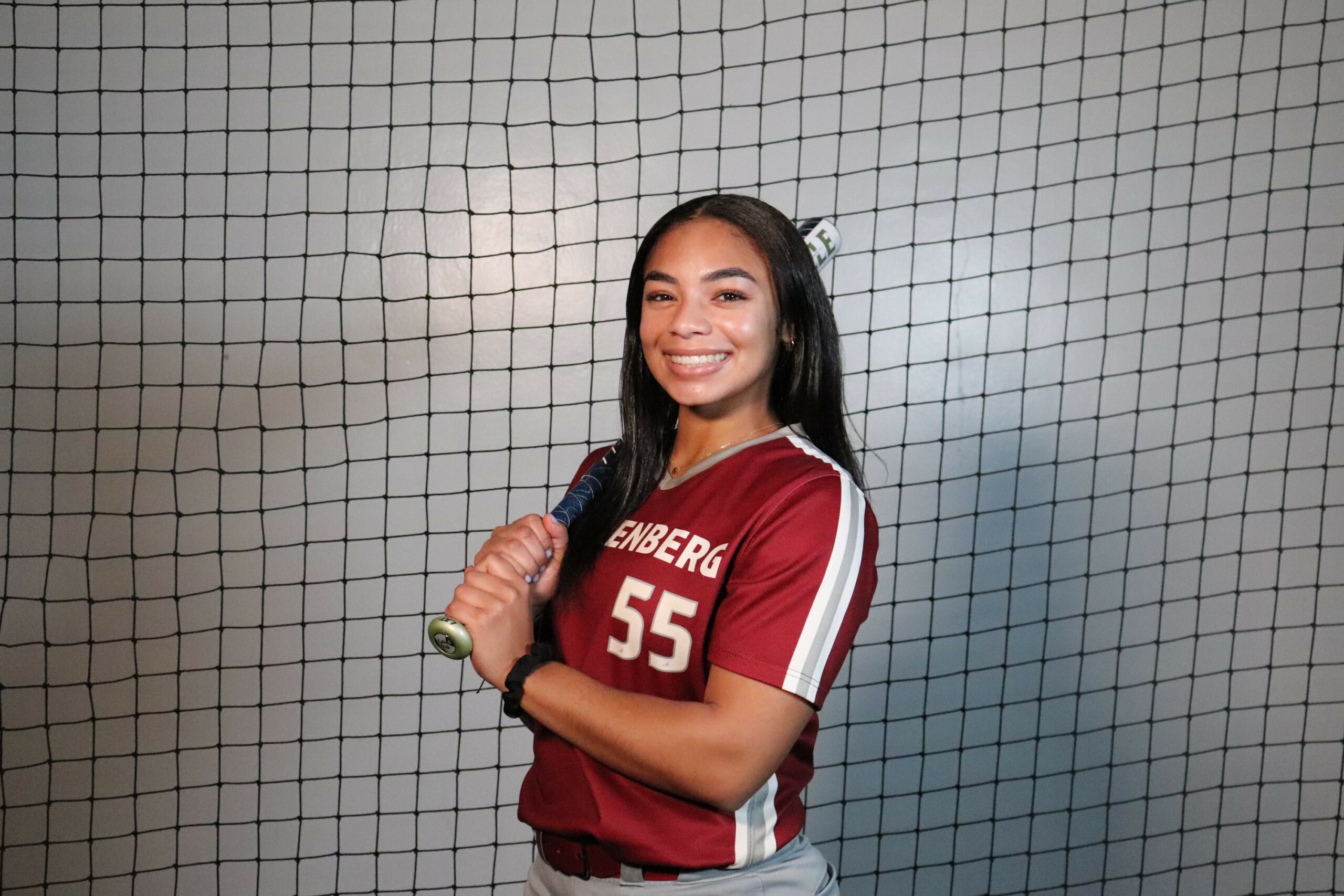
Kaya Mahy ‘25, in her final year at Muhlenberg, has found herself more engaged than ever with the community. From playing softball on Muhlenberg’s women’s softball team and serving as secretary of Head in the Game, to psychology and public health research and being an orientation leader, Mahy has paved her own way here at Muhlenberg.
“It’s getting better every single year,” Mahy reflects in regard to the student-run club Head in the Game, which focuses on advocating and coping with the mental health struggle that many student-athletes face, like performance anxiety, perfectionism and time management skills. Mahy is the club’s secretary, where she sends out emails and keeps track of materials being discussed and created during the meetings. “When I was a freshman, one of my teammates [co-founded] [Head in the Game], so as soon as I came into Muhlenberg it was already encouraged that I be part of the club, and that’s why we have such a high presence from the softball team,” Mahy explains when unpacking the club’s history. From her involvement with the club, she feels she has gained a better understanding and balance on just what it means to be a student-athlete. “A lot of time management is really important for me and other student-athletes, as well as communicating with professors and coaches. Just knowing how much work I have, along with practices and games, keeps me balanced.”
“It was the best week of my life, I knew I had to do it again”
Not only did Head in the Game help expand Mahy’s horizons in college athletics, but so has her research. The first research she did was for a research methods class taken for her psychology major, where she focused on parental involvement in child sports and whether it affects how long a child continues to play said sport, along with their enjoyment of said sport. “That was really interesting to me and it kind of jump-started the rest of my research interest being in athletics, but then I transitioned to collegiate athletics,” Mahy reflects. Her second piece of research became more involved in the differences between students in division one and division three sports and their ability to transition to a post-grad life when their college sport is over. “I love Division III. I’m very happy with my decision to go Division III, and that I had the ability to do a lot of other things that do make the transition easier post-grad, but I wanted to see if that’s actually true through my research.” Mahy explains how this research extended further, where she looked specifically at the Division III experience at Muhlenberg. She studied reasons and means for retirement in a post-grad life as a student-athlete and how these specific reasons play a part in a student-athlete’s adjustment to not playing their sport after college. Mahy goes on to explore the long term effects student-athletes feel after college, saying how, “there’s a lot of identity loss, no matter your reason for retirement, because you’ve been doing the sport your entire life and then it’s just done.” Conducted with Erika Bagley, Ph.D., associate professor of psychology, and under the Rosenberg research grant, Mahy explored this topic of identity loss. Her connections with Muhlenberg alumni helped her to further understand the change in oneself that comes with graduating and leaving behind your college sport.
Beyond the field and classroom, Mahy is part of the orientation team, which helps guide first-year students through their first few days of college. Mahy became an orientation leader going into her sophomore year and has continued with the program into her senior year. “One of the seniors on my team was an orientation leader when I was a freshman and we got along great, so she suggested that I do orientation and I was thankfully selected. It was the best week of my life, I knew I had to do it again,” Mahy describes when looking back on why she decided to become an orientation leader.
Part of being an orientation leader is going through four days of training with your peers, then another four days of working with first-year students and helping them adjust to college life, a “rewarding process,” as Mahy puts it. “That was the most rewarding thing, being able to be that guide and make the incoming students feel welcomed, then see them out and about later in the year happy and involved.” Mahy also reflected on her personal growth through orientation, noting her wide range of new connections. “I’ve met people and have had experiences I never would’ve had if I wasn’t an orientation leader.” She also noted the overall change in herself from the experience. “Just confidence in myself,” Mahy expressed, “the more times you see yourself succeed it just makes it easier,” a quote that can certainly be applied to her orientation experience, but also as a reflection of her time at the College, and the ways she has grown from her involvement and influential impact at Muhlenberg.

Emily Nally ‘27 is an English and Creative Writing major with a Women and Gender Studies minor. She is editor of the Campus Voices section and is so excited to be a part of such an immersive organization on campus. Outside of the Weekly, you can find Emily rereading “Little Women,” binge watching “Gilmore Girls,” or being really cool practicing her flute and guitar.