



















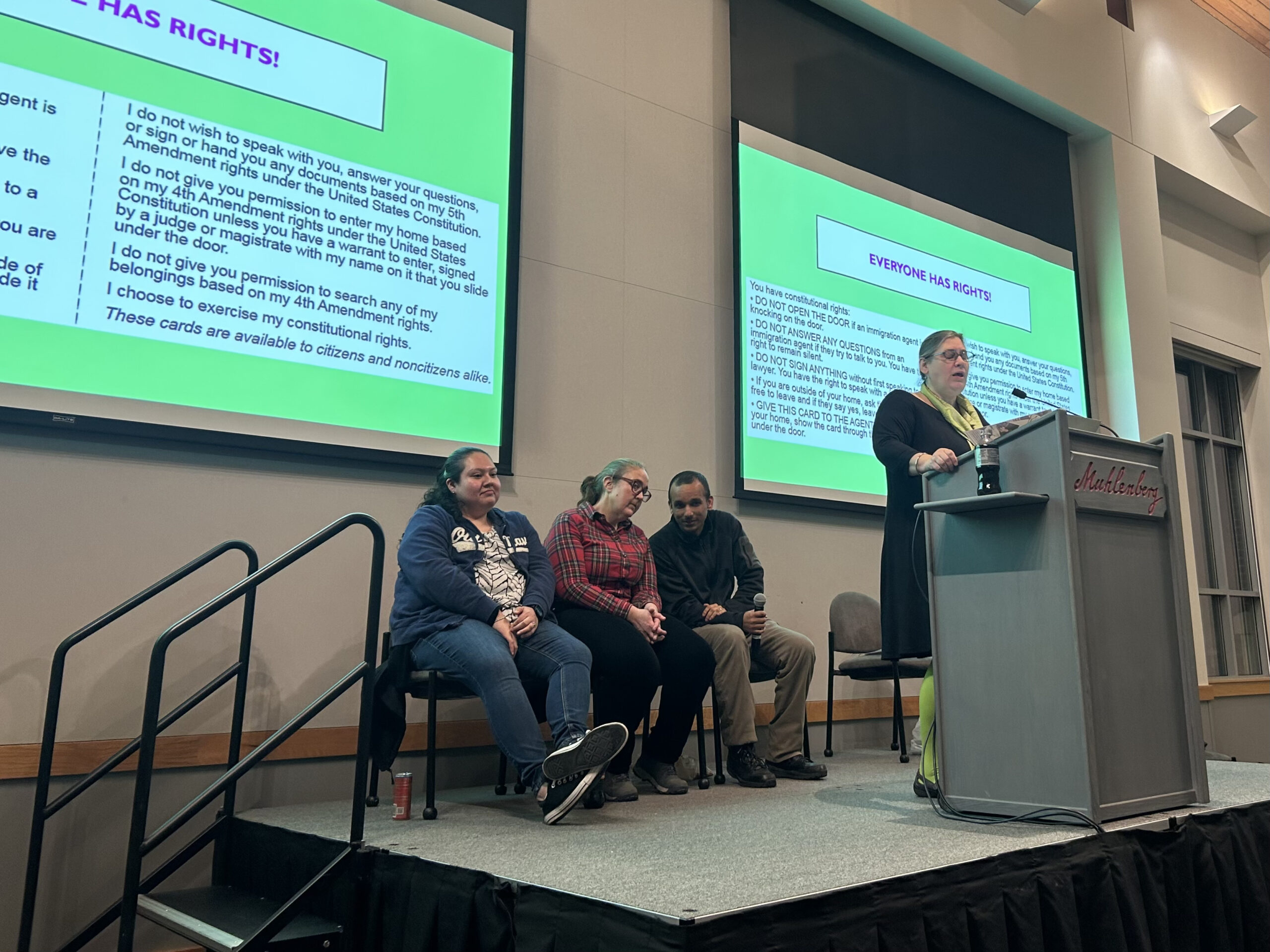
“There’s never been a clear line between legal and illegal [immigrants],” Erika Sutherland, Ph.D., shared with students, faculty and members of the Allentown community at the Immigration Outreach Training. On Feb. 10, Sutherland hosted an event with Attorney Katie Albarelli, who specializes in immigration law; Attorney Elliot Love, who practices family and criminal defense law; and Leslie Hernández, office manager and paralegal. The training, titled “Staying Aware and Keeping Calm: Support for Immigrants in Stressful Times” is one of multiple events that Sutherland plans to spearhead throughout the coming years.
Sutherland has been an advocate for immigrants for decades. She has directed the Grupo de Apoyo e Integración Hispanoamericano since 1999, detailing the two ways the group broadly helps Hispanic immigrants: working with immigrants to gain or regain legal status, and to help immigrants understand the resources and challenges of their communities.
Albarelli and Love spent the majority of the two hours allotted of the training answering questions from the audience, attempting to clear up mass confusion around changing laws, degrees of status, rights that immigrants have and what exactly U.S. Immigration and Customs Enforcement (ICE) can do.
Albarelli touched upon some of the impacts the Trump administration has had on the process of seeking asylum in the United States. “The system to seek an interview has been shut off entirely.” Other systemic barriers within the government became clear from Albarelli’s answers to audience questions. “Where we’re seeing a lot of due process problems is… when they’re going into locations and detaining people and then essentially putting them into an exported deportation proceeding,” based on a person’s failure to comply with two policy addendums that focus on the amount of time a person has been in the United States. “That makes it very difficult for us to lodge a fear-based claim. They are making excessive use of administrative removal procedures, which is essentially, for certain individuals who are detained, they basically serve them with a paper and say ‘you’re going to be deported now’ and then you have to file with relief under the Convention Against Torture, which is a very difficult claim to make. This all happens very rapidly, even before you may have the chance to get to an attorney.” She continues, emphasizing difficulty some may have in finding an attorney. “The federal government has taken away all of the pro bono funds out of the immigration courts.”
Eventually, the conversation moved towards family law, where Love answered audience questions and concerns about either children or their parents facing deportation. Love gave advice to families, telling them to “have your emergency contacts updated with the school” and consider “this great thing in Pennsylvania called Third-Party Custody.”
Albarelli and Love continued answering questions, sharing advice on what to do during detention, what people should do if ICE comes to your workplace or home and the consequences of the Laken-Riley Act, where immigrants accused of a crime can be detained or deported. John Fetterman, senator of Pa., co-sponsored the Laken-Riley Act, which passed with bipartisan support in the Senate.
Sonia Wold ‘27 reflected on the event. “I had no idea that Allentown parents were afraid their schools were ‘harboring criminal children’ and even worse, that the administration refused to hand out invaluable information to students and families in need because of this kind of fear-mongering. I also was disgusted to learn that the Laken-Riley Act states that any undocumented immigrant accused of any crime can be immediately deported, was endorsed by our own senator, John Fetterman.”
Multiple audience members asked specific questions about legal status, and shared that they were asking on behalf of affected friends, family and neighbors.
When asked how events such as this would impact students, Sutherland expressed, “There are two student-related goals here: One, to give our students an opportunity to understand what is coming out of Washington and to see how it connects with the people around them and two, through the community sessions that will follow the training, to provide a way to channel concern in a positive, community-engaged and productive way.”
Sutherland hopes students who have a personal connection also find support. “For our many students with a more personal connection to the issues–friends and family members either without legal status or in a status that has come under threat by the new administration (TPS [Temporary Protected Status], refugee or asylee status, DACA [Deferred Action for Childhood Arrivals], T [victims of trafficking], U [victims or witnesses of specified crimes], or V [spouse or child of a lawful permanent resident] visas… not to mention birthright citizenship…)– seeing the support from students, staff and faculty and hearing trustworthy advice, can be transformative.”
Students in attendance reflected on the event. Arwen Lutwyche ‘26 shares, “The event was really great in how it focused on practical steps for getting in the way of current immigration policies, and how legal help for immigrants is completely overwhelmed. I am looking forward to being part of the community activities Dr. Sutherland mentioned will be announced in the next few weeks. I met a couple of people from Allentown who came to the event, and learned about their longer practice at calling on representatives.”
“Abarelli chimed back in. ‘Any civic engagement at this point that is pro-community, pro-immigrant rights, is going to be so important.’”
Skylyn Ellison ‘27, shared a similar sentiment of feeling called to action, “I’ve been following the news and feeling hopeless. Coming together and talking to immigration lawyers who are really working out in the field, was able to take my hopelessness and turn it into a call to action. With the influx of media pouring in at all times, it was really great to have the facts honed in on. After attending this event, I am feeling a lot more motivated to do what I can in the Allentown community.”
Albarelli shares what she most wants students to know. “For students who are fearful, and directly impacted by the situation, they need to understand that the government is deliberately sewing misinformation, is fear-mongering, is creating a scenario where people believe they have no rights, no access to help and that nobody cares. None of these things are true. There are immigration lawyers out there, there are nonprofit agencies in Allentown, we are all out here fighting and we are going to keep doing this. These individuals do have rights, despite what the government is saying. We still have ways to assist people in removal proceedings, to defend them and those things, you can’t just summarily take that away.”
She continues with advice for students who are not directly impacted. “I would suggest being loud. Getting out there, finding correct information, communicating with elected officials, telling them what you really think about the situation, how it’s affecting your community.” Love then jumped in. “There are going to be a lot of instances where there will be times to physically show up at places. Having a group of people who can physically show up, would be very helpful.”
Abarelli chimed back in. “Any civic engagement at this point that is pro-community, pro-immigrant rights, is going to be so important.” She then circles back to people who are more directly impacted. “They need to know they still have rights, and they should call a lawyer immediately. There’s a lot of things happening out here in the ether, but it doesn’t mean anything. These battles get fought in court for a reason. People still have rights.”

Amy Swartz ‘26 is an English & Creative Writing and Political Science double major. She has been part of The Weekly since her freshman year, and is thrilled to be Editor in Chief! Outside of the Weekly, you can always find her reading a new book, crafting, or rewatching an episode of her favorite sitcoms!