



















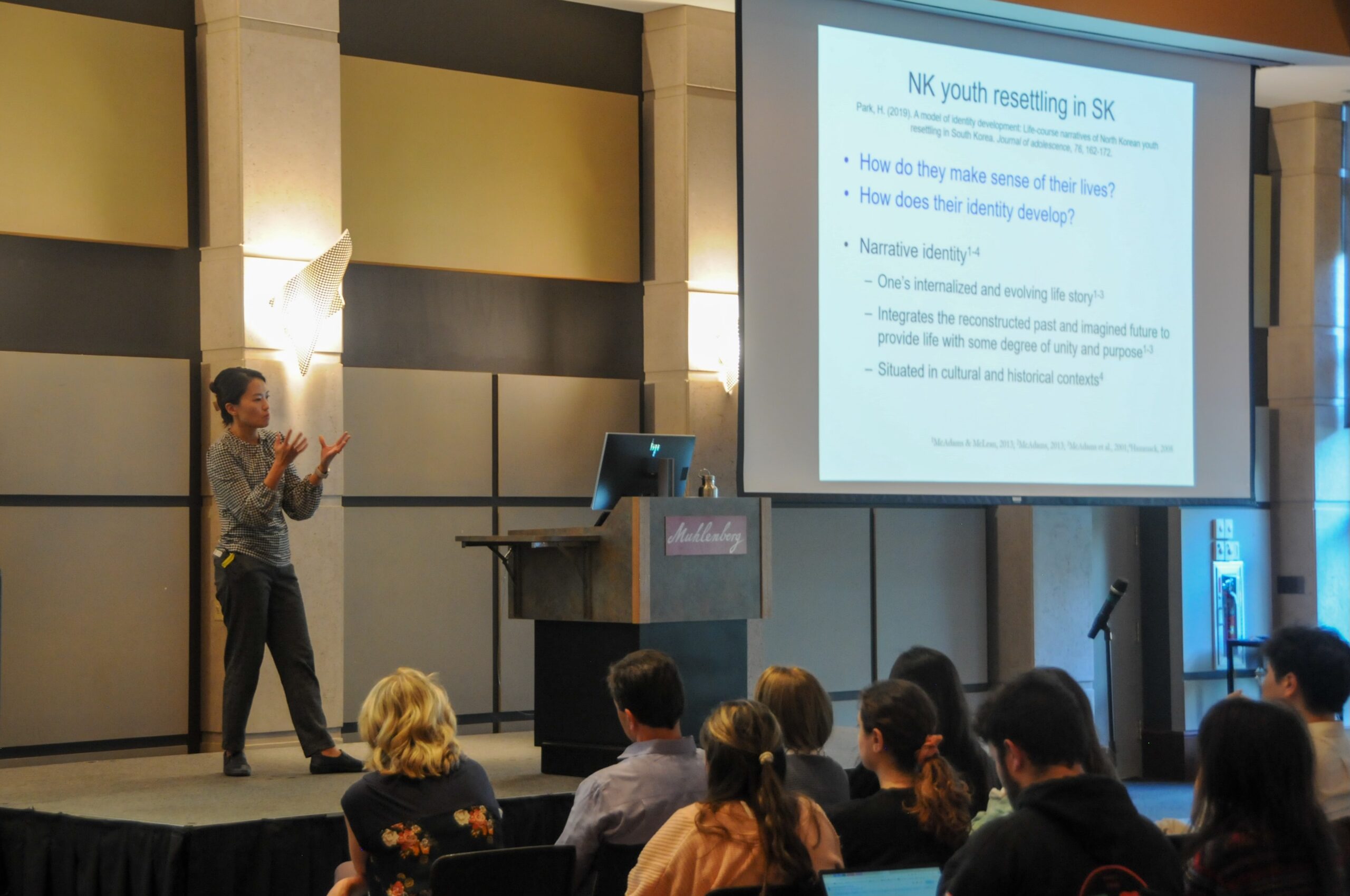
On Oct.17, Heejung Park, Ph.D. of Scripps College was a speaker for the John Rosenberg ’63 and Stephanie Lambert Speaker Series. She gave a talk titled “Global Perspectives on Identity Development and Resilience: Insights from North Korean Refugee Youth Resettling in South Korea.” This lecture series is coordinated by Muhlenberg’s Psychology Department. According to the head of the department, Stefanie Sinno Ph.D., the goal of the series “is to bring nationally and internationally recognized scholars of developmental psychology to Muhlenberg.”
Park’s speech focused on her work regarding refugee youth from North Korea and how their resettlement process affected their identities over time. Park identified six identity stages that North Korean refugees experience throughout their lives: vulnerable, invisible, renewal, turmoil, achieved and self-transcendent. The vulnerable and invisible stages occurred when these individuals were in North Korea and China respectively. The individuals in this study lived in China before they were able to live in South Korea. When the individuals were in China, there was a huge risk that they would be caught and be deported, so the refugees had to spend their time there in hiding. As they had to mask their true identity to the majority of the population, this caused fear, insecurity and identity loss. However, some people had positive experiences such as gaining supporters and finding relief from their troubles via spirituality.
The goal of the series “is to bring nationally and internationally recognized scholars of developmental psychology to Muhlenberg.” Stefanie Sinno Ph.D.
The remainder of the stages happen when the individuals are living in South Korea. These stages focus on the new experiences of living in a different country and the difficulties they would face. Eventually, after the initial complications that they will likely go through, there is a point where the people become more satisfied with their lives by reaching a stage where there is a sense of a stable positive self-view. Sinno mentioned that “Dr. Park’s research highlights the importance of active listening and empathy in understanding individuals’ lived experiences within diverse sociocultural contexts through a lifespan approach.”
In addition to Park’s speech, she also had the opportunity to visit a child development psychology course and Research Methods in Psychology. Connie Wolfe, Ph.D., the professor who teaches the section of research methods that Park visited, said, “Park visited our Research Methods class to share her research expertise as a cultural and developmental psychologist. We talked about a variety of topics including her use of mixed methods (qualitative and quantitative), and the ethical, logistical and cultural considerations that are important to her research. In a broader sense, we learned how important it is for researchers to make consistently intentional decisions informed by ethics and core values.”
Megan Block ‘26 thought that “the talk was very invigorating and made me learn the importance of an individual’s story regarding their identity.”

Shaiyan Feisal '26 is a neuroscience major with a minor in public health. She enjoys writing news and arts & culture pieces to highlight the various voices among the student body and show the variety of commodities Muhlenberg has to offer. When she isn't writing, she enjoys reading murder mystery novels and painting.