








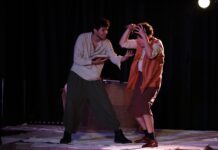










“Speak, Mephistophilis, what means this show?” Faustus, played by Alex Piteris ‘27, asks the question that is ringing in every audience member’s head. When he does, he invites the entire room to question everything, as he does throughout the play.
Following the cancellation of Muhlenberg Theater and Dance’s “Dr. Faustus,” Berg Production supported a fully student-led production of “The Tragical History of Doctor Faustus” that ran Oct. 1 to 4. Directors Jenna Dodge ‘29 and Zachary Rejonis ‘27 used Christopher Marlowe’s original text to create a world that challenges its audience to think critically and sit in the uncomfortable truth of what they do not know. The show does so by creating liminal spaces that include and immerse the audience, making attendees believe that the actor coming down the aisle is a demon and then breaking that connection with absurdist physical comedy. Lily Snowberger ‘30 said that “There were many times I wanted to pull away from the story but literally couldn’t, which was scary and thrilling.” She expounded on the immersion by describing how the lighting, done by Lupe Bueno ‘27, created a “feeling of unease as soon as you stepped into the theatre space.”
Faustus’s curiosity, and subsequently the audience’s, is rewarded with liminality.
When Faustus first meets demons Mephistophilis and Lucifer, the staging and direction become darker and more intimate. Faustus’s curiosity, and subsequently the audience’s, is rewarded with liminality. The opposite is true of the comedic characters. Whenever Raif, played by Joaquin Arce ‘29, and Robin, played by Justin Medina ‘29, are on stage, the characters serve as representations of people who are not curious, but find delight in their ignorance. They seem to enjoy their own sexual humour. Medina reflects on his own character that “my role is there to not only provide a foil to Faustus … but to upset the world created by his clowning.”
The same humour is found in the scholars and clergymen, the difference being that they are presented as people who believe they know something about the world. They perform sexual comedy similar to Medina and Arce, having two scholars forced together at one point and striking the pope on his butt. In this way the performance has punished both knowledge and ignorance. It encourages the audience to laugh at anyone that is not curious.
Medina’s fight choreography advances this message by having the overtly sexual clown characters be punished directly for their sexual presence, going so far as having the devils grab Robin’s chest in combat the same way that he would touch himself provocatively. The fight choreography in these scenes is outlandish. The audience can see the air between the devil’s fist and Robin’s face, whereas when Faustus cuts himself, they see the blood trickling down his arm. In this way the action on stage rewards the intimacy of Faustus’s curiosity while it punishes the ignorance of the fools. The play effectively creates two worlds, one of absurdist comedy and one of frightfully believable tragedy. Every time that tone shifts, the audience is forced to face their world and question what is good, bad and fair.
Rejonis reflected on the piece, saying, “I hope the play leaves people with questions, that they ask them and share them, but also sit with not having answers quite yet.” The show’s acting, designs, choreography and direction provide wonder to everyone who entered the space. The audience gasped in awe and horror, only to laugh seconds later. If one attended “The Tragical History of Doctor Faustus” looking for laughter or drama, the performance would have been satisfying, but its greatest accomplishment is how it forced its audience to face uncertainty.

