



















An opportunity that takes place every three years, the Living Writers series invites writers to partake in conversations and readings with students and the public. This year’s cohort of writers included short-story writer Lorrie Moore, poet and memoirist Safiya Sinclair, poets Safia Elhillo and Roger Reeves and playwright Branden Jacobs-Jenkins.
Gabriel Dean, assistant professor of English literature, Linda Miller, associate professor of English and Dawn Lonsinger, program director of creative writing and journalism all teach sections of Living Writers courses. Offered as a workshop or a lecture, the Living Writers course allowed students to read works by every visiting writer and partake in specialized Q&As and lunches with the authors.
Speaking on the organization of the course, Dean shared, “Living Writers has been a particular joy to teach this semester. All of our accomplished writers have brought such generous spirits to our community, and I think enriched and enlivened us. I’ve thoroughly enjoyed living in their words with the students. The foundation of the course has been laid for many years by Miller and the majority of logistics for this iteration was gracefully executed by Lonsinger, and I’m grateful for both of their hard work. It’s an honor to work and learn with them.”
The first writer to visit campus was Lorrie Moore, coming to call on Sept. 18. Those in the Living Writers class read her “The Collected Stories,” an anthology of short stories Moore had written over the years. Author of several collections, Moore’s writing has also appeared in The New York Review of Books, The New Yorker, The Yale Review and The Atlantic.
During her reading, Moore shared a story not available for purchase taking place during the COVID-19 pandemic in spring 2020. The story was emotional and humorous at the same time, following the main character as they communicate with a sick relative over Facetime. In the campus-wide Q&A following the reading, Moore gave insight into her goals for writing. She stated, “I am writing to my ear.” Later she elaborated, “I’m trying to be accurate to what life contains.”
“Moore gave insight into her goals for writing. She stated, “I am writing to my ear.” Later she elaborated, “I’m trying to be accurate to what life contains.”
On Oct. 9, Safyia Sinclair arrived at Muhlenberg with a long gray coat and intimidatingly skillful sense of style. Raised in Montego Bay, Jamaica, Sinclair is now a professor of creative writing at Arizona State University. Sinclair’s memoir, “How to Say Babylon,” received international acclaim via inclusion on more than 17 best book lists for 2023. It discusses her upbringing in Jamaica as well as her complicated relationship with her father.
For her reading, Sinclair pulled snippets of her memoir and also shared poems she had written. Sinclair shared that, in writing her memoir, “I didn’t really want to leave anything out… [I] wanted to be as truthful as possible.” This led her to some very interesting conversations with her family, who are featured heavily in the piece. In a moment which spurred laughter throughout the audience, Sinclair reflected, “To my family’s detriment, I have a very good memory.” In a particularly poignant moment, she reflected, “To me, writing is synonymous with survival.”
After Sinclair, author Safia Elhillo came to Muhlenberg on Oct. 23 to discuss her poetry collection, “Girls That Never Die.” Self-described as Sudanese by way of Washington, D.C., Elhillo writes poetry that discusses various themes such as womanhood and identity.
During her reading, Elhillo breathed life into a series of old and new poems, leaving the audience reeling with her powerful imagery. Many of her poems featured Arabic, leading the Q&A portion to discuss Elhillo’s relationship with language and translation. She discussed the concept of “translationese,” and seeing translation as not necessarily a 1:1 comparison but instead a means of observing what happens to the quality or texture of a language when it is “haunted” by another language. Touching on her own work, Elhillo shared, “I want to give the poems permission for the word to come out in whatever language it was thought in. Reflecting on poetry as a never-ending craft, Elhillo also pondered, “Imagine you write the perfect poem. What do you do the next day?”
“Touching on her own work, Elhillo shared, “I want to give the poems permission for the word to come out in whatever language it was thought in. Reflecting on poetry as a never-ending craft, Elhillo also pondered, “Imagine you write the perfect poem. What do you do the next day?”
The most recent author visit occurred on Nov. 6 when Roger Reeves stepped onto campus. Currently a professor of English and creative writing at his alma mater, the University of Texas at Austin, Reeves is the author of three award-winning poetry collections including “Best Barbarian.” His collection is a creative compendium of references to Western canon, mythology, hip-hop and popular culture that explores concepts including racial trauma and fatherhood.
Dean introduced Reeves at his reading. This sparked several playful anecdotes, as Reeves and Dean attended the same graduate school. Notably, Reeves shared that he and Dean both hold the title of Sock Wrestling Champion at their alma mater. Continuing discussion of playfulness, during the Q&A section, Reeves commented, “When I’m at my best, I’m playing.” Speaking further on his writing, he added, “If there’s any technique it’s to never banish anything that comes to mind from the poem.”
Discussing his interaction with the literary canon and use of allusions, Reeves also discussed exploring how these techniques are read differently when a Black author uses them versus a white author. He also referred to literature and poetry as an ongoing conversation. He said, “The way you make things is to be out of order.” In embracing these ideas, he asks questions like “What would courtly love look like on social media?” He summarized, “We’re all made of many influences.” What’s particularly interesting is “how we combine things we have received.”
Speaking on the amount of poets in the series, Sof Oberg ‘26 added, “I’ve never spent too much time on poetry before, so getting to explore writing poetry while also reading poems from authors [that are new to me] has been really exciting!”
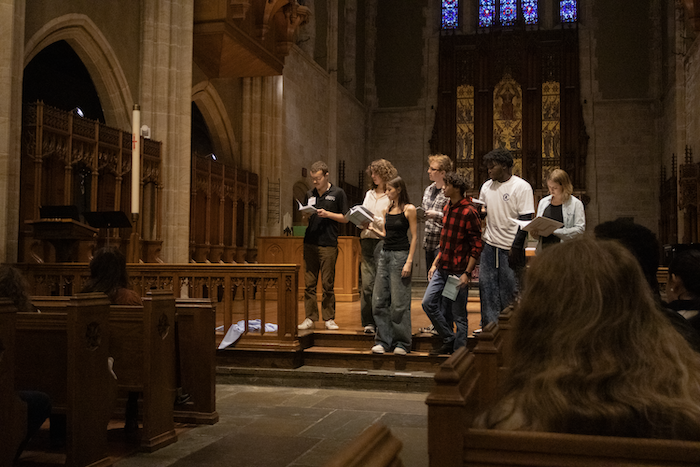
On Nov. 20 at 7 p.m. the final Living Writer will come to campus. Jacobs-Jenkins is the author of “Everybody,” a play that draws from the morality play “Everyman” in order to discuss life, death and the space in between. As a special treat for those taking the Living Writers course, the cast of next semester’s department performance of “Everybody” gave a staged reading in Egner Memorial Chapel. Hauntingly hilarious, the reading drew gasps and laughter from the audience, who were drawn into the play itself.
Reflecting on the experience as a whole, Oberg commented, “It’s been awesome getting to meet and speak with different authors, especially because they’re from all different genres. Going from reading their books or collections to then meeting them gives new meaning to their work, and it’s been fun going back and rereading what they’ve written after hearing them speak about it…I’m also usually exposed to authors who have been dead for a while or who feel very removed from their work, so it makes the writing feel more alive and human knowing I get to meet the authors later.”
Summarizing this experience, Fiona Porter ‘27 added, “Being able to hear from the authors after spending so much time immersed in their work is a rare and wonderful experience that I will always value.”

Emma Northrop '27 is a History, English Literature and International Studies major at Muhlenberg. She loves writing for the Weekly, and is immensely excited to be a managing editor. When not at the Weekly, she loves reading her favorite fantasy novels, drinking lavender vanilla iced lattes, and scrapbooking.