



















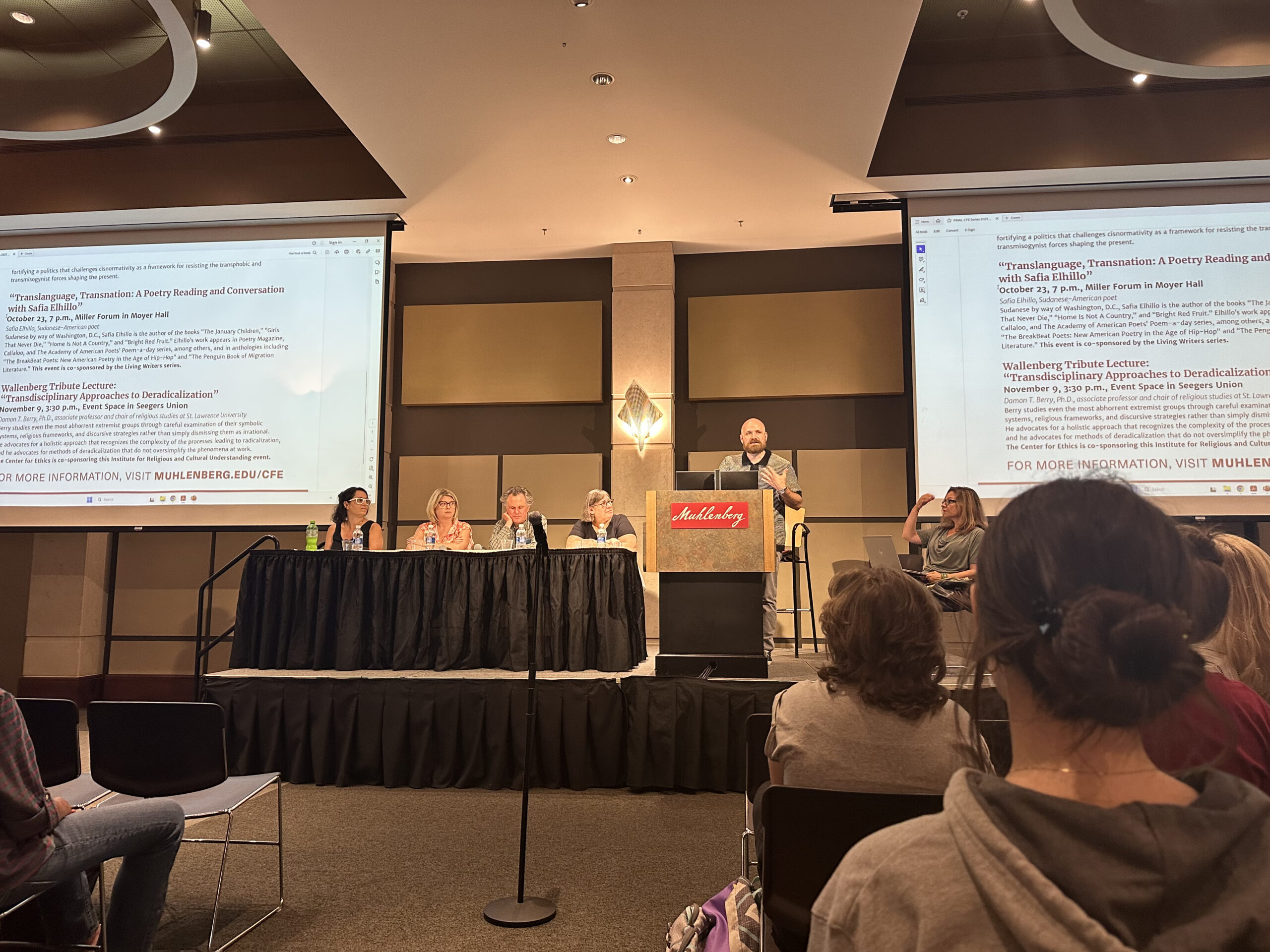
On Wednesday, Sept. 3, the Center for Ethics started its thirtieth year with a panel titled “Transacademic Echoes.”
Explaining how she developed the theme of “Transform, Translate, Transcend,” Ioanna Chatzidimitriou, associate professor of French and organizer of this year’s Center for Ethics events, shared, “I am a translation scholar, so I always wondered what other kinds of meaning this prefix could have.” Chatdzimitriou and co-organizer Joshua Barsczewski, assistant professor of English, invited faculty across disciplines to approach the prefix “trans-.”
This year’s event featured Associate Professor of Spanish Erika Sutherland, Professor of Biology Bruce Wightman, Professor of Psychology and Director of Women & Gender Studies Kate Richmond and Professor of English and Film Studies and Director of Women & Gender Studies Francesca Coppa.
“Don’t cancel art, you live in it.” – Coppa
Focusing first on translation, Sutherland explained how language professors are “constantly telling our students not to translate– to think in a different language.” She noted, “Translation reflects not only time and geography, but, perhaps more importantly, perspective and philosophy.” She provided an example of signage through which malicious or poorly worded translation can make certain populations feel welcomed while shutting out others. She remarked, “When you have a blindness to language issues, you have a blindness to people that don’t speak English.” She ended her segment by encouraging attendees to learn a second language in order to communicate equitably as one moves through the world.
Following Sutherland, Wightman examined the prefix “trans-” through the lens of DNA. To do so, he called upon a quote from a 2015 interview with Barack Obama: “What is also true is that the legacy of slavery, Jim Crow, discrimination in almost every institution of our lives– you know, that casts a long shadow. And that’s still part of our DNA that’s passed on. We’re not cured of it.” While acknowledging the metaphorical aspect of this statement, Wightman simultaneously contemplated the “preoccupation with DNA and identity.” This was particularly salient to his discussion of genetic modification and its pitfalls. Wightman noted, “Genes don’t do just one thing. When you start monkeying around with one gene, you don’t know what all the consequences are.” Ending his segment, he left attendees with a question of the attention to ethics with this kind of genetic manipulation.
Richmond, who identified herself as a feminist therapist, centered the discussion around the transgender community. She explained how “trans” as a word in psychology signifies “boundary crossing.” While boundaries are important to maintain in some psychological situations, Richmond noted that boundary crossing on a personal level reflects a “tension between pleasure and regulation.” She continued to discuss the trans community through this lens of tension– tension between social and self identification, the ability to control one’s body, the “born this way” origin story and legitimacy of trans identities and visibility and safety. She also explained how she and other therapists are on call, as the current government administration is attempting to pressure the Children’s Hospital of Philadelphia to disclose the names and numbers of all children receiving gender diversity care.
Coppa approached the prefix “trans-” through transmedia– telling stories across media or one story on different platforms. She gave examples of transmedia projects, citing Star Wars, Marvel and Harry Potter. Coppa also elaborated on her role as a founder of the Organization For Transformative Works (OTW), a nonprofit organization supporting fan works. With the OTW, Coppa also helped create the Archive of Our Own (Ao3), “the largest female-built open source software project on the web.” Ao3 is home to a wealth of fanfiction and fan works. As Coppa notes, “Fanfiction relies on fair use, and in particular on transformative use.” Coppa explained “The wilder a story is…the further away from canon…the more likely it is to be a transformative work.”
Dina Maltser ‘26 shared, “I found the panel really interesting, especially Dr. Coppa’s discussion of art across different media and adapted beyond its original author.”
The panel then moved into a question and answer session, where attendees were given the opportunity to clarify information from the prepared discussions and further prompt the professors. Wightman was asked to expand upon the genetic effects of slavery, while Sutherland expanded upon the use of automatic translation devices by professional translators.
A question posed by Jeremy Teisseire, Professor of Neuroscience, sparked the panelists to discuss the idea of loss as a shadow to transformation, exploring their relationship with transformation with respect to their discipline.
To this, Richmond replied, “I have to go beyond my discipline to be effective.” She also touched upon the concept of ambiguous loss, or the feeling of loss for someone or something that is still there, just not in the way you knew, can affect the communities she serves.
Sutherland added, “If you stay within your discipline, you’re working in a very sterile way.” Wightman also commented, “The history of science is full of people coming from outside the discipline,” a practice that often leads to big distinctions.
Coppa also used this opportunity to address the difference between intellectual property and material reality. “If I take your idea, you still have it,” she began. “If I steal your bicycle you don’t have it.” Coppa stated, “All my ideas are yours and I stole them from somebody else and I call that learning.”
Maltser commented, “Considering the theme of the Center for Ethics this year, I would’ve loved to see more of a focus on different languages, and am hoping for more of that throughout the year…I appreciated the dialogue between professors and the genuine interest they seemed to have in one another’s work.”
“The Center for Ethics does really try to be a liberal arts embodiment…[and] it shows in a public way that liberal arts can tackle big questions.” – Barsczewski
In a particularly passionate moment, Richmond and Coppa debated the concept of “separating the art from the artist.” Richmond shared, “Once I found out Picasso was a serial sexual predator, I don’t see it the same way.” Coppa took the stance: “Don’t cancel art, you live in it.”
Reflecting on the event, Barsczewski shared, “The Center for Ethics does really try to be a liberal arts embodiment…[and] it shows in a public way that liberal arts can tackle big questions.” Events for the Center for Ethics will take place throughout the semester, from garden tours to lectures to poetry readings. To learn more, visit https://www.muhlenberg.edu/aboutus/cfe/upcomingevents/ or check the campus calendar of events.

Emma Northrop '27 is a History, English Literature and International Studies major at Muhlenberg. She loves writing for the Weekly, and is immensely excited to be a managing editor. When not at the Weekly, she loves reading her favorite fantasy novels, drinking lavender vanilla iced lattes, and scrapbooking.