


















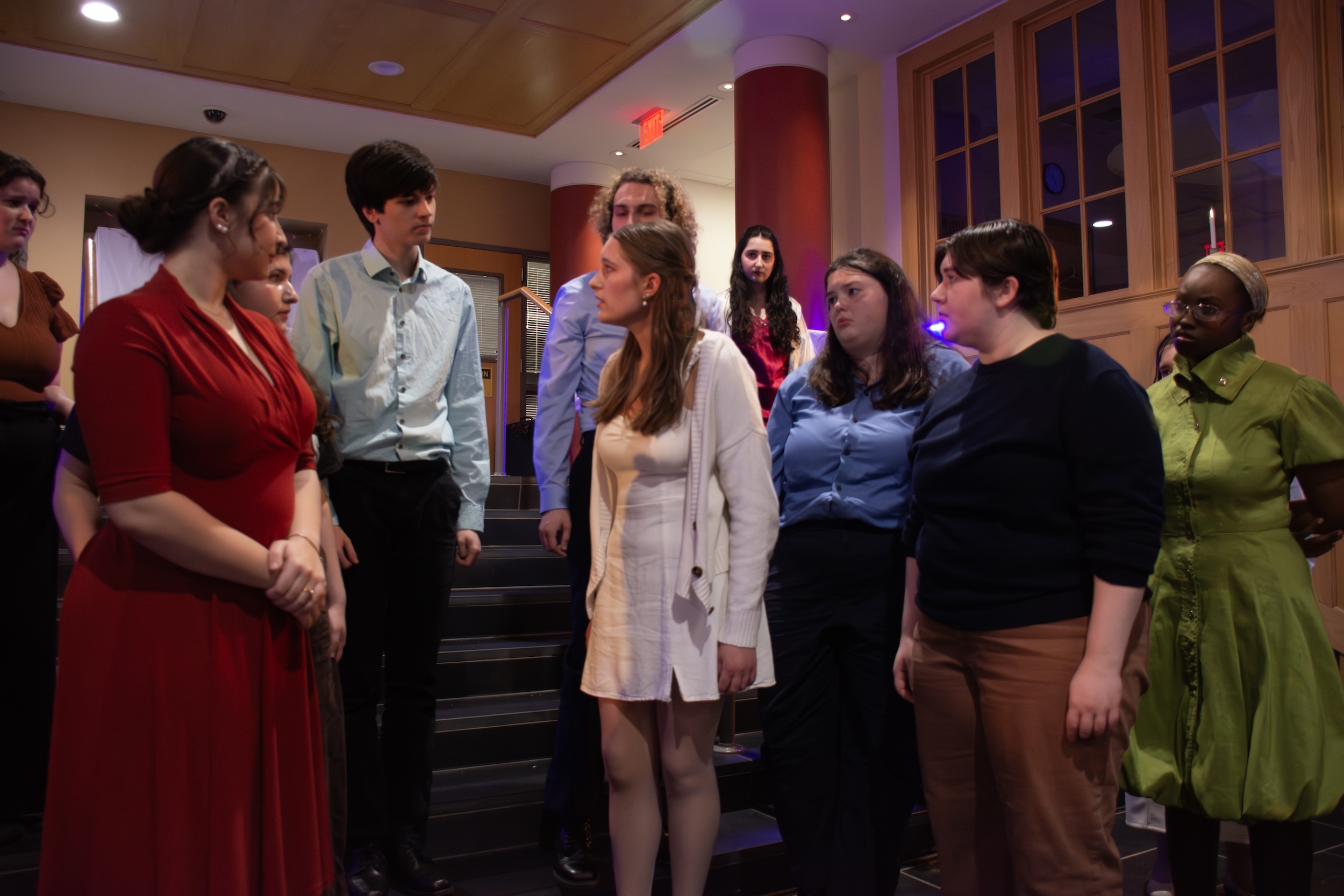
After merging with the Muhlenberg Theater Association (MTA) last fall and taking the semester off, BergImmersive debuted “The Willard Suitcases” by Julianne Warwick Davis. Running April 17-19 in the New Science lobby, the show was under the direction of Eliyah Burg ‘28 with Music Director Remi Young ‘27.
The song cycle, a collection of songs intended to be performed as a sequence, took inspiration from a series of photographs by Jon Crispin that depict suitcases left behind when Willard Psychiatric Center closed in 1995. Although the characters in “The Willard Suitcases” are fictional, each of them is inspired by a particular suitcase from Crispin’s series.
The show kicked off with a “ghost tour” starting in Parents Plaza, where cast members were seen in windows. Some characters, like Frank, played by Penelope Wagner ‘28, paced through the Century Arch. Other “ghosts” were seen holding candlesticks or watching the audience.
Upon entry, the New Science lobby was transformed into the south wing of the abandoned Willard Asylum. It was there that the ghosts of the former patients gathered to tell their tales, opening with one question: “What would you pack?”
The story of the show is told through a series of solo performances, in which each ghost gets to share their own story inspired by their suitcase. Yet, not every ghost in the asylum got to answer that question for themselves. Anna, played by Julia Gitelson ‘29, was forcibly admitted to the asylum by her abusive husband. Her song tells the story of the final car ride she took on her way to the asylum. This puts her in a situation unique from the rest of the ghosts. As Gitelson puts it, “Unlike the other characters, she didn’t get to pack her own suitcase, and she’s struggling with processing her situation and learning to trust again.”
The material of “The Willard Suitcases” is heavy; many of the vignettes feature hard topics on top of mental illness, including child death, war and abuse. In her portrayal of Mary, a young mother who killed her son, Samantha Marrero ‘28 found herself struggling with “finding a healthy balance between highlighting the serious topics at hand, while also not putting her in a box and making her one-dimensional through defining her by her condition.”
Beyond just topics, the material also broached a physicality that was new to some cast members. Eva Schwartz ‘26 played Laverene, an old woman in love with her mail carrier. Laverne sends a series of postcards, hoping that the mail carrier will finally see her through the window. Schwartz took on a new challenge with this role, “I had never played such a blatantly sensual character onstage before, so I was terrified, but in doing my own character work and bringing that confidence forward, I was able to come around and cherish my portrayal of her.”
This was the first-ever song cycle produced through BergImmersive, a format that has rarely even been done by theatrical organizations on campus. As such, it can be difficult for general audiences, or rather, those who do not frequently attend the theater, to fully understand. As Schwartz put it, “It’s essentially telling the story of fifteen ghosts who haunt an asylum and what got them sent there in the first place. I don’t think that every show needs to have a moral, but I can understand coming out of the show feeling confused and potentially unsatisfied because there was no beginning, middle and end.”
“The Willard Suitcases” is a ghost story whose inhabitants still haunt us today. As Marrero put it: “To me, it served as a reminder that we are all human at the end of the day, and those who have struggled with their mental health shouldn’t be defined as such.”

