


















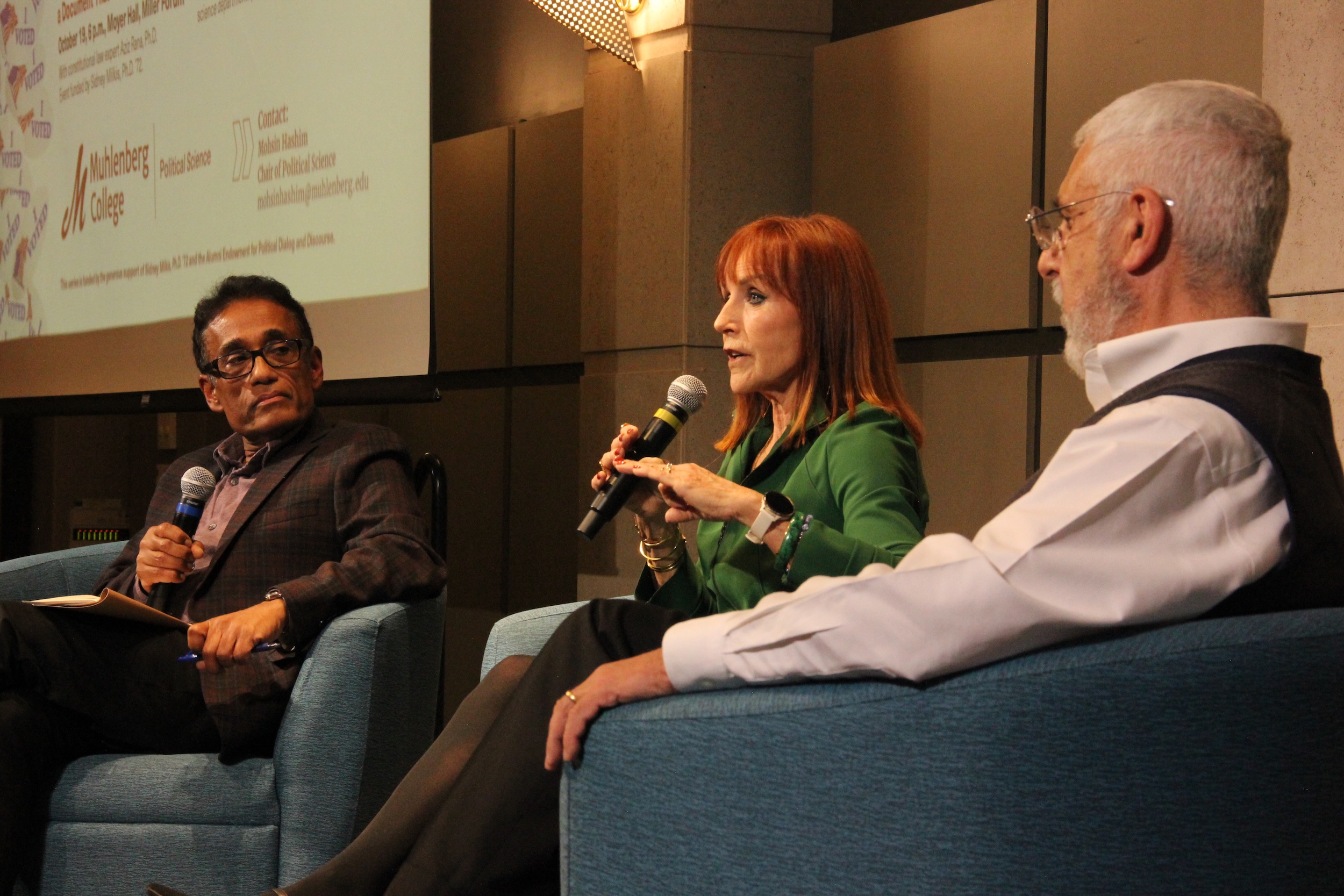
On Oct. 6, Muhlenberg kicked off the 2026 Midterm Election Series with a discussion on national security and its implications in the upcoming election. The panel featured guest speakers Lauren Anderson ‘79, a former senior FBI executive and Muhlenberg trustee alum, and Steven Cash, a CIA veteran. Both speakers represent The Steady State, a nonprofit advocacy organization of military and intelligence personnel who maintain government operations across administrations. Cash and Anderson brought their experience and insights to discuss national security and its role in the upcoming election.
Established in 1992 by the political science department, the Election Series has long served as a pillar of political discourse at Muhlenberg. The program brings experts to campus to introduce students to perspectives that go beyond what is taught in the classroom. Mohsin Hashim, professor of political science and moderator of the panel, shared that Pennsylvania’s status as a critical swing state draws more importance to civic engagement in the community. He stated, “Part of liberal arts education is to promote civic and political engagement. We don’t try to influence your vote, but we want to make sure you’re engaged in your communities.”
In preparation for the Election Series, the political science department discusses budget allocations and identifies relevant topics in order to select engaging guest speakers.
Although the Election Series is typically funded through the college’s Lectures and Forums committee, this year’s program is supported by the Alumni Endowment for Political Dialogue and Discourse, as well as by contributions from Sidney Milkis ‘72, a Muhlenberg alum and professor of politics at the University of Virginia. The department’s search for a speaker was also slightly different from the search in past years as faculty were quickly led to Anderson, who had already connected with the department about bringing The Steady State’s mission to campus. Faculty selected Cash and Anderson, who represent The Steady State, to speak at the opening panel, acknowledging the connection between federal administrations and national security.
Throughout the panel, Cash and Anderson outlined how federal institutions are directly tied to democracy. Cash explained that The Steady State’s primary function is to provide warning to the public. “We’ve seen democracies fall. We’ve seen democracies resist autocracy. We’ve seen autocrats take power, lose power and keep power. So we know how it happens. So we know what the indicators are,” said Cash. Based on these indicators, Cash concluded that the dangers being caused by current executive actions are an “existential threat.” He cautioned, “I may have voted in the last free and fair election that I will ever vote in.”
Anderson detailed how recent departures from federal agencies are impacting operational capabilities, noting that the FBI has lost 1,600 personnel since last year. “With the hollowing out of expertise we’re losing experienced people and institutional expertise, not only through departures, but through the removal of career public servants,” stated Anderson. “Understanding national security and the threats we face is not something anyone learns in a day, a week or a month. It takes literally years to build a deep understanding in some of these areas.”
Both speakers stressed that protecting democracy requires action outside of government agencies. Anderson urges voters to look at how officials use their power rather than voting off of political parties. “The responsibility for maintaining our democratic institutions can’t belong only to the people who work inside of them. The responsibility belongs to all of us. We’re the ones who can decide what conduct we will accept from everyone that we entrust with governmental authority,” stated Anderson.
The panel drew a crowd of enthusiastic students who were prepared to engage with the speakers and develop a deeper understanding of federal administrations. Hashim shared that the emotional maturity shown by Muhlenberg students at the panel came from a place of deep care for the country, as they framed their political anxieties in an intellectual way and asked questions that impressed the speakers. The unexpected engagement from the crowd led to an extended Q&A session that ran past its scheduled end time.
For Gabi Damens ‘27, the panel highlighted the urgency of voter participation: “As a political science student, I’m already motivated to follow the midterms, but I think this event and others like it are important for encouraging other students to pay attention to politics and turn out to vote. They’re an easy, accessible way for students to learn about and develop a better understanding of important issues, and motivate political participation.”
The overarching goal of the opening panel was to explain political realities and to turn Muhlenberg students into informed citizens. Anderson summarized the civic responsibility at stake: “It’s not about whether you’re a Republican or Democrat. It’s critical that each of us recognize and embrace our role as citizens and voters.”

