



















While most Muhlenberg students decided to return home during summer break, others chose to continue their research on campus.
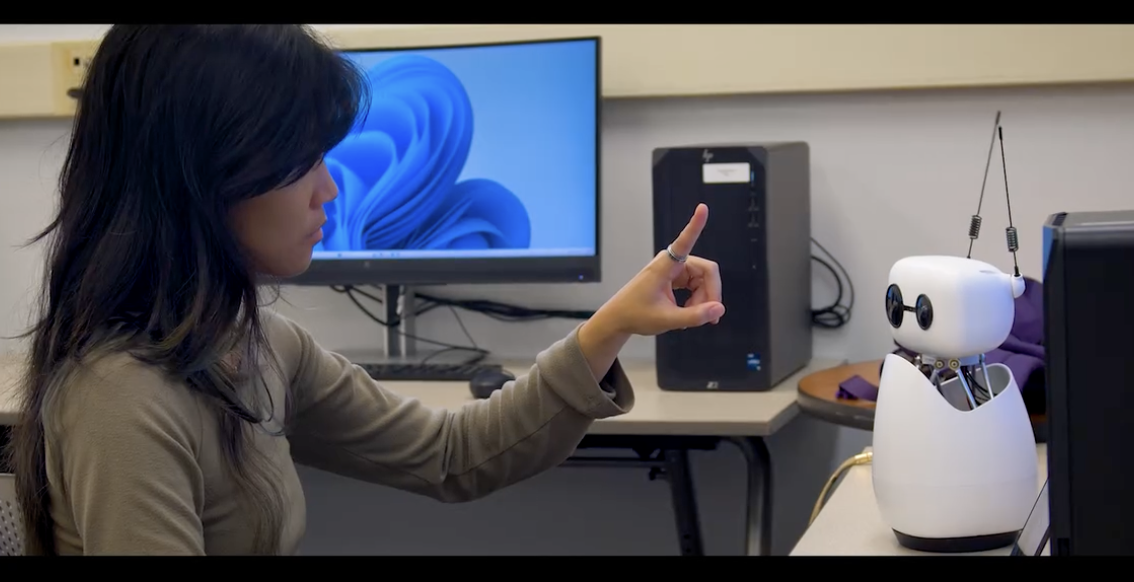
Melina Sarion ‘27, a computer science and mathematics double major, stayed at Muhlenberg over the summer to study human-Artificial Intelligence (AI) interaction. Thanks to the Galgano Student Research Fund, Muhlenberg-provided housing and a community of researchers, Sairon was able to begin the project “Raising Reachy.”
Sarion worked closely with Assistant Professor and Director of Computer Science Hamed Yaghoobian who initially proposed the idea of building a robot, Sarion was able to begin the project “Raising Reachy.” Wanting to “engage in an ethical research project to figure out the limitations of certain mediums of AI,” Sarion assembled Reachy Mini, “a robot designed by Pollen Robotics and Hugging Face” and spent the summer experimenting with human-robot interaction.
Using Reachy, Sarion gathered how different ways of framing an large language model (LLM)-powered robot influences an undergraduate’s way of engaging with and perceiving its “intelligence, likeability, animacy, safety, trust and anxiety.” She also wanted to see “what values, social norms and cognitive biases do undergraduates reproduce when ‘raising’ Reachy.”
Very aware of the environmental effects AI has, Sarion made a conscious decision to run all models through her own device in order to minimize her impact. She notes, “This impacts the quality of the conversation, but I believe this tradeoff does not affect the quality of the research or diminish the interaction between Reachy and the volunteers.” With the goal to “bridge the gap between human psychology and technology, especially in the context of anthropomorphic robots,” Sarion believes it is crucial for her to “study how humans interact with technology through different framings, embodiments and contexts.”
Ultimately, Sarion “would love for more people, especially older generations and those who choose to incorporate AI into their lifestyles, to understand more about the risks and costs of relying on LLMs.” Still actively looking for participants to have five-minute conversations with Reachy, Sarion plans to present her research at a conference and continue to work closely with robots.
Alongside Sarion, wrapping up his freshman year, Ethan Ross ‘29 decided to use the summer to pursue an independent research project. With Associate Professor of psychology Alexandra Frazer as his advisor, Ross spent eight weeks analyzing trends in physiological drama films from four different countries in his project called, “The National Identity of the Psychological Drama Film.”
Tired of lifeguarding, Ross stated, “I wanted to do something that felt a little more productive and educational for my summer. I feel very stagnant when I’m just sitting on the guard chair for hours on end.” He expresses his gratitude for Muhlenberg’s system that encourages students to pursue independent research saying, “If you have a research project in mind, go tell Dr. Frazer, she will let you get it done. It’s never something someone should be like I don’t know if I have been at the school long enough to do this’ or ‘I don’t know if my research proposal is good enough’ because if you talk to Dr. Frazer she doesn’t care how long you have been there and she will help you make your proposal good enough. Anyone can do research here.”
Under Frazer’s advisory, Ross worked independently watching about a film a day for the first two weeks, moving onto reading research papers afterwards. With original plans to cover countries like Sweden, Australia, Italy and Russia to touch every continent aside from Antarctica, Ross realized he had to narrow his scope down. With the official title and focus of his research emerging half way through, Ross stated, “I went through a series of mutations of my main theme and ended up with something I felt was pretty solid and substantial.” This is when he landed on exploring films from the United States, England, Japan and South Korea, where he could also explore comparing two Anglo countries and two Asian countries.
Moving forward into his sophomore year Ross commented, “A lot of this was just for me. I love film and I love thinking about the philosophy of the mind especially in a cultural context so now I’m able to tackle films from different countries and different languages and kinda be able to think about them a little differently.” He only continues to grow as an important realization he had was learning to be comfortable with admitting he didn’t know something at times, because “it just means that I can build on the understanding.” To any student thinking about doing summer research, Ross says, “If you want to do this, please do it. There’s nothing holding you back.”
Interestingly Zachary Cohen-Neamie ‘27, a biology major and mathematics minor, decided to tackle two four-week long research projects over the summer. Notably, neither of them were directly associated with his majors.
With one project being in the chemistry department, specifically organic chemistry, Cohen worked in a wet lab with Assistant Professor of organic chemistry Ian Mackenzie to develop a library pyrylium photocalyst. His second project was in computer science. Despite having only taken one class in the discipline, Cohen spent four of his eight weeks in the computer science lab working on AI fusion models and computer vision.
Working on flood data with Assistant Professor of computer science Youngsun Jang, Cohen introduced a new graph neural network into that model with extra contextual data for improved performance to the classical U-net baseline model. By mapping and taking satellite images of flooded areas, Cohen would be able to differentiate between “which one was a water source versus an area that was land before and is now flooded.” Cohen noted this model “has practical applications in terms of [helping] with damage detection.” This is important work because the current baseline cannot differentiate the difference between satellite images of flooded areas.
However, Cohen believes there is room for improvement in the student experience. The Mobile Mule, Muhlenberg’s campus food truck, was the only campus dining available. It was only open 1.5 hours a day. Cohen found that, “It was especially tough for me because I had to watch what I was eating because I was on a descent plan for wrestling.”
Without reaching out to professors directly Cohen wouldn’t have known about these opportunities available. He said, “Don’t limit yourself to doing research in your major” because “the Muhlenberg faculty is so nice. They are willing to talk to students, willing to actually tell them about their research. We’re not a school that’s trying to prevent people from doing stuff.”
Muhlenberg’s summer research fosters a culture of curiosity, where students from various disciplines can explore within and beyond their majors. With Muhlenberg’s engaged professors and plentiful opportunities, any student with a passion can decide to pursue summer research.

Gabriela Mendez ‘28 plans to major in English with a minor in Spanish. She is very excited and honored to be joining the Weekly staff! Outside of writing, she loves to read, be one with nature, and watch new movies.