



















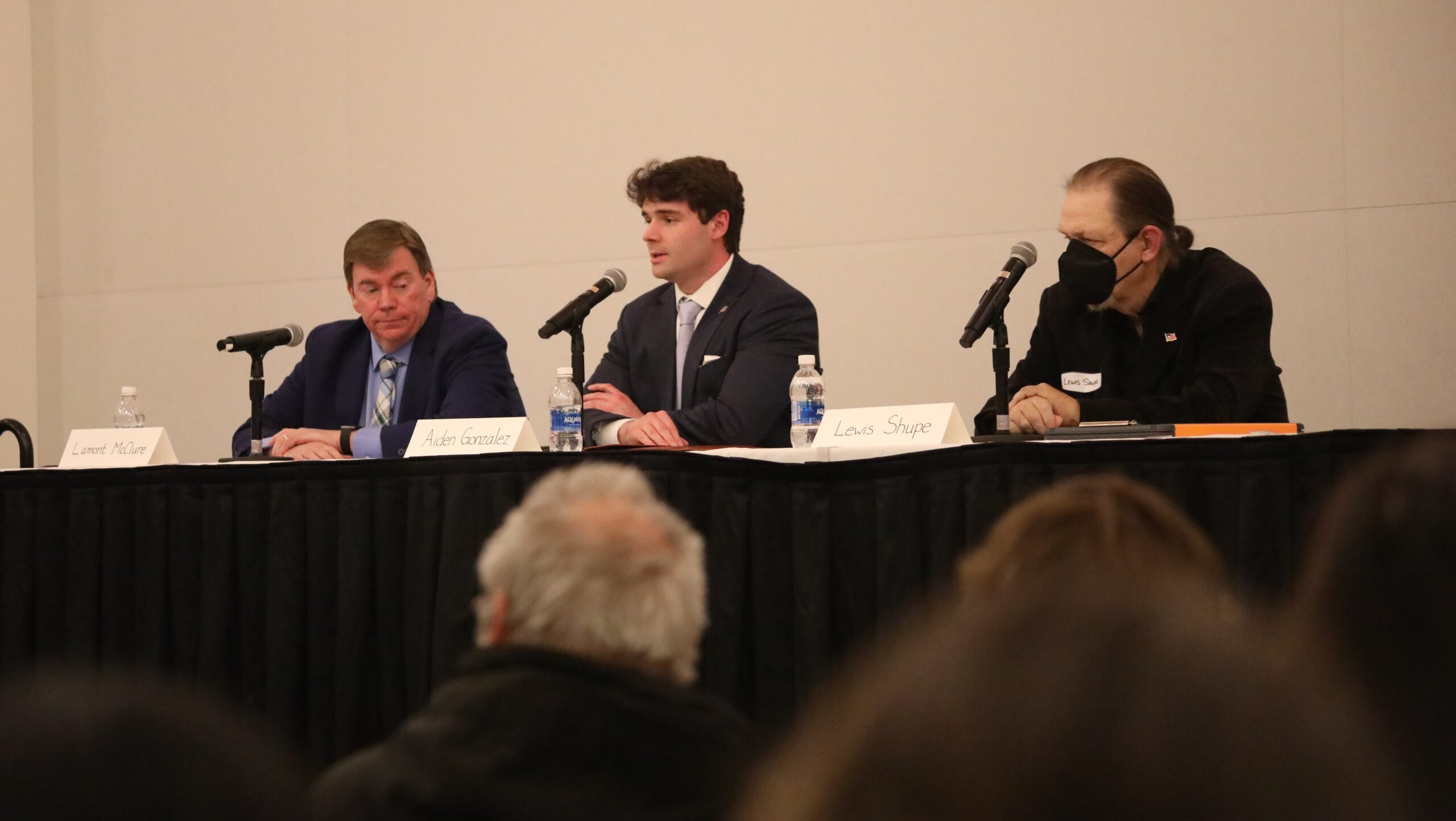
Muhlenberg College’s Great Room was filled with students and local residents last Thursday as the Lehigh Valley Young Democrats (LVYD) partnered with Muhlenberg College Democrats, also known as “BergDems,” to host a Democratic primary debate for Pennsylvania’s Seventh Congressional District.
The event marked a milestone for LVYD, whose chapter was officially chartered in November, making this their first event. According to the LVYD President Shad Yoder, he reached out to BergDems “to see if I could join a meeting and help promote Lehigh Valley Young Democrats and meet fellow young Democrats in the area.” Having recently graduated from the University of Mary Washington, Yoder said college outreach was a priority from the start.
BergDems President River Levy ‘28 said that they already planned to host a congressional candidate panel this semester, but when the LVYD reached out with a date and candidate commitments, but no venue, the partnership was formed. Levy said, “We were absolutely thrilled that they reached out to us and we were happy to extend our resources.”
While most candidates initially confirmed their attendance, the panel saw several last-minute cancellations. Mark Pinsley dropped out of the race a day before the event. Later that same evening, Carol Obando-Derstine, Ryan Crosswell and Bob Brooks stated they had scheduling conflicts and withdrew from the panel. Levy noted, “Both BergDems and LVYD understand the busy schedule of these congressional candidates, but their last-minute cancellations did come as a surprise.” Levy continued, saying, “The event was still incredibly successful and informative and we are so grateful for the candidates who did show up and were able to shed some light on their campaigns and goals.”
Three Democratic candidates participated in the panel: Lamont McClure, Aiden Gonzalez and Lewis Shupe. Throughout the evening, the candidates fielded audience-submitted and prewritten questions covering reproductive rights, immigration enforcement, healthcare, environmental protection and party leadership.
When discussing immigration and the role of U.S. Immigration and Customs Enforcement (ICE), a wide range of responses were prompted; however, all agreed that there needs to be a change. Gonzalez argued that the agency “as it stands shouldn’t exist” and said he would personally withhold a vote for funding for armed individuals who are felons, vote to defund and pursue prosecution. Shupe suggested removing liability from every federal agent, not ICE agents. McClure stressed his experience, citing the time he kicked ICE out of the Northampton County Courthouse and they haven’t been back since, for they need to follow the law and acquire a warrant to do anything.
Environmental concerns were discussed as well. Gonzalez called for the banning of fracking and investing in renewable and nuclear energy. McClure pointed to his record for preserving farmland and environmentally sensitive land in Northampton County. Shupe proposed exploring hydroelectric infrastructure, especially locally and expanding environmental oversight.
When asked what their first piece of legislation would be if elected, the candidates offered distinct policies. Shupe said he would introduce an Anti-Corruption Act aimed at increasing governmental accountability, such as an assembly line of impeachment for every Supreme Court justice who voted down Roe v. Wade. McClure stated he would address the one trillion dollars in Medicaid cuts as his top priority. Gonzalez said he would prioritize establishing a single-payer healthcare system to ensure universal coverage.
Overall, McClure highlighted his experience as Northampton County Executive, centering his platform on his experience, economic stability and youth engagement. He urged young voters to turn out to the polls, saying, “Without you, without the youth, we will not win.” McClure emphasized his 17-year record of fighting large corporations on behalf of steelworkers and saving taxpayers $25 million during his tenure. He pledged to “fight like hell” for constituents to ensure a stable future. Gonzalez focused his campaign on forward-looking change. His plan entails investing in renewable and nuclear energy, bettering technology and establishing single-payer healthcare, so people “do not have to worry.” He stressed that the current administration should not be adding to the national debt and cutting programs that affect teachers, students and the middle class. Gonzalez ended by expressing pride in the Democratic Party’s legacy and calling for people to have pride in being a Democrat. Shupe emphasized government reform and voter empowerment as the backbone of his platform. He highlighted his online presence and called on the audience to “harness the power of the registered voter.” Alongside the Anti-Corruption Act, Shupe proposed publicly funded journalism and strict punishments for hate crimes. In his closing remarks, he committed himself to combatting growing hate and promised to serve constituents to the best of his ability if elected.
The organizers and audience members stressed the importance of attending political events to be more informed. “Primary elections are so important, especially if we feel that our party isn’t properly representing us. Whether that “us” is our generation or another group someone identifies within, we all deserve to feel represented. These panels give students the opportunity to make an informed vote on who they want to run in their party,” said Levy.
Yoder echoed that sentiment, stating, “It is no secret that young voters make or break election results, and time and time again we are reminded that we are the future and our participation in politics is paramount. We are the future of the party and of politics. We should be active and engaged right now. College campuses are pivotal to that type of participation and create a way to bring politics to students and young voters, even if they may not want to get involved just yet.”
Debra Condon, an attendee and member of Indivisible Lehigh Valley Bethlehem, stated she came to the event because “our democracy is obviously at the brink right now, and people sometimes think…protesting and everything is extremely important, but… our voting is the most powerful thing that we have right now, and primaries are really important.” She continued, stating, “I want to hear because there’s candidates you know, we need to get behind. The Democratic nominee is… just really important.”
Isaac Backenroth ‘29 stated, “democracy is stronger when more people are involved in it, and going to a debate is pretty much the best way, besides voting to be involved in the democracy. We’re seeing a lot of democratic values and norms kind of eroded right now in our country. I think that a large part of that is due to a lack of involvement in politics. So the more that we can get people to go to these things and see things in a rational light, and hear candidates out in a full way instead of watching clips of them on social media apps, is very important to healing our country.”

Amanda Growney ‘28 is a history major on the pre-law track. She is absolutely thrilled to be a copy editor for The Muhlenberg Weekly. When she's not attending classes or club meetings, you’ll find her rewatching “How I Met Your Mother,” watching a sports game, socializing with friends, or sleeping.