



















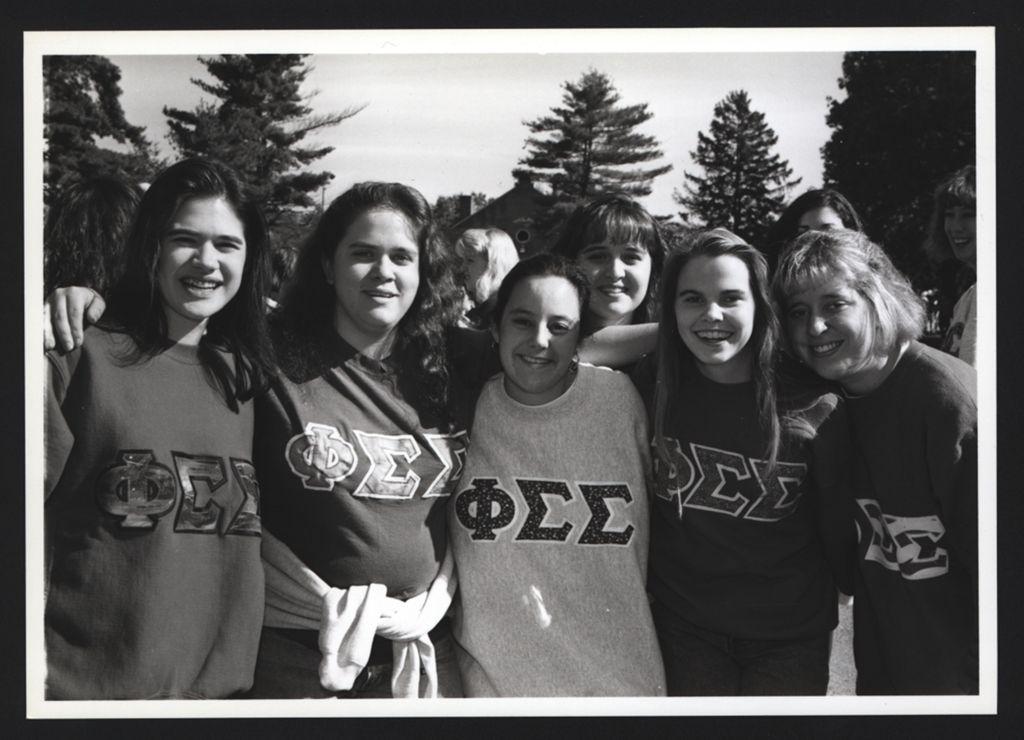
In November 1960, June Renninger ‘61 wrote in The Weekly, “A majority of coeds [female students] interviewed agreed that the campus was too small to warrant sororities.” At the time, Muhlenberg had around 100 female students– it was only three years previously, in 1957, that the College opened its red doors for female students to enroll. By fall of 1983, opinions had changed, alongside the enrollment of significantly more female students. A student committee interviewed a total of five sororities for the possibility of them opening a chapter on campus, and three were approved by school administration. Alpha Chi Omega, Delta Zeta and Phi Sigma Sigma would become a part of Muhlenberg for the decades to come. Over a year later, Muhlenberg held its first recruitment for sororities in January 1985. On Feb. 18 of that year, 172 bids were extended to students. At this point, all three chapters were classified as “colonies,” meaning that they were in a probationary period until they were officially charted by the national organization.
Ten years previously, in 1974, a group of eleven women applied to live in the Fredrick Augustus house but were rejected on the basis that as female students, they should reside somewhere closer to the middle of campus for safety purposes. This group of students then appealed to the Pennsylvania Human Rights Commission, claiming that this rejection was discrimination on the basis of sex. Before public hearings were held, a compromise was reached that allowed female students to live in Frederick Augustus. A decade later, this house would be assigned to Delta Zeta. In the spring of 1986, each sorority was assigned a house. Alpha Chi Omega was given Millerheim, one of the “special interest” houses that switched between housing male and female students each year, and similarly, Phi Sigma Sigma was given Henrietta. The Frederick Augustus House was assigned to Delta Zeta.
Notably, at this time Phi Sigma Sigma was considered the only sorority to be non-sectarian and therefore considered to not have explicit ties to a Christian cause. James T. Bryan, dean of students in 1984, stated that the inclusion of a non-religious chapter would help make Greek life on campus “palatable to a larger range of people.”
Nearly a decade after the first recruitment for sororities, Phi Mu would join the ranks of Greek life at Muhlenberg in the 1991-1992 academic year. In 1994, they would be assigned MacGregor 103 but would be re-assigned to a residence on North 22nd Street in 1995, which is where the chapter currently resides.
In February 2003, a fifth sorority that identified as a multicultural society and independent from the National Panhellenic Council, would join Muhlenberg. Theta Nu Xi was started at Muhlenberg by founding member Kristin Boydston ‘05 who believed that, “A sorority is a celebration of differences.” Boydston’s motivations for starting Theta Nu Xi laid in the fact that she felt that sororities on campus did not effectively promote diversity or understanding of each other. Christopher Kovats-Bernat, faculty advisor to the sorority, told The Weekly in 2003, “Theta Nu Xi is a different kind of Greek organization because it is a sisterhood defined by its inclusiveness rather than its exclusiveness, and I think that that’s a healthy approach to achieving the progressive campus climate that we should all be striving to attain.” The chapter held their first rush alongside the other sororities and fraternities in fall 2003. Their last recorded rush class was in 2018, this chapter is no longer active.
Forty years after sororities were introduced to Muhlenberg campus, Alpha Chi Omega, Phi Sigma Sigma, Delta Zeta and Phi Mu have held their second recruitment in the spring since the seasonal switch began last year. Natalie Shaw, director of student life, weighed in the importance of knowing the origins of Muhlenberg’s Greek organizations. “History provides important context by helping us understand where organizations came from, the values they were founded on, and it serves as a connection to alumni. Ultimately, the longevity of organizations depends on how well they evolve, with current members shaping traditions that remain meaningful for students today. History helps us understand what to carry forward and what to do differently, while today’s members shape their organization’s future.”

Alexandra Downey ’27 is an English & Creative Writing and Media & Communication double major. She is incredibly excited to be Editor-in-Chief! She enjoys playing tennis, rereading everything on her bookshelf, and showing off pictures of her dogs.