


















“When things are complicated, those are the things we should be talking about.”
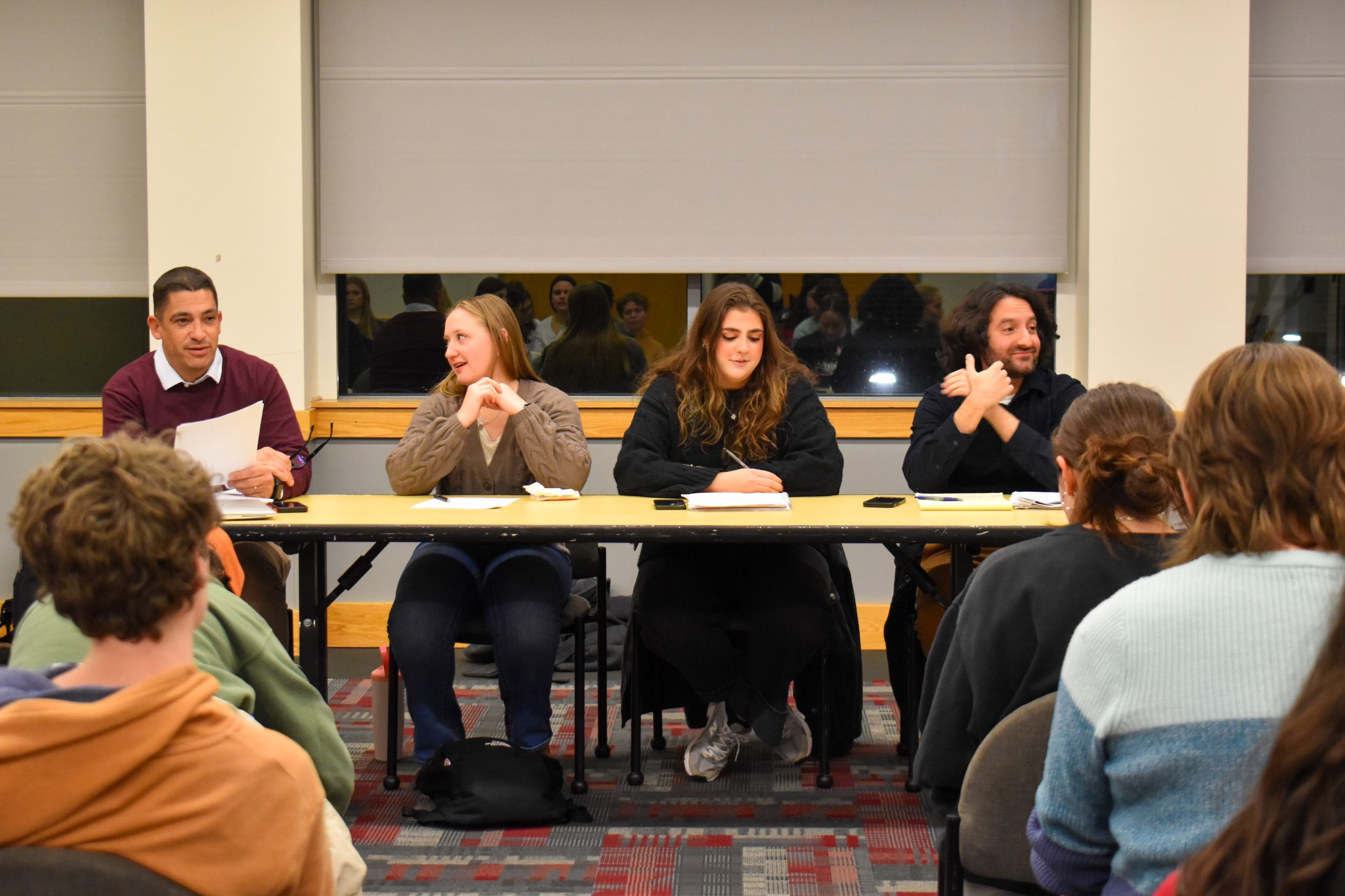
This sentiment, shared by Muhlenberg Professor of Political Science Brian Mello, encapsulated the evening’s lively discussion. On Nov. 12, panel was held to discuss the complexities of free speech in academic institutions; a topic especially prevalent today due to the Trump Administration’s recent crackdown on academia. Mello was joined by fellow Professor of Political Science Ross Dardani and student leaders from the Women in Politics organization, Leeanna Zagrodnik ‘26, and Olivia Hagey ‘26. The goal of the panel was to dissect one of the most controversial questions in higher education: Where do we draw the line between free speech and a student’s sense of belonging?
The panel began with an analysis of the current political climate by Mello. He drew on the work of German thinker Carl Schmitt to explain the state we find ourselves in. Mello explained that for Schmitt, the distinguishing feature of politics was that it involves the existential battle of friends and enemies. Mello equated these ideas to the reality in which we find ourselves today: a form of democracy that is politically polarized, influenced more by tribalism than empathy. He referenced Monica Guzman’s book, “I Never Thought of It That Way” to explain that existing in this climate leads to three harmful behaviors: sorting– aligning yourself only with people you agree with; othering– viewing opposing groups as existential threats; and siloing– cutting off contact with opposing perspectives. Dardani then gave his perspective, attributing much of the polarization our society experiences to a fear of beginning to bridge the divide. He references Timothy Snyder’s “Work on Freedom” explaining, “You can’t have free speech unless you have free people who can then engage in dialogue as free speakers.” He stressed that the best traditions of free speech are ones that emphasized marginalized people, highlighting how speech becomes more free when everyone is speaking on the same playing field. Dardani encourages people to look past stigmas and fears around political leanings, and engage in pure conversation in order to better understand each other.
“You can’t have free speech unless you have free people who can then engage in dialogue as free speakers.”
While the faculty provided more theoretical, big picture insights, the student leaders on the panel focused on the reality of student life and how issues related to free speech affect them on a daily basis. Zagrodnik, majoring in political science, highlighted a platform many Muhlenberg students use every day, Yik Yak. She argued that the anonymous nature of these apps can enable students to project hate. “We need to be able to foster a community on this campus that invites different perspectives instead of shutting them down,” Zagrodnik said, noting that groups across the political spectrum have faced harassment on these platforms. She argued that when speech turns into targeting peers to the point of exclusion, it ceases to be a protected value and becomes a barrier to education.
On college campuses, protected speech is more complex than just the First Amendment. The First Amendment restricts government punishment for speech, but private academic institutions can also create their own rules surrounding speech. Hagey noted that when she expresses herself, she is less scared of getting trouble legally or by the school, but more about potential social ostracization. Hagey argued that true inclusion requires “letting people make mistakes,” creating a space where students can test “half-baked ideas” without fear of permanent social exile.
Hagey argued that true inclusion requires “letting people make mistakes,” creating a space where students can test “half-baked ideas” without fear of permanent social exile.
During the Q&A, the conversation turned to classroom dynamics between students and teachers. A fear held among many students present was being punished by professors for their political leanings. Zagrodnik believes that students may dislike when professors share strong political opinions, perhaps thinking their grades may suffer. The line is crossed, according to her, when a professor uses their role to attack views irrelevant to the course material. Zagrodnik shared a story she heard from a fellow student: “The professor had a day where they talked about Christianity and [was] talking badly about it. But the class was about women’s and gender studies, it wasn’t a theology [course], I feel like when they stray so far from something that you sign up to learn about is when things can get alarming.”
The discussion then pivoted to a specific incident which reflected a lot of the previously discussed material: The dismissal of Professor Maura Finkelstein for social media reposts about the Israel-Palestine conflict. Her dismissal has led to questions surrounding free speech and academic freedom on campus. Among them is Bryan Guzman ‘26, who shared his concerns with the power institutions hold and how they contribute to the regulation of speech before the panel began. Guzman sees the dismissal of Finkelstein as an example of the institutionalized suppression that he feels students and faculty experience. Guzman emphasized what he perceives as a lack of transparency from the College, “The fact that you don’t know how she got fired or the reasons for it is behind the environment that creates the fear of speaking up.” Guzman encouraged all students to ask: “How can we as students create structural change that allows us to have these conversations?”
The panel concluded not with a clear answer to where the line was, but instead a collective recognition of the complexities of the intersections in between free speech and belonging. If there was one consensus among the speakers however, it was that students and faculty alike must continue to engage in difficult conversations with empathy, understanding and an open mind.

